

From BCMA to CD19: Why Huadong Medicine Is Doubling Down on the Crowded CAR-T Arena with a Major Investment

Huadong Medicine
Large Comprehensive Pharmaceutical Product Developer
Imunopharm
Developer of Gene and Cell Therapy Technologies
The potential and value of the CAR-T product market are attracting an increasing number of China's pharmaceutical giants!
Recently, Huadong Medicine Co., Ltd. announced that its wholly-owned subsidiary, Huadong Medicine (Hangzhou) Co., Ltd. (hereinafter referred to as "Huadong Medicine"), has officially signed an exclusive commercialization cooperation agreement with Beijing Yimiaoshenzhou Medical Techology Co., Ltd. (hereinafter referred to as "Yimiao Shenzhou").
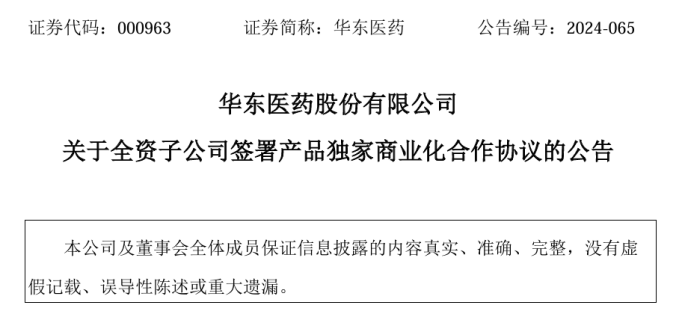
According to the agreement, Huadong Medicine will obtain the exclusive commercial rights in mainland China for IM19 Chimeric Antigen Receptor T-Cell Injection (referred to as "IM19 Injection"), an autologous CAR-T candidate product targeting CD19 developed by Beijing Yimiaoshenzhou Medical Techology Co., Ltd. For this, Huadong Medicine will pay 125 million RMB as an upfront payment to Beijing Yimiaoshenzhou Medical Techology Co., Ltd. and has committed to paying up to an additional 950 million RMB upon reaching registration and sales milestones.
In fact, Huadong Medicine had previously acquired the BCMA CAR-T product, Saikaze (Zevor-cel Injection), from Carsgen Therapeutics. This time, with its move on the CD19 CAR-T product, the value orientation is very clear: in terms of market promotion, it will deeply integrate IM19 CAR-T Cell Injection with its existing key products such as Saikaze, sharing expert networks, research, and clinical resources.As major pharmaceutical companies in China gradually enter and lay out CAR-T, on the track crowded with domestic pharmaceutical companies such as Fosun, Wuxi, Innovent, and Huadong Medicine, who will become the "leader"?


Huadong Medicine Fully Deploys CAR-T in China
What are the chances of two opportunities arising?
CAR-T Therapy: CAR-T therapy involves extracting T cells from the patient, genetically engineering them in the lab to express chimeric antigen receptors (CAR) that can specifically recognize and attack tumor cell surface antigens (e.g., CD19). After being reinfused into the patient, the modified CAR-T cells precisely identify and destroy CD19-expressing tumor cells, achieving the therapeutic goal.
As the core product of Beijing Yimiaoshenzhou Medical Techology Co., Ltd., IM19 injection targets the CD19 antigen, which is widely expressed in various B-cell malignancies, and covers three major indications: relapsed/refractory diffuse large B-cell lymphoma (r/r-DLBCL), acute B lymphoblastic leukemia (B-ALL), and mantle cell lymphoma (MCL). Due to their high recurrence rates and poor prognosis, these diseases often fail to achieve ideal outcomes with traditional treatments. Therefore, the emergence of CAR-T therapy has provided new hope for these patients.
Currently, significant progress has been made in the clinical research of IM19 injection. The product has initiated clinical trials in China targeting the aforementioned three indications, with the Phase II clinical trial for the last-line treatment of diffuse large B-cell lymphoma nearing completion. Preliminary data indicates that IM19 injection demonstrates favorable efficacy and safety in treating patients with relapsed or refractory diffuse large B-cell lymphoma.
It was reported that among the 59 patients who had completed at least one efficacy evaluation, the incidence rates of cytokine release syndrome (CRS) and neurotoxicity (NT) were 42% and 7%, respectively, with no occurrence of grade 3-4 CRS or NT events. In evaluable patients, the best overall response rate (ORR) for IM19 injection reached 76%. The marketing authorization application is expected to be submitted in the fourth quarter of 2024.
In addition, the research on IM19 injection for acute B lymphoblastic leukemia and mantle cell lymphoma has also entered a critical stage. The Phase I clinical trial has successfully completed the infusion for all subjects and is about to enter Phase II clinical trials. Notably, preliminary non-registration clinical studies for the B-ALL indication showed that a single infusion of IM19 achieved a complete remission rate of 97.5% in relapsed or refractory B-ALL patients, with good safety.
The cooperation between Huadong Medicine and Beijing Yimiaoshenzhou Medical Techology Co., Ltd. undoubtedly has far-reaching significance. Huadong Medicine will obtain the exclusive commercial rights of IM19 injection in mainland China, which will further enrich its product pipeline in the field of hematological tumors and significantly enhance market competitiveness.
At the same time, Beijing Yimiaoshenzhou Medical Techology Co., Ltd. will leverage the rich commercialization experience and market coverage capabilities of Huadong Medicine Co.,Ltd. to accelerate the commercialization process of IM19 injections, in order to meet the urgent needs of patients with B-cell hematological tumors in China. The cooperation between the two parties will not only promote the development of CAR-T cell therapy drugs produced in China, but also provide more and better treatment options for cancer patients.
It is worth mentioning that Huadong Medicine has long been active in the CAR-T market. At the beginning of last year, Huadong Medicine successfully acquired the exclusive commercial rights for mainland China to Beijing Yimiaoshenzhou Medical Techology Co., Ltd.'s BCMA CAR-T product Zevor-cel injection with "an upfront payment of 200 million yuan plus registration and sales milestone payments of up to 1.025 billion yuan."The product was approved in March this year for the treatment of adult patients with relapsed or refractory multiple myeloma.
As the second BCMA CAR-T product manufactured in China to be marketed, the launch of Zevor-cel Injection not only enriches Huadong Medicine's product portfolio but also further solidifies the company’s position in the field of hematological oncology treatment. After its market release, the response has been enthusiastic, with both patients and medical professionals expressing high hopes for its efficacy.
It is generally believed in the industry that Huadong Medicine has quickly entered the CAR-T market by introducing high-quality external CAR-T products and combining them with its strong commercialization capabilities. As one of the earlier companies in China to enter the CAR-T market, Huadong Medicine has already secured a position in the domestic CAR-T market through the successful introduction and commercialization of Zevor-cel Injection and IM19 CAR-T Cell Injection.


Multiple Products Launching in Competition
"Open Book" in the Chinese Market
With the impact of multiple factors such as aging population and changes in dietary environment, the incidence of cancer continues to rise, making the demand for more effective treatment options increasingly urgent. In this context, CAR-T cell therapy, as an emerging treatment method, although not yet widely promoted or applied, has already demonstrated significant efficacy and advantages in personalized customization, indicating enormous market growth potential.
According to statistics, to date, a total of 11 CAR-T products have been approved for marketing worldwide, of which China accounts for 5, specifically including three CD19 CAR-T products and two BCMA CAR-T products.
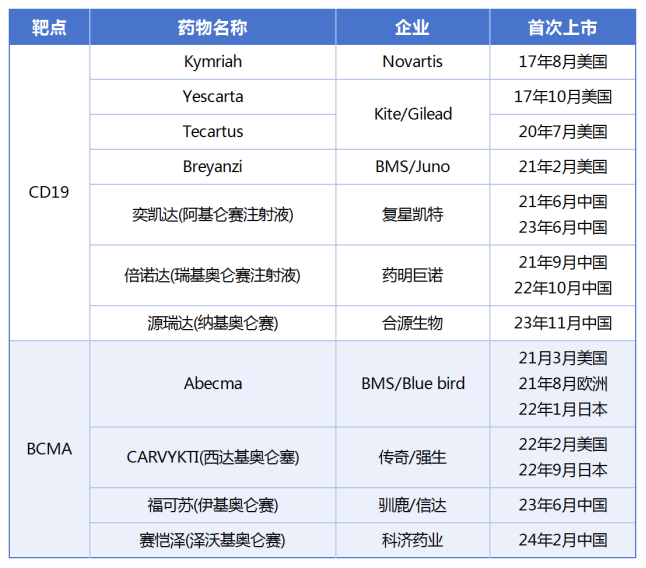
CD19, an important protein expressed on the surface of B lymphocytes and follicular dendritic cells, is a member of the immunoglobulin (Ig) superfamily. It plays a key regulatory role in the development, proliferation, and differentiation of B cells through both B-cell receptor (BCR)-dependent and -independent pathways. Currently, the main clinical approaches targeting CD19 for the treatment of malignant tumors include chimeric antigen receptor T-cell (CAR-T) therapy and antibody-drug conjugates (ADCs).
In terms of CD19 CAR-T products, China has made remarkable progress. At the end of last year, the injection of Nageoerance developed independently by Hopstem Biotechnology was successfully approved for marketing in China. This product is not only the first CD19 CAR-T cell therapy product with full independent intellectual property rights in China, but also the first CAR-T product approved for marketing in China for the treatment of leukemia. Its unique CD19 scFv (HI19a) structure and internationally leading production technology have demonstrated a 100% production success rate in the pivotal clinical study for adult r/r B-ALL.
Currently, there are three CD19 CAR-T products available in the Chinese market: Fosun Kite's Axicabtagene Ciloleucel Injection, JW Therapeutics' Relmacabtagene Autoleucel Injection, and Hekang Bio's Naxicabtagene Autoleucel Injection.
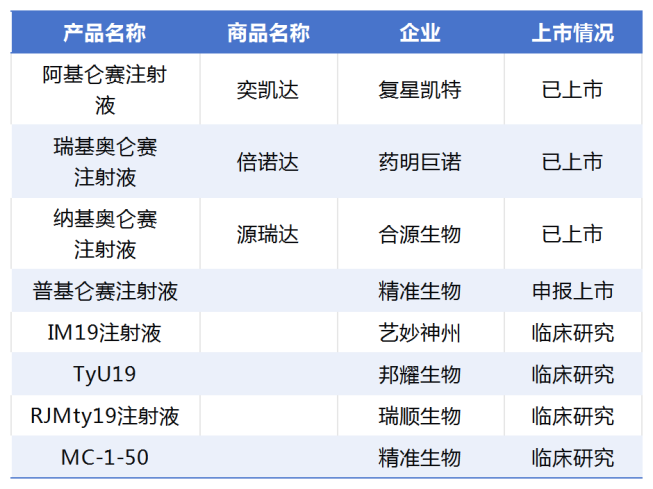
Not long ago, the marketing application of Chongqing Precision Biotech's CD19 CAR-T therapy, Pujilun Injection, was accepted by the NMPA. Public information shows that Pujilun Injection is independently developed by Precision Biotech and is a CAR-T cell immunotherapy product designed for malignant hematological diseases originating from CD19-positive B cells. The product optimizes the CAR structure and uses a safer gene transduction vector system, potentially offering better efficacy and safety.
Pucilencer Injection for the treatment of pediatric and adolescent B-cell acute lymphoblastic leukemia (B-ALL) was approved to conduct registrational clinical trials in China in 2019. According to previously published Phase 1 registrational clinical data, all nine enrolled patients achieved complete remission (CR), with an overall response rate of 100%. Moreover, minimal residual disease (MRD) was negative in all patients who first achieved CR, and the overall safety and tolerability were favorable. In addition to leukemia, Pucilencer Injection is also being studied for the treatment of diffuse large B-cell lymphoma, follicular lymphoma, and mantle cell lymphoma.
In addition, according to incomplete statistics, several CD19 CAR-T products are undergoing clinical research in China, including IM19 developed by Beijing Yimiaoshenzhou Medical Technology Co., Ltd., TyU19, an allogeneic universal CAR-T cell therapy product targeting the CD19 antigen developed by Bangyao Biotechnology, RJMty19 Injection from Guangdong Ruisun Biotechnology Co., Ltd., and the MC-1-50 cell preparation from Chongqing Precision Biotechnology Co., Ltd.
At the same time, as a refractory malignant plasma cell disease, the number of patients with multiple myeloma in China will continue to increase. According to Frost & Sullivan, it is estimated that the number of patients with multiple myeloma in China was approximately 153,000 in 2023, with 23,200 new cases. It is expected that by 2030, the number of patients with multiple myeloma in China will grow to 266,300. B-cell maturation antigen (BCMA), as the most widely used and mature target for CAR-T treatment of multiple myeloma (MM), is receiving widespread attention.
In June 2023, the Idecabtagene Vicleucel Injection developed by IASO Biotherapeutics and Innovent Biologics was approved for marketing, becoming the first BCMA-targeted CAR-T therapy approved in China.For the treatment of relapsed/refractory multiple myeloma (R/R MM).
Subsequently, CARsgen Therapeutics' Zevor-cel Injection also received NMPA's new drug marketing approval.This is an autologous BCMA-targeted CAR-T cell product used for the treatment of relapsed/refractory multiple myeloma. Its impressive efficacy data caught the attention of Huadong Medicine, which secured the exclusive commercial rights for Zevor-cel in mainland China by paying an upfront fee of 200 million RMB and up to 1.025 billion RMB in registration and sales milestone payments.
Globally, BCMA is becoming a competitive focus in the CAR-T field as an important target for multiple myeloma. In addition to Icarma (Edralbrutinib Injection) from Yimiao Shenzhou Medical Technology Co., Ltd., Abecma from BMS/Bluebird Bio and Carvykti from Johnson & Johnson/Legend Biotech have also been approved by the U.S. FDA for the treatment of adult patients with R/R MM who have received multiple prior therapies. Notably, Carvykti, independently developed by Legend Biotech, is the first cell therapy independently developed in China to be approved for marketing overseas.
In China, multiple BCMA-targeted CAR-T therapies are still in clinical development, such as GC012 from Gracell Biotechnologies and HR003 from Hengrui Dason. This demonstrates that CAR-T, as a revolutionary cell therapy, has shown tremendous market potential in the field of cancer treatment.
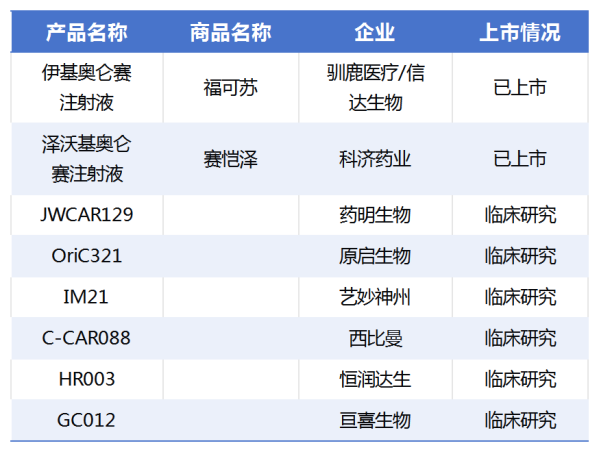
In recent years, the market size of CAR-T therapy has grown rapidly. According to market research reports, the global CAR-T market size has increased from US$100 million in 2017 to billions of dollars in 2023 and is expected to maintain a high growth rate in the coming years. As one of the countries with a high incidence of cancer globally, China has an especially urgent demand for CAR-T technology, with huge market growth potential. It is predicted that by 2030, the market size of CAR-T in China is expected to reach hundreds of billions of RMB.
Currently, the commercial cooperation in China's CAR-T market is in a stage of rapid development. Multinational pharmaceutical companies are quickly capturing the market by introducing mature products from overseas and conducting localized production in China, while local enterprises are promoting the listing process of domestically produced CAR-T products through independent research and clinical trials.
Moreover, cooperation between domestic companies as well as between companies and research institutions and medical institutions is becoming increasingly frequent, jointly promoting the industrial development of CAR-T technology. Companies such as Fosun Kite, WuXi AppTec Juno, and Legend Biotech are all advancing the market entry process of China-produced CAR-T products through independent research and clinical trials. At the same time, numerous startups in the research and development stage are also actively participating in this field.
Industry insiders point out that there are numerous participants in China's CAR-T market, including large multinational pharmaceutical companies such as Novartis and Gilead, as well as many local innovative enterprises. These companies have increased their R&D investment to promote the development and commercialization of CAR-T products. However, with the increase in market participants, competition has become increasingly fierce, and the phenomenon of internal competition has gradually emerged.



www.yyjjb.com.cn
Insight into Industry Trends

"Pharmaceutical Economy Herald"
Academic Official Account
Focusing on the Frontiers of Oncology Academia

Terminal Official Account