

Cloudbreak Pharma Licenses First-in-Class Pterygium Drug CBT-001 to Santen for $91M, Files IPO Prospectus
Santen Pharmaceutical (China)
Ophthalmic Pharmaceutical Manufacturer

Cloudbreak Pharma
Ophthalmic New Drug Developer
On August 6, 2024, Cloudbreak Pharma Inc. (hereinafter referred to as "Cloudbreak Pharma"), a clinical-stage ophthalmic drug company, and Santen Pharmaceutical Co., Ltd. (hereinafter referred to as "Santen Pharmaceutical"), a specialized ophthalmology enterprise, announced the signing of a licensing agreement. Cloudbreak Pharma has licensed its multi-kinase inhibitor CBT-001, which is under development for the treatment of pterygium, to Santen Pharmaceutical. This licensing covers Southeast Asian regions including Japan, South Korea, Vietnam, Thailand, Malaysia, the Philippines, Singapore, and Indonesia. According to the terms of the agreement, Cloudbreak Pharma grants Santen Pharmaceutical the rights to develop, manufacture, and commercialize the CBT-001 drug in this region.
According to the agreement, Cloudbreak Pharma will receive an upfront payment and milestone payments totaling up to $91 million (over 650 million RMB). In addition, Cloudbreak Pharma will also receive a double-digit percentage of the product's future net sales as royalties.
Global Ophthalmology Rising Star Fills Market Gap for the First Time
The history of Cloudbreak Pharma can be traced back to September 2015. Dr. Jinsong Ni, the founder and CEO, has over two decades of experience in the pharmaceutical industry and academic research in drug discovery and drug development. Before establishing Cloudbreak Pharma, Dr. Jinsong Ni served as a Scientific Director at Allergan for 15 years and as a Senior Scientist at Pfizer for 3 years. During his tenure at Allergan and Pfizer, Dr. Jinsong Ni focused on ophthalmic and dermatological diseases, leading project teams to successfully launch several related products.
Since its establishment in 2015, Cloudbreak Pharma has been deeply committed to the field of innovative ophthalmic drugs. Starting from California, USA, the company has gradually built a globalized R&D and industrial layout, subsequently setting up branches in Guangzhou and Suzhou to continuously expand its R&D and production capabilities. Focusing on independent product development and differentiated innovation, Cloudbreak Pharma has achieved several results that are international firsts in new indications and mechanisms, striving to become a pioneer in the First-in-Class field of innovative ophthalmic drugs.
The protagonist of this cooperation agreement, CBT-001, is an eye drop developed by Cloudbreak Pharma, mainly used for the treatment of pterygium.
Pterygium: A Benign Hyperplastic Disease of the Ocular SurfacePterygium is a benign hyperplastic disease of the ocular surface, characterized by wing-shaped fibrovascular conjunctival tissue growing at the edge of the cornea. As it damages the cornea, it can lead to visual impairment. Although pterygium grows on the sclera, its apex invades the cornea, causing significant ocular symptoms including congestion, irritation, pain, and a foreign body sensation, thereby affecting the patient's quality of life. It has a tendency to recur and is non-metastatic. Exposure to ultraviolet (UV) light, such as sunlight, is widely recognized as a key risk factor for the development of pterygium, with individuals frequently exposed to sunlight considered a high-risk group. Due to alterations in local ocular surface homeostasis, the main components of pterygium include limbal stem cell proliferation clusters, active fibrovascular tissue, epithelial metaplasia, extracellular matrix changes with collagen and elastic fiber accumulation, and inflammatory infiltration.
Currently, there are no approved drugs for the treatment of pterygium available in the global market. Doctors often prescribe artificial tears and short-term topical ocular steroids that lack clinical trial validation. However, these medications may be ineffective or unsafe for long-term use. When pterygium invades the visual axis or causes persistent congestion, surgical excision is usually required. Although various surgical methods, such as transposition surgery and conjunctival flap transplantation, are available, all treatments tend to have a risk of recurrence.
According to the prospectus of Cloudbreak Pharma, the global market size for pterygium treatment drugs is expected to reach US$273 million by 2027 and US$2.529 billion by 2032, with a compound annual growth rate (CAGR) of 56.0%. The market size for pterygium treatment drugs in the United States is projected to reach US$13.59 million by 2027 and US$1.417 billion by 2032, with a CAGR of 59.8%. In China, the market size for pterygium treatment drugs is expected to reach US$218 million by 2027 and US$2.022 billion by 2032, with a CAGR of 56.1%.
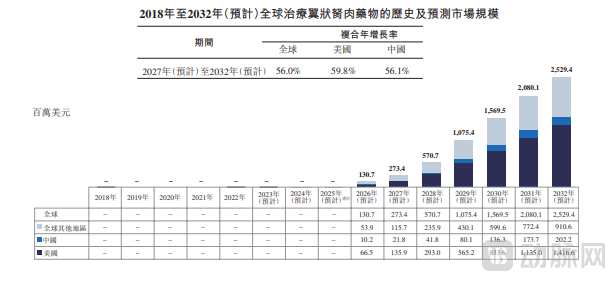
Global Market Size for Pterygium Treatment Drugs, Image Source: Cloudbreak Pharma Prospectus
CBT-001 is an emulsified nintedanib eye drop developed by Cloudbreak Pharma, mainly used for the treatment of pterygium. Nintedanib is a multi-kinase inhibitor that primarily targets VEGF (vascular endothelial growth factor) receptors, PDGF (platelet-derived growth factor) receptors, and FGF (fibroblast growth factor) receptors, thereby inhibiting angiogenesis and fibrosis.
The development of CBT-001 has been smooth sailing. In the second year after Cloudbreak Pharma was established, CBT-001 submitted an Investigational New Drug (IND) application in the United States, and the FDA did not raise any objections during the 30-day review period for the IND application to proceed to Phase 2 clinical trials. In April 2018, CBT-001 completed Phase 2 clinical trials in the United States.
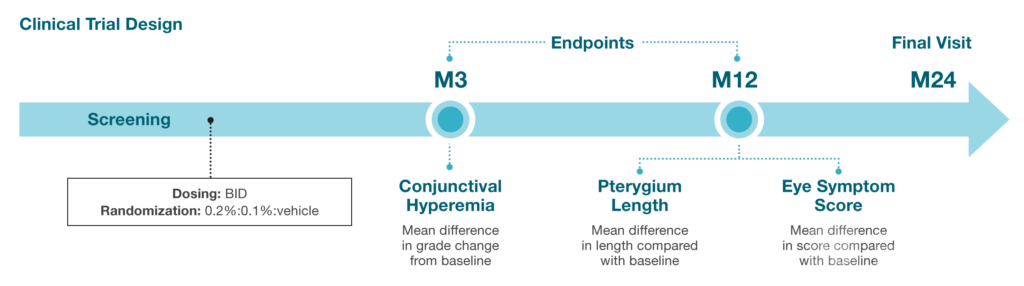
Phase 2 Clinical Trial NCT03049852 was divided into two stages. The first stage included dose escalation of CBT-001 in 24 patients to determine the maximum tolerated dose. The results demonstrated ocular safety and tolerability, with negligible systemic drug exposure. In the second stage, 51 patients received a 4-week TID cycle of CBT-001 (n=25) or vehicle (n=23) treatment, followed up until week 24. By week 4, the mean vascular distribution score in the treatment group significantly decreased compared to the control group and remained sustained until week 16. Additionally, the mean change in lesion length observed at week 4 was significantly reduced compared to the control group and persisted until week 8.
In addition, CBT-001 was well-tolerated. Most of the commonly reported adverse events in the CBT-001 group were ocular adverse events, which were mild in severity and resolved after treatment. No patients discontinued CBT-001 treatment due to adverse events.
Current Progress of CBT-001, Image Source: Cloudbreak Pharma Official Website
In April 2020, Cloudbreak Pharma entered into an exclusive commercialization licensing agreement with Grand Pharmaceutical for CBT-001. Currently, CBT-001 is undergoing large-scale global multi-center Phase 3 clinical trials in the United States, China, Australia, New Zealand, and India. Notably, CBT-001 is currently the fastest progressing drug globally for the treatment of pterygium. Worldwide, there are only three clinical-stage drug candidates applicable for preventing pterygium growth and reducing conjunctival congestion, two of which are in Phase 2 clinical trials, while CBT-001 is the only drug in Phase 3 clinical trials.
Synchronous Development of a Miracle Drug for Adolescent Myopia
Cloudbreak Pharma has also entered the global market for myopia drugs targeting adolescents. According to a Frost & Sullivan report, the compound annual growth rate (CAGR) of the global market size for drugs treating adolescent myopia is projected to be 103.5% from 2022 to 2027 and 17.6% from 2027 to 2032.
Cloudbreak Pharma's another core product, CBT-009, is a novel atropine ophthalmic formulation used for treating juvenile myopia. Atropine is a widely used drug in ophthalmology that can delay the progression of myopia by inhibiting the growth of the myopic eyeball, and is also marketed as a "miracle drug for myopia."
At present, atropine is the only treatment proven to continuously and effectively slow the progression of myopia, and is the only one approved by China's "Children
Guidelines for Appropriate Technologies for Myopia Prevention and Control in Adolescents" recommends the use of anticholinergic drugs. Higher concentrations of atropine (such as 1% or 0.5%) have been proven effective, but the incidence of photophobia side effects is relatively high, which is associated with a higher rate of treatment discontinuation. Even when using low-concentration atropine, patients may still experience various adverse reactions to atropine, including photophobia, changes in intraocular pressure, rebound effects, local allergic reactions, and systemic adverse effects, which can also lead to poor patient compliance. Photophobia is the most common adverse reaction associated with the use of atropine.
It is understood that currently, neither the United States nor China has approved any atropine drugs for the treatment of juvenile myopia, and the drug approved in China for treating juvenile myopia is non-atropine.
Cloudbreak Pharma stated in its prospectus that once approved, CBT-009 is expected to be the world's best-in-class drug for treating juvenile myopia. Currently, the third-phase clinical trial of CBT-009 has been approved in the United States. Based on the clinical trial and formulation stability results of CBT-009, it is expected to significantly improve patient tolerance, safety, and product stability, and it is preservative-free.
A Perfect Match with Santen Pharmaceutical (China) Co. Ltd.
Santen Pharmaceutical was founded in 1890 and has a history of 130 years. Santen Pharmaceutical is a professional company focusing on ophthalmology, mainly engaged in the research and development, marketing, and sales of pharmaceuticals, over-the-counter products, and medical devices. It is the market leader in prescription ophthalmic drugs in Japan. The term "Santen" originates from "The Doctrine of the Mean," and its corporate philosophy is to understand the laws of heaven and earth to contribute to human health.
Globally, the number of people suffering from major ophthalmic diseases continues to rise. Due to the widespread use of electronic products, the populations of teenagers with myopia and dry eye syndrome exceeded 550 million and 900 million, respectively, in 2022. Additionally, the overall growth of an aging population, along with increasing cases of diabetes and hypertension, has driven up the prevalence of age-related ophthalmic conditions such as pterygium, pinguecula, and glaucoma. With the sharp increase in ophthalmic disease cases and related Disability-Adjusted Life Years (DALYs, the years lost due to ill health, disability, or early death), the demand for appropriate treatments is expected to grow in the coming years, thereby promoting the expansion of the ophthalmology market.
In addition, with continuous innovations in therapies for ophthalmic diseases and supportive policies, the global ophthalmic drugs market has shown a rapid growth trend in recent years. Meanwhile, unmet medical needs are also driving the introduction of new products.
This may explain why Santen Pharmaceutical, already a giant in ophthalmic drugs, is still constantly seeking change in order to seize the market opportunity. Santen Pharmaceutical has been actively transforming its core business and nurturing new businesses. This is why the "Santen Ecosystem" came into being. The system includes four pillars: ophthalmic drugs (prescription and over-the-counter), medical devices, medical services, and new models.
Against this backdrop, CBT-001, the core drug in Cloudbreak Pharma's pipeline and a potential first-in-class treatment for pterygium, is particularly valuable. This is also why Santen Pharmaceutical (China) Co. Ltd. has seized the opportunity.
"When talking about China's eye health market, Takayuki Yamada, President of Santen Pharmaceutical (China), stated: 'We must not only focus on the elderly but also on the eye health needs of young people. We will fully utilize the 'Santen Ecosystem' plan to map out the entire eye health field.'"
And CBT-009 happens to have the potential to become the best in its class. Perhaps in the future, we may see further cooperation between Santen Pharmaceutical (China) and Cloudbreak Pharma.