

LeadMicro Medical Advances Innovative Solutions with Self-Developed Super-Microsurgical Robot and Dry Eye Therapy Device
Legding Micros
Ophthalmic Surgical Robot Developer
Text | Chang Zeyu
Editor | Hai Ruojing
A Blue Ocean of Ophthalmic Diagnosis and Treatment Needs Is Taking Shape: The "2022 China Health Statistics Yearbook" shows that in 2021, the number of outpatient and emergency visits to ophthalmology departments in medical and health institutions in China was close to 134 million, with inpatient visits at ophthalmology specialty hospitals reaching 2.374 million people; according to the "2023 Mid-to-High-End Ophthalmic Equipment Industry White Paper," in 2022, the number of patients with refractive errors in China exceeded 700 million, the number of dry eye patients was nearly 360 million, the total number of cataract patients surpassed 220 million, and the number of patients with macular degeneration—one of the three major causes of blindness globally—was close to 30 million.
According to Frost & Sullivan analysis, by 2025, the market size of ophthalmic drugs and medical devices in China is expected to reach 44 billion RMB and 55.6 billion RMB, respectively. Moreover, due to the fact that most ophthalmic diseases are difficult to cure with medication alone, in recent years, the demand for technically advanced mid-to-high-end ophthalmic equipment has been increasing annually.
Insight into this trend, in June 2022, Beijing Legding Micros (hereinafter referred to as "Legding Micros") was established. Focusing on the vast potential of the ophthalmology market, the company has set its core pipeline around an ophthalmic microsurgery robot platform and a thermal pulsation meibomian gland treatment device. Additionally, relying on the team's years of technical accumulation in the field of microsurgical robots, Legding Micros has also made ultra-microsurgery robots another key research and development focus.
Ma Weimin, founder of Legding Micros, introduced to 36Kr that the core highlights of the company's microsurgical robot under development mainly lie in the precise control of the master-slave dual arms, end-point micrometer-level movement positioning accuracy, 0 to 200 times motion scaling algorithm technology, millinewton-level micro-force feedback technology, and the design and processing capability of high-precision miniature end effectors with a 2.5mm diameter. "Since its establishment, we have been granted 15 core technology invention patents, and these highlights have already been achieved both in terms of intellectual property and product development."
In specific clinical application scenarios, the initial development of ophthalmic microsurgical robots mainly focuses on puncture and injection under the retina and in retinal blood vessels. Ophthalmic microsurgical robots for related indications are expected to complete type inspection this year and achieve clinical enrollment next year.
However, in Ma Weimin's plan, the application scenarios of the ophthalmic microsurgery robot go beyond this. Legding Micros will significantly expand the application scope of the ophthalmic micro-robot: "Preliminary research on robot-controlled vitrectomy, membrane peeling, and other retinal surgeries is already underway. We hope to deepen the vertical application in the ophthalmology field and provide a one-stop ophthalmic surgical robot platform for clinical ophthalmology in the future."
The ultra-microsurgical robot represents the company's "cross-boundary" application of its relevant technologies beyond ophthalmology. This surgical robot is primarily developed for highly challenging microsurgeries such as lymphatic-venous anastomosis (LVA). It is expected to complete the development of the prototype and commence animal model trials by the end of this year.
Lymphedema is associated with the accumulation of lymphatic fluid in tissue spaces due to impaired lymphatic drainage, and it is a highly disabling condition. According to data from the China Red Cross Foundation in 2022, the total number of lymphedema patients in China is close to 20 million, with hundreds of thousands of new cases annually.
Using super-microsurgical techniques, Lymphaticovenular Anastomosis (LVA) can anastomose superficial lymphatic vessels with surrounding small veins, reconstructing the lymphatic-venous drainage pathway. LVA requires a high level of precision in both the surgeon’s skills and microsurgical instruments, making it a procedure with a high degree of difficulty. Its implementation in China is currently relatively limited. However, due to its ability to rapidly and significantly improve lymphedema symptoms, it has become the "gold standard" for surgical treatment of lymphedema.
Another product in the ophthalmology sector, the Thermal Pulsation Meibomian Gland Treatment Device, is expected to provide a more cost-effective option for patients with dry eye syndrome associated with Meibomian Gland Dysfunction (MGD).
Among patients with dry eye syndrome, those associated with meibomian gland dysfunction account for up to 92.8%. For a long time, physical therapies such as hot compresses, steam treatments, and manual meibomian gland massage have been the primary methods used. However, these treatments generally result in poor patient comfort and low treatment efficiency. Although some hospitals in China have introduced foreign treatment devices in recent years, the high cost of the main unit and consumables has limited the scope of application of these instruments.
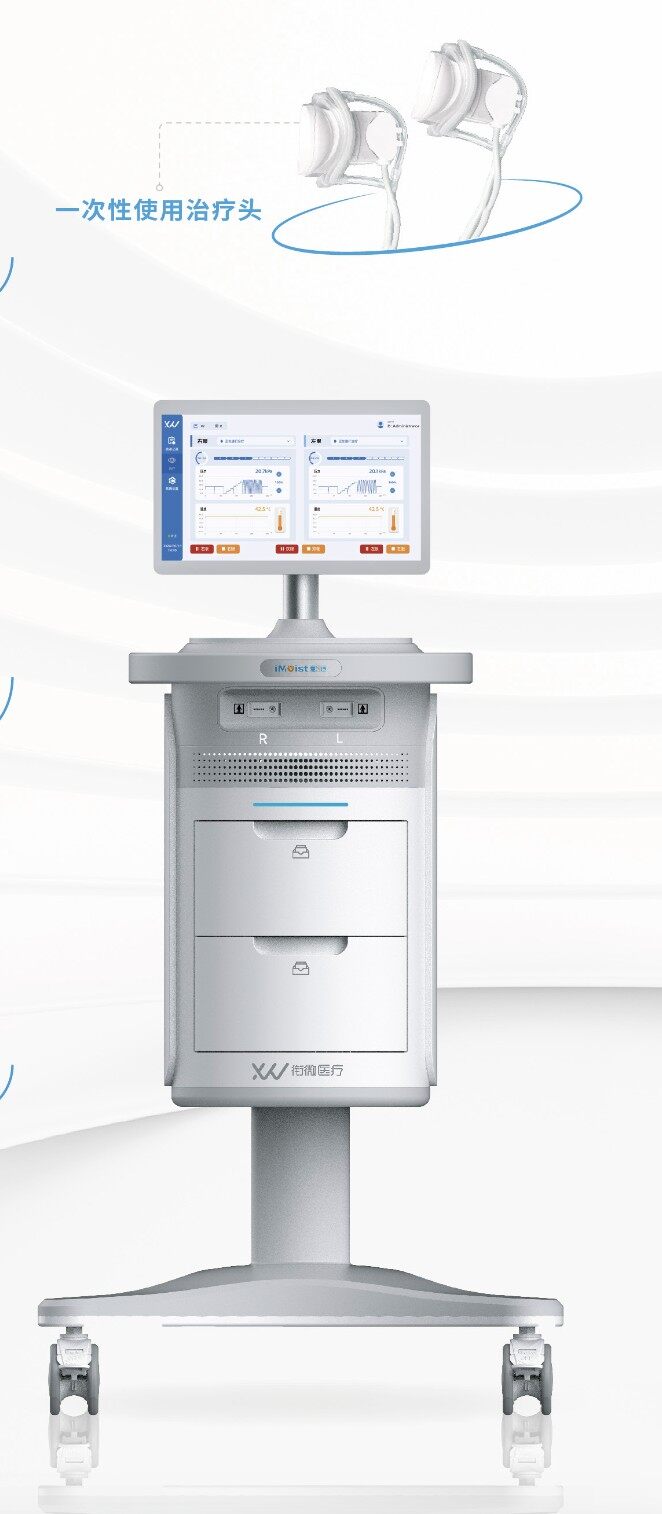
Schematic diagram of Legding Micros' Thermal Pulsation Meibomian Gland Treatment Device; Source: Interviewed Company
Ma Weimin introduced to 36Kr that, by combining heating and pulsatile compression, the therapeutic device under development by the company can melt and expel the hardened meibomian gland secretions blocking the meibomian glands, thereby unblocking the glands and alleviating dry eye symptoms. The duration of a single treatment is only about 12 minutes, with effects lasting from six months to a year. In preliminary tests, patients experienced almost no discomfort during treatment, and post-treatment results and feedback were positive. Meanwhile, with the help of proprietary thermal conductive materials and a constant temperature control system, the treatment cost will be significantly reduced compared to similar foreign products.
This thermopulsation meibomian gland treatment device is also the fastest-progressing product by Legding Micros. It is expected to obtain Class II medical device registration certification in the fourth quarter of this year and achieve sales revenue in 2025. Currently, the company is advancing cooperation matters with some partners and potential customers, such as equipment and consumables distributors and ophthalmology private hospital groups. A sales and marketing team is also being established.
"The market launch of dry eye-related products will enable the company to generate cash flow early on," said Ma Weimin, who comes from a medical sales background and particularly emphasizes the importance of marketing. "In the current market environment, whether a startup can achieve scalable revenue as soon as possible directly determines its survival."
In terms of product implementation, Legding Micros has already partnered with a CDMO to advance instrument registration and production. Subsequently, plans for building its own factory will be based on product sales and other factors. Regarding market planning, in addition to engaging with relevant institutions in China, the company has also signed framework agreements with related partners to prepare for expansion into the Southeast Asian market.
It is reported that the company has completed seed round and angel round financing, and is currently conducting Pre-A round financing.