
Source: PharmaDJ
Author:April RainEditor: Vitamin
Takes effect quickly in 30 minutes
Effective for up to 10 hours
Recently, Lenz Therapeutics submitted a new drug application to the FDA for Aceclidine, a presbyopia treatment that takes effect in 30 minutes and lasts for up to 10 hours.Aceclidine is aSmall Molecule Acetylcholine Receptor Agonist, with mAChRs as the main target, is primarily used to treat eye diseases and neurological disorders.The indications currently under development include presbyopia, pupil constriction, and myopia. The original research organization for this drug is LENZ Therapeutics. The current global development status is submission for marketing approval, while the highest development status in China is Phase 3 clinical trials.Aceclidine, as a therapeutic drug targeting mAChRs, is expected to bring new treatment options for patients with eye diseases and neurological disorders. With the progress of drug development, its market launch may provide more treatment possibilities for patients, which has certain clinical significance for patients in related fields. As China's pharmaceutical regulations continue to improve and the approval process accelerates, it is believed that the market approval of Aceclidine will proceed smoothly, hopefully benefiting Chinese patients as soon as possible.Benefit。In terms of efficacy, aceclidine has the advantages of rapid onset and long-lasting effects.Phase 3 clinical data showed that 71% of patients achieved an improvement of three lines or more on the eye chart within 30 minutes, and 40% of patients achieved an improvement of three lines or more within 10 hours. Near best-corrected visual acuity (BCDVA) significantly improved by three lines (15 letters) or more, while distance vision did not decrease by one line (5 letters) or more. LENZ Therapeutics reported positive topline results from the pivotal Phase 3 study.LNZ100 (1.75% Aceclidine) Achieved All Primary and Secondary Near Vision Improvement Endpoints.Globally Under ResearchPresbyopia Drug Review
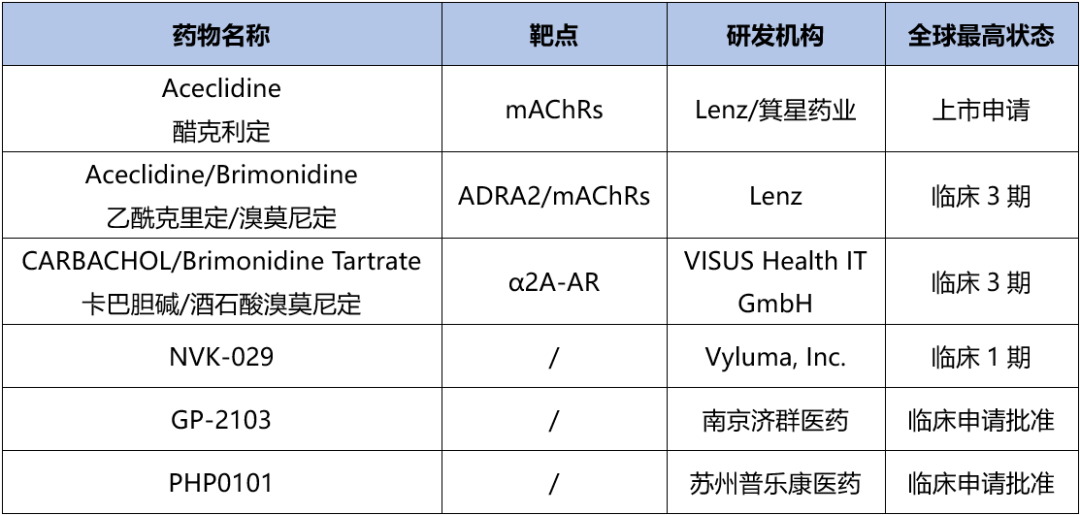
According to PharmaDJ data statistics, there are currently multiple presbyopia drugs under research and development globally, but most are in the early stages of development. The table below summarizes the information on these drugs currently in development worldwide.Table 1. Partial List of Global Presbyopia Drugs Under Research
According to PharmaDJ data, there are currently 8 drugs in the preclinical stage and 4 drugs in Phase 3 clinical trials for the indication of presbyopia.There are two drugs in Phase 2 clinical trials,There are 3 drugs in Phase 1 clinical trials,Application for listing has 2Types of Drugs. Notably, there is 1 drug already in the approval stage for market release, namelyPilocarpine Hydrochloride, indicating that this track has relatively high feasibility. However, the number of drugs currently in the clinical application approval and Phase 3 clinical trial stages is relatively small, necessitating increased research and development efforts to improve the success rate of new drug launches.Table 2. Summary of the Number of Drugs in the R&D Stage for Presbyopia Indications, Source: PharmaDATA
In terms of companies under research, most of these drugs come from small and medium-sized companies such as Visus Therapeutics, Inc. and Cytokinetics, Inc., but larger pharmaceutical companies like LENZ Therapeutics, Inc. and Zhaoke Ophthalmology Ltd. are also involved. According to Pharma Intelligence data, more than 20 pharmaceutical companies have participated in the research and development of related drugs.In terms of targets, including multiple targets such as mAChRs, α2A-AR, ADRA2x mAChRs, and CRYAA. Among them, one drug targeting mAChRs has applied for marketing, one drug targeting α2A-AR and ADRA2x mAChRs is in Phase 3 clinical trials, and drugs targeting CRYAA are still in the preclinical stage. Therefore, drugs for these targets are still in different stages of development and are expected to contribute to the treatment of related diseases in the future.Comprehensive analysis shows that there are multiple drugs currently under development for presbyopia, and the distribution of drugs at different stages of development is relatively balanced.In terms of drug typesCurrently, the drugs under research for presbyopia are basically small-molecule chemical drugs, and it is hoped that other types of drugs will be applied in this field in the future.Overall, the majority of drugs for presbyopia currently in preclinical stages globally amount to eight in total.The number of drugs in Phase 1, Phase 2, and Phase 3 clinical trials, as well as those applying for market approval, is relatively small compared to the number of drugs in preclinical stages.They are 3, 2, 4, and 2 respectively. Specifically, in terms of the distribution of drug development numbers across institutions, several organizations represented by Visus Therapeutics, Inc., Cellix Bio Pvt Ltd., and Cloudbreak Pharma, Inc. have a relatively large number of drugs in the preclinical stage. Additionally, from the perspective of countries/regions, Chinese pharmaceutical companies are also actively entering this field, with 12 research institutions involved. Regarding the distribution of drug types, small-molecule chemical drugs dominate, covering various stages of development including preclinical, clinical application approval, phase 3 clinical trials, and marketing authorization submission.In summary,The following opportunities and challenges exist in the current field of drug development:In terms of institutional layout, China, as a globally significant pharmaceutical market, possesses substantial research and development advantages. In the R&D phase, both preclinical and Phase III clinical trials are particularly active, especially for conditions like presbyopia. Regarding drug types, the development of small-molecule chemical drugs is relatively robust. Nevertheless, it faces competitive challenges from foreign pharmaceutical companies with strong technical capabilities and superior R&D conditions. Therefore, domestic pharmaceutical enterprises in China should enhance independent innovation, improve R&D capabilities, and leverage the advantages of the domestic market to strengthen international cooperation and elevate overall competitiveness.A Large Base of Presbyopia Patients
The Market Space for Related Drugs is Broad
According to the "World Report on Vision (2019)" released by the WHO, in 2015, there were 1.8 billion people worldwide suffering from presbyopia, including 826 million untreated. It was estimated that by 2020, the number of people with presbyopia would increase to 2.1 billion. According to the "2023 China Presbyopia Population Insight Report," among China's population aged 35 and above, 56.9% have presbyopia issues, reaching 390 million people.This shows that there is a huge potential drug market in the presbyopia sector, with a potential market size of approximately 28 billion US dollars.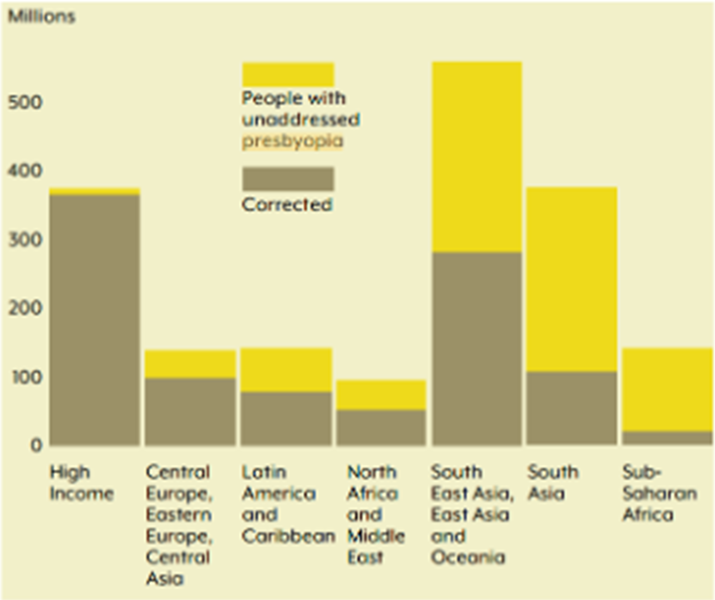
Figure 1. Total number of presbyopia patients and the proportion of untreated patients in different regions worldwide (unit: million people),Source: WHO, Pacific Securities
As China's population aging intensifies, the number of presbyopia patients will continue to rise, and there is an urgent need for new treatment methods among presbyopia patients in China.Presbyopia is mainly due to the loss of normal adaptability of the lens and the decline in ciliary muscle function, which prevents the focus from being concentrated on objects beyond arm's length. This condition worsens with age, typically appearing around the age of forty and gradually leading to the loss of focusing ability after the age of sixty-five.As LENZ Therapeutics submits its new drug, Aceclidine, to the FDA for the treatment of presbyopia, it signals the forthcoming era of treating presbyopia with eye drops. However, with the accelerating pace of aging in China and a large population affected by presbyopia, there are currently no approved drugs for presbyopia in China. We look forward to the emergence of new treatments for presbyopia in the future.
References:
[2]https://d1io3yog0oux5.cloudfront.net/_1b75a0055e0f2e21ec4f05c07a9d694b/lenztx/db/2266/21446/presentation/Clarity+Topline+Presentation+Slides+04022024+final+locked.pdf[3] Pacific Securities Research Report
*Disclaimer: This article only introduces the research progress in the pharmaceutical and disease fields, briefly describes the research overview, or shares pharmaceutical-related information. It does not recommend any treatment or diagnostic plans, nor does it constitute any advice on related investments.If there are any omissions in the content, please feel free to communicate and point them out!