

Qilu Pharmaceutical Launches Domestic-First Biosimilars of Ranibizumab and Aflibercept, Forging a 'Dual-Sword' Strategy in Ophthalmology

Qilu Pharmaceutical
Specialty Formulations and Active Pharmaceutical Ingredients (API) Developer
The ophthalmology medical field, known as the "golden track" in the healthcare investment community, boasts extensive market demand and tremendous development potential. Qilu Pharmaceutical Group is advancing at full speed on this track.
On August 19, according to the announcement on the website of the National Medical Products Administration, Qilu Pharmaceutical's Ranibizumab Injection (QL1205) has been approved for marketing, becoming the first approved biosimilar of ranibizumab in China.

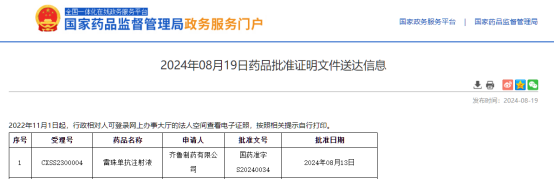
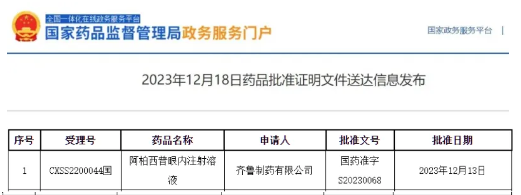
In fact, Qilu Pharmaceutical has been deeply engaged in the ophthalmic drug market for many years. Last December, Qilu Pharmaceutical's Aflibercept biosimilar was approved for marketing, as the first generic version in China. With the successful launch of biosimilars of the two best-selling ophthalmic products, Qilu Pharmaceutical's leading position in the ophthalmic drug field has been further consolidated.
With the continuous expansion of the ophthalmic drug market, global pharmaceutical companies are strengthening their strategic layout in this field. This series of actions by Qilu Pharmaceutical has undoubtedly injected new vitality into the ophthalmic drug market in China.
Anti-VEGF drugs play a core driving role in the ophthalmic drug market and have undergone several generations of development. From the first generation of ranibizumab to the second generation of aflibercept, and now the third generation of faricimab, the importance of this class of drugs in the field of ophthalmic treatment continues to grow.
With the expiration of the patents for ranibizumab and aflibercept, the emergence of biosimilars has not only improved treatment accessibility but also brought new competitive momentum to the field of ophthalmology.
The original product of Ranibizumab was developed by Roche and is a revolutionary VEGF inhibitor. Since its first launch in the United States in June 2006, it has been widely used to treat ophthalmic diseases such as wet age-related macular degeneration, becoming the world's first anti-VEGF drug used in the ophthalmology field.
In the Chinese market, since its approval for marketing in December 2011, ranibizumab has been approved for six indications, including wet age-related macular degeneration (AMD), macular edema secondary to retinal vein occlusion (RVO-ME), diabetic macular edema (DME), myopic choroidal neovascularization (mCNV), retinopathy of prematurity (ROP), and diabetic retinopathy (DR).
As the first-generation anti-VEGF drug in the field of ophthalmic treatment, Ranibizumab was once a blockbuster drug in the global ophthalmic drug market. From 2011 to 2021, its annual global sales remained at over 3 billion US dollars, peaking in 2014 with more than 4.3 billion US dollars. In recent years, impacted by biosimilars and other competitive products, the market has declined somewhat, but it still maintains a certain level of sales.
According to data from Menet, in 2023, the sales of ophthalmic drugs in Chinese public medical institutions exceeded 14 billion yuan, of which the sales of Ranibizumab Injection exceeded 1 billion yuan, ranking second, indicating the significant position of Ranibizumab in the Chinese ophthalmic drug market.
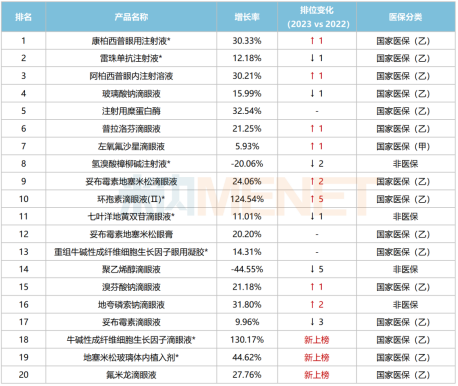
Top 20 Ophthalmic Drugs in Chinese Public Medical Institutions in 2023

Since 2012, Qilu Pharmaceutical has been developing ranibizumab injection. In January this year, Qilu Pharmaceutical's ranibizumab injection (brand name: Rimmyrah) received approval for marketing in the European Union. This is not only the first time that a biologic agent for ophthalmology produced in China has successfully "gone overseas," but also an important milestone for pharmaceutical companies in China to gain a foothold in the global market. Recently, Qilu Pharmaceutical's ranibizumab injection also received approval from the NMPA.
Notably, at the end of last year, Qilu Pharmaceutical's Aflibercept Intravitreal Injection Solution was approved as the first domestically produced generic drug in China for the treatment of adult patients with nAMD and DME.
Aflibercept, a VEGFR-Fc fusion protein jointly developed by Bayer and Regeneron, has seen rapid growth in sales of its original intravitreal injection solution in Chinese public medical institutions, aided by medical insurance. According to data from Menet, the sales revenue of Aflibercept intravitreal injection solution in ophthalmic drugs at Chinese public medical institutions exceeded 1 billion yuan in 2023, ranking third.
With the two biosimilars, Aflibercept and Ranibizumab, Qilu Pharmaceutical has gathered the domestically produced versions of the best-selling products in the ophthalmology field.
Industry insiders pointed out that as the first company in China to receive approval for biosimilars of Aflibercept and Ranibizumab, Qilu Pharmaceutical's deep cultivation in the ophthalmology field and expansion into international markets not only provide patients with more treatment options but also offer valuable experience for the international development of pharmaceutical companies in China.
In the细分市场 of anti-VEGF drugs, Qilu Pharmaceutical has successfully developed products that can rival原研药, securing a position for Chinese pharmaceutical companies in the global market.
However, as the rise of biosimilars gradually cuts into the market share of originator drugs, the market also faces fierce competition from a new generation of innovative drugs. This transformation not only brings more treatment options for patients but also presents opportunities and challenges for technological advancement across the entire ophthalmic treatment field and market iteration.
In the 2023 Top 20 Ophthalmic Drug Brands compiled by Menet, Conbercept Ophthalmic Injection from Kanghong Pharmaceuticals ranked first. Conbercept is an anti-VEGF fusion protein developed by Kanghong Biotech. As a next-generation anti-VEGF fusion protein, Conbercept is 100% humanized in structure and can effectively bind to multiple pathological neovascularization-related targets such as VEGF-A, VEGF-B, and PLGF. Conbercept was first approved in China in 2014 for the treatment of nAMD, then approved in 2017 for the treatment of pathological myopia (pmCNV), in 2019 for the treatment of DME, and in May 2022 for the treatment of macular edema caused by RVO. Clinical research results have also confirmed its similar efficacy and safety compared to existing anti-VEGF therapies.
Further, Roche's Faricimab (Vabysmo) is the world's first bispecific antibody drug for the eye, which was approved by the FDA in the United States in January 2022 and launched in China on December 18, 2023. This innovative drug, with its unique dual mechanism of action, not only significantly reduces the frequency of administration but also enhances the convenience of patient treatment. In 2023, the global sales of Faricimab reached 2.357 billion Swiss francs (approximately 2.634 billion US dollars), increasing by 324% year-on-year. Its sales in the first quarter of 2024 increased by 108% year-on-year, reaching 923 million US dollars, making it a dark horse in Roche's ophthalmology field.
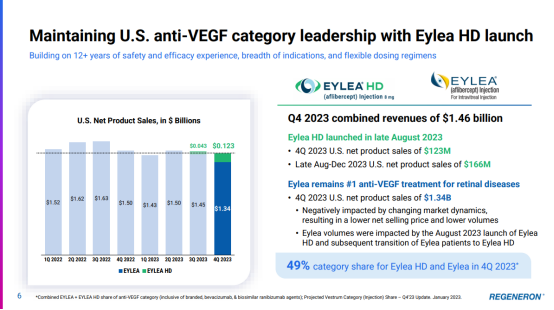
Market competition has not stopped. According to Regeneron's 2023 financial report, although the sales of Aflibercept (Eylea) reached $9.215 billion, it decreased by 4% year-on-year. Facing the impact of biosimilars and the challenge from competitors, Regeneron and Bayer launched the high-dose 8mg version of Aflibercept (Eylea HD), successfully extending the treatment interval from every two months to every four months, in order to maintain competitiveness in the market.
In China, besides Qilu Pharmaceutical and Kanghong's deep cultivation in the ophthalmic anti-VEGF drug field, Innovent Biologics and RemeGen have also demonstrated strong competitiveness.
Innovent Biologics' IBI302, an ophthalmic anti-VEGF-complement dual-target drug for neovascular age-related macular degeneration (nAMD), completed the first patient dosing in a Phase II clinical study in April 2021 and advanced to Phase III clinical trials in July 2023.
Rongchang Bio is not to be outdone, with its developed RC28-E, a VEGF/FGF dual-target fusion protein drug for the treatment of wet age-related macular degeneration (wAMD), showing good tolerability and efficacy in the Ib phase dose expansion trial. It has currently advanced to Phase III clinical research.
With the continuous expansion of the ophthalmic drug market, global pharmaceutical companies are strengthening their strategic layout in this field. In May this year, Merck & Co. acquired EyeBio, an ophthalmic biotechnology company, for up to $3 billion through its subsidiary, including $1.3 billion in upfront cash and up to $1.7 billion in potential milestone payments.
Looking ahead, the competition in the ophthalmic drug market will become more diverse and intense, bringing more treatment options to patients while also driving continuous innovation in ophthalmic medical technology.
Editor: Mingyao




www.yyjjb.com.cn
Insight into Industry Trends

"Pharmaceutical Economy Newspaper"
Academic Official Account
Focusing on the Frontiers of Oncology Academia

Terminal Official Account