

QL1706 (Iparomlimab and Tuvonralimab), a Novel PD-1/CTLA-4 Bispecific Combination Antibody, Demonstrates Promising Efficacy and Safety in First-Line Advanced Hepatocellular Carcinoma: Phase 2/3 DUBHE-H-308 Study Selected for ESMO-LBA Proffered Paper

Qilu Pharmaceutical
Specialty Formulations and Active Pharmaceutical Ingredients (API) Developer
HOT NEWS
The 2024 European Society for Medical Oncology (ESMO) Annual Congress will be held from September 13 to 17 in Barcelona, Spain. As one of the most influential international events in the field of oncology, the conference covers the latest advancements in clinical research, basic research, and translational research, providing an academic exchange platform for global oncology professionals and guiding new directions in cancer clinical practice.
As the field of oncology research continues to advance, Chinese scholars are increasingly becoming important participants in international academic conferences, making their voices heard on the global stage. Companies like Qilu Pharmaceutical, as a representative of domestically produced enterprises, shine brightly in the field of innovative drug development, showcasing their outstanding influence on the international stage.
Focusing on the 2024 ESMO Annual Meeting, Qilu Pharmaceutical Co., Ltd. showcased several innovative research achievements, demonstrating China's innovation strength in the field of cancer treatment.
On the eve of the conference, the China Medical Tribune specially selected some essence researches, "Qilu Pharmaceutical Voice" is here for a sneak preview!
QL1706-Liver Cancer:
The submission deadline for the latest breakthrough abstracts (Late Breaking Abstract) at this year's ESMO was August 7th. The list of selected Late Breaking Abstracts has been announced, and all related detailed content was revealed on the same day. Qilu Pharmaceutical's self-developed PD-1 and CTLA-4 bispecific antibody (research code QL1706) (iparomlimab and tuvonralimab) (Aipaloli Tovorali Monoclonal Antibody, abbreviated as Aito Combination Antibody) has been selected for the ESMO conference LBA Proffered Paper session with its latest research results in first-line liver cancer. This marks the most significant research achievement in Qilu Pharmaceutical’s history, representing a breakthrough in its new drug development, especially in innovative drug research!
[Type/Abstract No.] :
Proffered Paper presentation 4966
English Title:Iparomlimab and tuvonralimab (QL1706) with bevacizumab and/or chemotherapy in first-line (1L) treatment of advanced hepatocellular carcinoma (aHCC): a randomized, open-label, phase 2/3 study (DUBHE-H-308)
English Title:A Randomized, Open-label, Phase II/III Clinical Study of Aiparolitovorelizumab (QL1706) in Combination with Bevacizumab and/or Chemotherapy as First-line Treatment for Advanced Hepatocellular Carcinoma (DUBHE-H-308)
Leading PI:
Prof. Shukui Qin, Nanjing Tianyin Mountain Hospital Affiliated to China Pharmaceutical University
Fudan University Affiliated Zhongshan Hospital, Academician Jia Fan
Speaker:Chongqing University Cancer Hospital, Professor Dewei Li
Local time:Friday, September 13, 2024 16:00-16:10
Beijing Time:Friday, September 13, 2024 22:00-22:10
The following is a selective prospective preview of the contents related to the selected DUBHE-H-308 study:
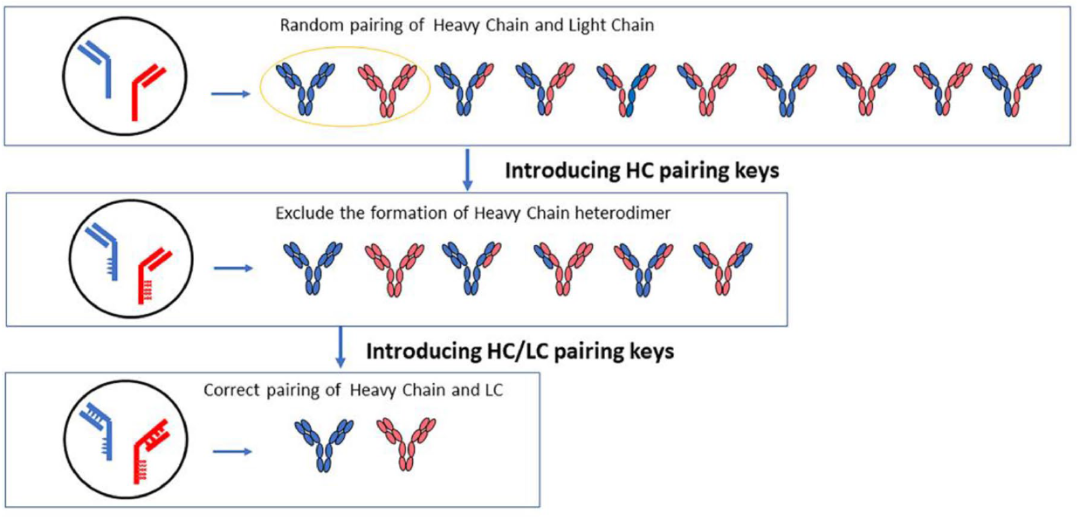
Aito Combination Antibody, namely Epalumab Tovorolizumab (Research Code:QL1706), is Qilu Pharmaceutical's use of MabPairTMThe world's first dual-immune drug developed on a biotechnology platform breaks through the limitations of existing treatments and represents a significant technological innovation in the biopharmaceutical field. The Aito combination antibody is a bifunctional combination antibody composed of a recombinant humanized IgG4 monoclonal antibody targeting human PD-1 and a recombinant humanized IgG1 monoclonal antibody targeting human CTLA-4, expressed in a predetermined ratio in the same cell line. The CTLA-4 component has been technically modified to moderately reduce its binding affinity to FcRn. This design not only improves the structure but also further optimizes the function, retaining the anti-tumor immune activity of CTLA-4 while significantly reducing the incidence and severity of adverse reactions.
The safety of the Aito combination antibody has been confirmed in preclinical and early clinical studies, especially in the Phase I clinical study led by Professor Zhang Li from the Sun Yat-sen University Cancer Center in Guangzhou, who was responsible for the design and implementation.[1]A total of 518 patients with advanced solid tumors were enrolled, making it the largest Phase I clinical trial in China before the market launch of domestically produced PD-1 and PD-L1 monoclonal antibodies. This trial laid a solid foundation for the subsequent clinical research of the Aito combination antibody.
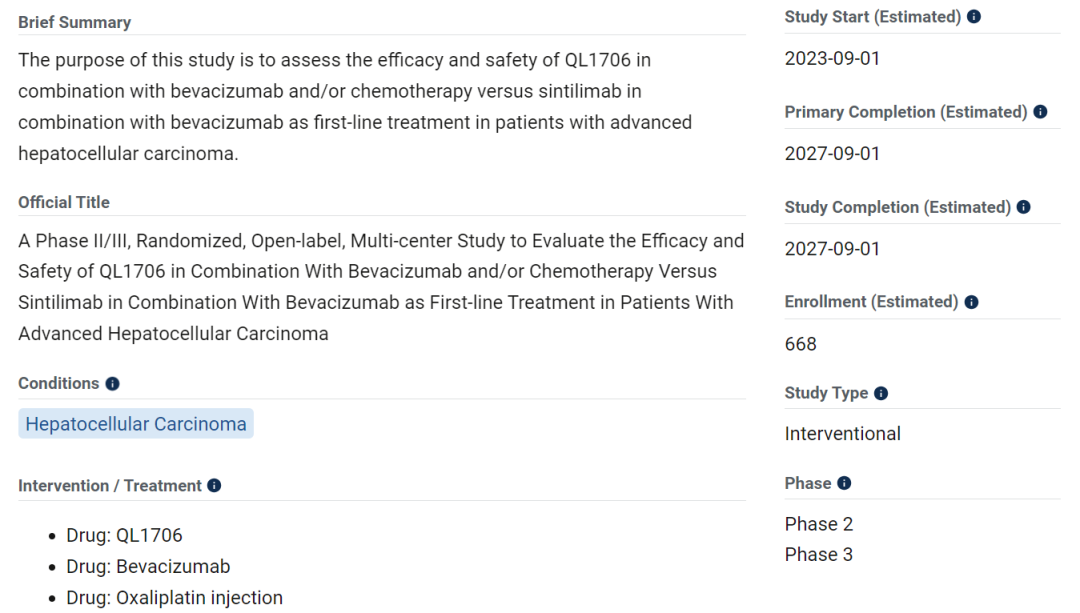
The DUBHE-H-308 study presented at this conference, led by President Shukui Qin of Nanjing Tianyin Mountain Hospital affiliated with China Pharmaceutical University and Academician Jia Fan of Zhongshan Hospital affiliated with Fudan University, is a Phase II/III trial investigating the first-line treatment of liver cancer using the Aitor combination antibody. The purpose of this study is to evaluate the efficacy and safety of QL1706 combination therapy compared to sintilimab combined with bevacizumab as a first-line treatment for patients with advanced HCC. The study design is as follows:
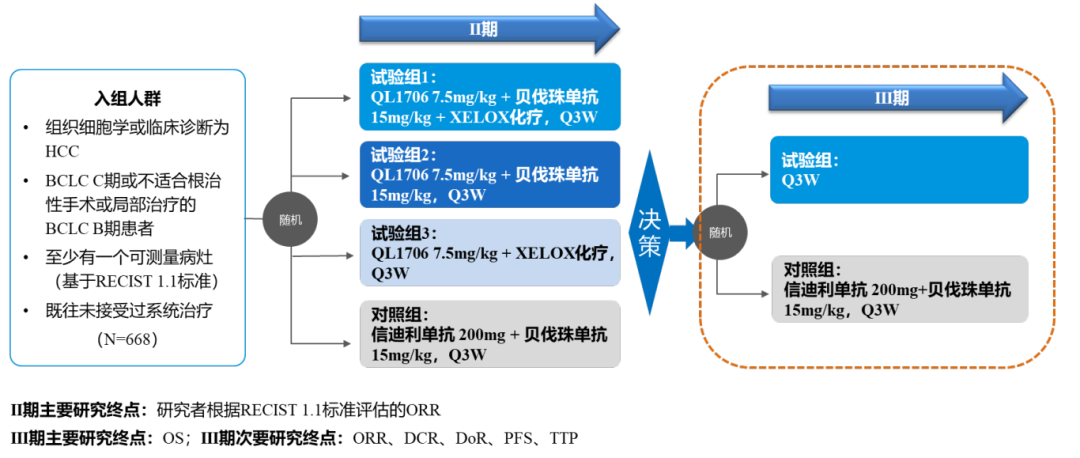
Experimental Group 1 adopted a triple-four-drug regimen consisting of Aitor combination antibody, bevacizumab, and chemotherapy, which has a synergistic anti-tumor effect with a clear mechanism:
First, oxaliplatin-based systemic chemotherapy can take effect quickly, rapidly suppress tumor progression, and buy time as well as lay the foundation for immunotherapy, which has a relatively slower onset of action.
Second, studies have shown that, compared with cisplatin and carboplatin, the third-generation oxaliplatin has a completely different anti-tumor mechanism. In addition to its cytotoxic effects, it mainly induces immunogenic cell death (ICD) in tumor cells, which can release tumor-specific antigens and enhance the effectiveness of immunotherapy.
Third, oxaliplatin has immunomodulatory effects, which can suppress regulatory T cells (Treg) and myeloid-derived suppressor cells (MDSC).)And tumor-associated macrophages (TAM), etc., remodel the tumor microenvironment and synergize with immunotherapy and bevacizumab.
Fourth, bevacizumab, as a classic anti-angiogenic drug, can also significantly improve the tumor microenvironment. Its combination with immunotherapy and systemic chemotherapy helps further enhance anti-tumor efficacy. The theoretical basis and clinical outcomes of the aforementioned combination treatment strategy have been validated, and this "combination" is expected to offer more effective and safer treatment options for liver cancer patients.
In view of the uniqueness of the study design, the Phase II study results were selected for the LBA Proffered Paper, shining at ESMO!
DUBHE, ChinaThe name of the star is Tianchu, the first star in the Big Dipper, located at the spoon's opening position of the Big Dipper, holding a prominent place. As the brightest star in the Big Dipper, it symbolizes wisdom, strength, governance, and management., which also symbolizes peace and hope. We look forward to the Aito combination antibody shining at ESMO like the star TianShu.
In addition to the field of liver cancer, the research on the Aitor combination antibody in esophageal cancer has also made significant progress, with the results being featured in a poster presentation at this ESMO conference.
Esophageal Cancer
[Type/Abstract No.]
Poster 1414P
English Title:Iparomlimab and tuvonralimab (QL1706) with definitive chemoradiotherapy for locally advanced esophageal squamous cell carcinoma: an open-label phase II study
English Title:An Open-Label Phase II Clinical Study of Aipalolitovorelimab (QL1706) Combined with Radical Chemoradiotherapy for Locally Advanced Esophageal Squamous Cell Carcinoma
Leading PI:Professor Qingsong Pang from Tianjin Medical University Cancer Institute and Hospital
Speaker:Professor Wencheng Zhang, Tianjin Medical University Cancer Institute and Hospital
Local time:Monday, September 16, 2024
Beijing Time:Monday, September 16, 2024
Iruak(Iruplinalkib) is a novel ALK-TKI developed by Qilu Pharmaceutical, which can potently inhibit ALK fusion proteins and drug-resistant mutations. It has been approved by the NMPA for first-line, second-line, and subsequent treatments of ALK-positive advanced non-small cell lung cancer (NSCLC). The first interim analysis of the Phase III clinical study, INSPIRE, showed that Iruplinalkib as a first-line treatment for ALK-positive NSCLC achieved a median progression-free survival (mPFS) of 27.7 months, compared to 14.6 months in the crizotinib group, with a PFS hazard ratio (HR) of 0.34 (P<0.0001). As the follow-up time extended, the PFS data maturity of the INSPIRE study further improved, and the updated PFS data was very impressive, earning a poster presentation at this year’s ESMO conference.
Iruak
Lung Cancer
[Type/Abstract Number]
Poster 1278P
English Title:Update of the INSPIRE study: iruplinalkib versus crizotinib in ALK TK-naïve locally advanced or metastatic ALK+ non-small cell lung cancer (NSCLC)
English Title:INSPIRE Study Updated Data: Iruac versus Crizotinib as First-Line Treatment for ALK-Positive Locally Advanced or Metastatic NSCLC
Leading PI:Professor Shi Yuankai from the Cancer Hospital of the Chinese Academy of Medical Sciences
Speaker:Professor Chen Xiao from the First Hospital of Jilin University
Local time:Saturday, September 14, 2024
Beijing Time:Saturday, September 14, 2024
The development of innovative drugs such as QL1706 and Iruac produced by Qilu Pharmaceutical has promoted the disciplinary advancement in the field of oncology treatment. We are looking forward to more innovative research achievements from China emerging at the upcoming ESMO conference, driving the progress of the global academic frontier and transforming the landscape of cancer treatment!
References:
[1] Zhao et al. Journal of Hematology & Oncology (2023) 16:50.