

Gracell Biotechnologies Submits IPO Application Following Breakthrough TIL Therapy GT201 with 100% Disease Control Rate in NSCLC and Gene-Editing Therapy ART001 Achieving Over 90% Reduction in Key Biomarker

Grit Biotherapeutics
Developer of Immunotherapy Drugs for Solid Tumors
▎Edited by the WuXi AppTec content team
Recently, the global cell and gene therapy (CGT) field has seen a series of advancements.Off-the-shelf allogeneic chimeric antigen receptor (CAR)-T cell therapy azer-cel benefited 3 patients in a Phase 1b clinical trial.Patients with relapsed/refractory diffuse large B-cell lymphoma (DLBCL) achieved complete response (CR), with a CR rate of 33%.Developed by Gravel BiotechnologyTumor-Infiltrating Lymphocyte (TIL) Product GT201 Injection Receives IND Approval from U.S. FDA. In clinical trials,GT201The disease control rate for treating non-small cell lung cancer patients reached 100%.Used for the treatment of transthyretin amyloidosis (ATTR)In vivo gene editing drug ART001 receives clinical trial approval from the U.S. FDA. Previous studies have shown,Peripheral of patients in the high-dose groupTransthyretin (TTR)Decreased by more than 90% from baseline on average.ThisThis article will provide a brief introduction to some of the important advancements, for readers' reference only.

Image Source: 123RF
———✦Research and Development Progress✦———
◇ Imugene Announces Off-the-Shelf Allogeneic CD19-Targeted CAR-T Cell Therapyazercabtagene zapreleucel(azer-cel) The Phase 1b clinical trial for the treatment of relapsed/refractory diffuse large B-cell lymphoma (a type of non-Hodgkin lymphoma) has achieved encouraging preliminary results.The study focused on patients with relapsed DLBCL after receiving autologous CAR-T cell therapy, all of whom had undergone 4-5 lines of treatment prior to the trial.As of now, 10 patients have received azer-cel treatment, 6 patients in Cohort A have received azer-cel plus lymphodepletion chemotherapy, and 4 patients in Cohort B have received azer-cel plus lymphodepletion chemotherapy plus interleukin-2 (IL-2) treatment.
The study results showed that all patients who received azer-cel and lymphodepletion chemotherapy demonstrated acceptable safety. Additionally, the treatment with azer-cel + lymphodepletion chemotherapy + IL-2 showed clinically meaningful efficacy and durability in DLBCL patients.Among all treated patients, the overall response rate was 44%, with 3 patients achieving CR and 1 patient achieving partial response (PR). Two patients in Cohort B who achieved CR have sustained responses for over 90 days and 120 days, respectively.Currently, all 4 patients in Cohort B are still in the trial, with 1 patient awaiting evaluation.
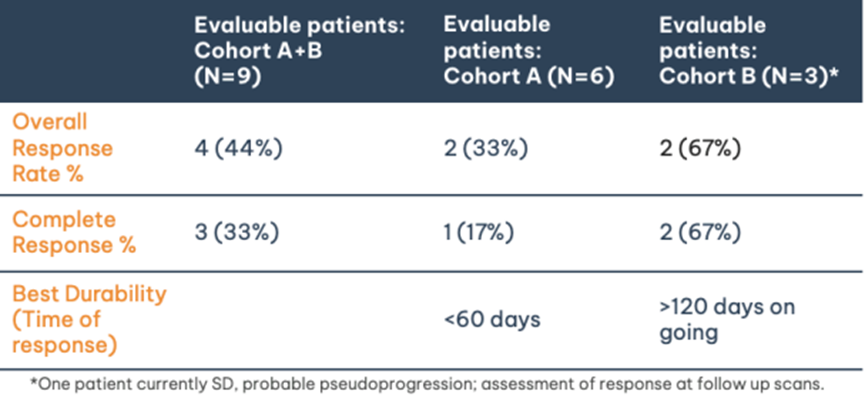
▲Phase 1b study results of Azer-cel (Image source: Reference [1])
In addition to studying the efficacy of azer-cel in blood cancers, Imugene also plans to combine azer-cel with its novel onCARlytics program to treat patients with solid tumors, covering 90% of non-blood cancers.
◇ Atsena Therapeutics Announces Initial Data from Ongoing Gene Therapy ATSN-101 Trial for Treatment ofGUCY2DLeber Congenital Amaurosis Caused by Biallelic Mutations(LCA1)Phase 1/2 Clinical Trial Data of the Patient.ATSN-101 is a gene therapy drug using adeno-associated virus 5 (AAV5) as a vector, delivering functional humanGUCY2DGenes introduced into photoreceptors.ATSN-101 has been granted Rare Pediatric Disease Designation, Regenerative Medicine Advanced Therapy Designation, and Orphan Drug Designation by the U.S. FDA for the treatment ofGUCY2DRelevant LCA1.
In this study, 15 confirmed LCA1 patients received unilateral subretinal injections to determine the safety and preliminary efficacy of ATSN-101. The results showed,In the high-dose group, the mean change in dark-adapted full-field stimulus testing (FST) was 20.3 dB, which means the treated eyesDark Adaptation FST of the EyeImproved 100 times.This improvement was first observed on day 28 and persisted for 12 months (p=0.012). A slight improvement was also observed in best-corrected visual acuity (BCVA), with the high-dose group showing an average improvement of 0.16 logMAR, or the equivalent of 8 letters on the eye chart, at 12 months post-treatment (p=0.10).
In terms of safety, the severity of all adverse events was mild (91%) or moderate (9%). No serious adverse events related to the drug were reported, and most treatment-related adverse events were associated with the surgical procedure. Ocular inflammation was mild and reversible with steroid treatment.

◇ Cartesian Therapeutics announced that the first patient has been dosed in the first-in-human Phase 1 trial of its next-generation autologous anti-B-cell maturation antigen (BCMA) mRNA-engineered CAR-T cell therapy, Descartes-15.Similar to the company's lead candidate product Descartes-08, Descartes-15 is designed without the need for pre-conditioning chemotherapy and does not use integrating vectors.In preclinical studies,Compared with Descartes-08, the CAR expression level of Descartes-15 increased by about ten times.And has selective target-specific killing effects. This Phase 1 dose-escalation trial will evaluate the safety and tolerability of Descartes-15 in patients with multiple myeloma under outpatient conditions. Following the Phase 1 dose-escalation trial, the company expects to further evaluate the application of Descartes-15 in autoimmune diseases.
◇ Medigene Announces FDA Approval of IND Application for Lead Program MDG1015, Phase 1 Clinical Trial to Initiate in Patients with Advanced Gastric Cancer, Ovarian Cancer, Myxoid/Round Cell Liposarcoma, and Synovial SarcomaMDG1015 is a potential "first-in-class" third-generation T-cell receptor.(TCR)Engineered T-cell therapy targeting NY-ESO-1/LAGE-1a, whose TCR can specifically recognize the target while demonstrating high safety and sensitivity.These TCR-T cells are further enhanced by the addition of proprietary PD1-41BB costimulatory switch protein (CSP) technology, demonstrating significantly enhanced antitumor activity against tumor cells expressing varying levels of PD-L1.
Compared with the first-generation TCR-T therapy, the production process of MDG1015 is faster, requiring only 6 days to expand the cells needed for treatment. These cells are younger and healthier, and the number of cells required for treatmentPossibleLess. The entire treatment process, from collecting the patient's cells to infusion, has been shortened to approximately 20 days. Additionally, the generatedMDG1015The cells are almost all CD8+ cells, about 95% of which have stem cell-like characteristics, meaning they can survive longer in the body, providing more sustained therapeutic effects while potentially reducing adverse events.

◇ BlueRock Therapeutics Announces FDA Approval of IND Application for OpCT-001OpCT-001 is an investigational induced pluripotent stem cell (iPSC)-derived cell therapy designed to treat primary photoreceptor diseases.Primary photoreceptor diseases are a subgroup of inherited retinal disorders that affect the structure and function of photoreceptor cells in the retina, leading to irreversible vision loss in both children and adults.The press release noted that OpCT-001 is the first iPSC-derived cell therapy to undergo clinical testing for primary photoreceptor diseases.
◇ Grail Bio announced that its TIL product GT201 injection has received IND approval from the U.S. FDA.GT201 is a genetically engineered TIL product that overexpresses a membrane-bound IL-15 complex to enhance T-cell function, thereby improving the in vivo persistence and anti-tumor capabilities of TIL cells.
In July 2023, GT201 Injection received IND approval in China. In terms of clinical efficacy,Tumors in multiple patients significantly shrank and their conditions improved, with one patient experiencing a 69% reduction in tumor size after receiving GT201 treatment. Among all non-small cell lung cancer patients, the disease control rate (partial tumor response or stable disease for over 24 weeks) of GT201 reached 100%.In addition, regarding cell persistence, GT201 cells showed stable expansion in all patients, with a survival duration of over 6 months. In terms of safety, GT201 demonstrated good safety, with no serious adverse reactions directly related to GT201 cells observed. All adverse reactions disappeared or decreased to grade 2 or lower within 14 days.

◇ Accuredit announces that its self-developed in vivo gene editing drug ART001 based on non-viral vectors has been approved for clinical trials by the U.S. FDALicense, intended for development to treat transthyretin amyloidosis.ART001 delivers CRISPR gene editing components to the liver through lipid nanoparticles (LNP).TTREdit genes to block the expression of TTR protein, thereby preventing the abnormal deposition of amyloid substances at the source.
In June 2024, Raygen Gene released the 24-week clinical study data of ART001 at BIO 2024 held in San Diego, USA.After 4 weeks of treatment until 24 weeks, the peripheral TTR protein levels in the high-dose group decreased by more than 90% on average from baseline.As of now, all subjects have been followed up for 36 weeks or more, and the drug's efficacy remains stable. In terms of safety, no infusion-related reactions have occurred in all subjects treated with ART001. Meanwhile, regarding the most concerning safety aspect of gene-editing products—off-target editing,ART001 showed no detectable off-target editing at dozens of times the saturation dose.According to the press release from Raygen Gene, ART001 has the potential to be a "best-in-class" drug in terms of comprehensive safety and efficacy.
———✦Financing, Cooperation, M&A✦———

Image Source: 123RF
◇ Arsenal Biosciences Announces Completion of $325 MillionSeries C Financing, and the proceeds will be used to advance the development of its core projects. The company will continue to build a research and development pipeline for cancer treatments based on its proprietary T-cell engineering technology, and develop tools to discover new cell therapies.
ArsenalBio aims to reprogram T cells using CRISPR-based gene editing to enhance their anti-cancer activity while reducing potential toxicity.The company's reprogramming of T cells includes the introduction of logic gate components, which enable the generated CAR-T cells to activate only when they recognize two different proteins expressed on the surface of tumor cells, further enhancing the specificity of T cell therapy. Additionally, the company's technology platform can also introduce various components that overcome the tumor microenvironment, improve cell persistence, and enhance tumor inflammatory responses, thereby increasing the efficacy and durability of T cell therapy.
◇ Acepodia Announces Collaboration with Pfizer Ignite, a Subsidiary of PfizerStrategic Clinical Collaboration Achieved, jointly supporting the development of its investigational therapies in the field of autoimmune diseases. Under this agreement, Pfizer Ignite will provide strategic guidance and resource support to Acepodia, assisting in the development of potential "first-in-class" cell therapies for treating cancer and autoimmune diseases.
Acepodia’s Antibody Cell Conjugate (ACC) platform utilizes bioorthogonal chemistry, building on the groundbreaking work of 2022 Nobel laureate Dr. Carolyn Bertozzi in applying click chemistry to living systems, to create an off-the-shelf CAR-T cell therapy without the need for genetic engineering.This therapy is more amenable to large-scale production and avoids common side effects of CAR-T cell therapy, such as cytokine release syndrome and neurotoxicity.

▲To learn more about the application of cutting-edge technologies in the biopharmaceutical industry, please long press and scan the QR code above to access "WuXi Live Studio" and watch live discussions and exciting replays on related topics.
Copyright Statement: This article is from the content team of WuXi AppTec. Individuals are welcome to share it on their social media circles, but unauthorized reproduction by media or institutions in any form to other platforms is prohibited. For authorization to reproduce, please reply with "reprint" on the "WuXi AppTec" WeChat Official Account to obtain reprint guidelines.


Share,PointLike,In View, Focusing on Global Biomedical Health Innovation