

Atsena Therapeutics Submits IPO Filing for ATSN-101, AAV Gene Therapy Demonstrating Up to 10,000-Fold Vision Improvement in LCA1 Patients with Sustained Efficacy Over 12 Months

Atsena Therapeutics
Gene Therapy Developer for Blindness Treatment
Disclaimer: Due to limited expertise, errors are inevitable, and some information may not be the most up-to-date. Feel free to point out in the comments. This article is only an introduction to medical and health-related drugs, not a recommendation of treatment plans (if involved); this article does not constitute any investment advice.
Atsena Therapeutics recently announced that the investigational gene therapy ATSN-101 treats carriersGUCY2DPhase 1/2 Clinical Trial Data for Leber Congenital Amaurosis (LCA1) Patients with Biallelic Mutations Published in The Lancet.This study, funded by Atsena Therapeutics, confirmed the safety and efficacy of the therapy, laying the groundwork for future approval.ATSN-101 is the first gene therapy for the treatment of LCA1 patients and may become the first gene therapy for this hereditary retinal disease.
LCA1 is a monogenic ophthalmic disease that causes damage to retinal function. The disease is caused by mutations in the GUCY2D gene, leading to early and severe vision impairment or blindness. Currently, there are no approved treatments for LCA1.
ATSN-101 is a gene therapy delivered via an adeno-associated virus 5 (AAV5) vector, introducing a functional human GUCY2D gene into photoreceptor cells.ATSN-101 has been granted Rare Pediatric Disease Designation, Regenerative Medicine Advanced Therapy Designation, and Orphan Drug Designation by the U.S. FDA for the treatment of GUCY2D-related LCA1.
All 15 patients with genetically confirmed LCA1 received unilateral subretinal injections to determine the safety and preliminary efficacy of escalating doses of ATSN-101. In the dose-escalation phase, three cohorts of adults (three per cohort) received three escalating doses: 1.0E10 vg/eye (low dose), 3.0E10 vg/eye (medium dose), and 1.0E11 vg/eye (high dose).Each dose level must be evaluated to ensure safety before increasing the dose for the next group.During the dose-expansion phase, one adult cohort and one pediatric cohort (three participants each) received the high dose.
The primary endpoint of the Phase 1/2 clinical trial was the incidence of treatment-emergent adverse events (TEAEs), with secondary endpoints including full-field stimulus testing (FST) and best-corrected visual acuity (BCVA), along with multi-luminance mobility testing (MLMT).
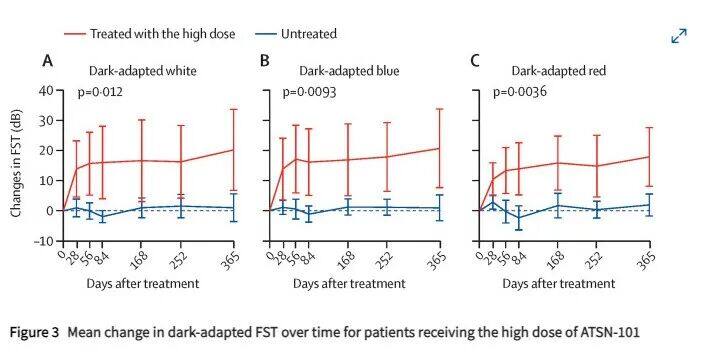
Patients receiving high-dose ATSN-101 treatment, the average change in dark-adapted FST was 20.3 decibels,This means the subject's vision has improved 100 times.。Improvement was observed on Day 28 of treatment and persisted for 12 months.(p = 0.012)。
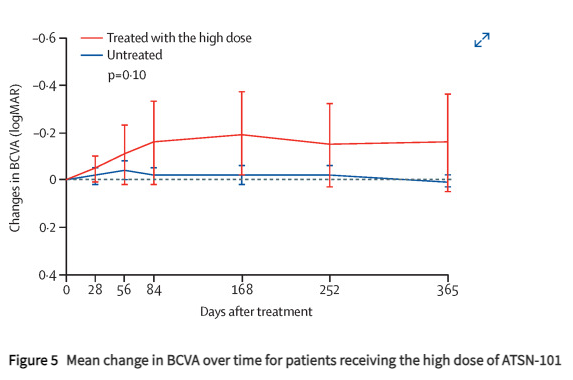
High-dose subjects also had a moderate improvement in BCVA, with an average improvement of -0.16 logMAR or 8 letters at 12 months post-treatment (p=0.10).
Among the 6 high-dose subjects undergoing MLMT treatment, 3 reached the 12th month.The MLMT test score for the treated eye reached the highest score.Among the nine patients receiving the maximum dose treatment,The vision of two patients improved 10,000-fold.。
"The 10,000-fold improvement is equivalent to patients being able to see their surroundings outdoors on a moonlit night, as opposed to requiring bright indoor lighting before treatment," said Dr. Artur Cideciyan, professor of ophthalmology research and co-director of the Center for Retinal Degeneration.
References:
https://www.thelancet.com/journals/lancet/article/PIIS0140-6736(24)01447-8/fulltext