QL1706 (Iparomlimab and Tuvonralimab) Combined with Bevacizumab and Chemotherapy Demonstrates Promising Efficacy and Manageable Safety in First-Line Advanced Hepatocellular Carcinoma: Phase 2 Results from the DUBHE-H-308 Study

Qilu Pharmaceutical
Specialty Formulations and Active Pharmaceutical Ingredients (API) Developer

The 2024 ESMO Annual Meeting will open on September 13 local time. At this year's conference, Qilu PharmaceuticalQL1706 in Combination with Bevacizumab and/or ChemotherapyUsed forFirst-line Treatment for Advanced Hepatocellular CarcinomaThe phase 2/3 study was selected for LBA. Data showed that QL1706 + bevacizumab combined with chemotherapy had good antitumor activity and safety as first-line treatment for advanced hepatocellular carcinoma.
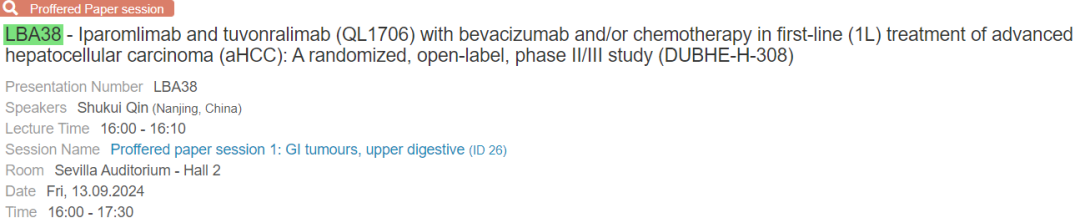
Screenshot source:ESMO Official Website
QL1706 is a drug developed by Qilu Pharmaceutical based on the MabPair bispecific antibody technology platform.PD-1/CTLA-4 Combination Antibody, byPD-1 Antibody Aipalolizumab(Iparomlimab) andCTLA-4 Antibody Tovorali Monoclonal Antibody(Tuvonralimab) Composition.Previously, in the Phase 1b/2 study, QL1706 combined with bevacizumab for first-line treatment of advanced hepatocellular carcinoma demonstrated promising anti-tumor activity and favorable safety.
Selected for the LBA of this year's conference is a randomized, open-label Phase II/III study (DUBHE-H-308) ofPhase II Study Section, aiming to evaluate the efficacy and safety of QL1706 in combination with bevacizumab and/or chemotherapy for first-line treatment of advanced hepatocellular carcinoma.The primary endpoints of this Phase 2 study include ORR as determined by the investigator according to RECIST v1.1 and safety.。
In this study, patients were randomly assigned (1:1:1:1) to the following four groups:
Group 1, QL1706 (7.5 mg/kg, Q3W) + Bevacizumab (15 mg/kg, Q3W) + Chemotherapy (aHCC regimen, i.e., Oxaliplatin 85 mg/m2+Capecitabine 1000 mg/m2`, Q3W, up to 4 cycles`);
Group 2, QL1706 + Bevacizumab;
Group 3, QL1706 + Chemotherapy;
Group 4, PD-1 antibody Sintilimab (200 mg, Q3W) + Bevacizumab.
The study enrolled a total of 120 patients. As of the data cutoff date (July 12, 2024), the median follow-up time was 6.7 months. The baseline characteristics of the four groups were roughly balanced. The data shows:
In terms of ORR, from Group 1 to Group 4 were 35.5%, 36.7%, 36.7%, and 13.8%, respectively.
In terms of DCR, from Group 1 to Group 4 were 87.1%, 80.0%, 86.7%, and 72.4%, respectively.
Progression-Free Survival (PFS) is not yet mature.6-Month PFS Rate, from Group 1 to Group 4 were 78.5%, 64.3%, 53.8%, and 50.3%, respectively.
Grade ≥3 treatment-related AEs occurred in 46.7%, 50.0%, 46.7%, and 37.9% of patients in the four groups, respectively. In Group 4, one patient died due to treatment-related hepatic failure.
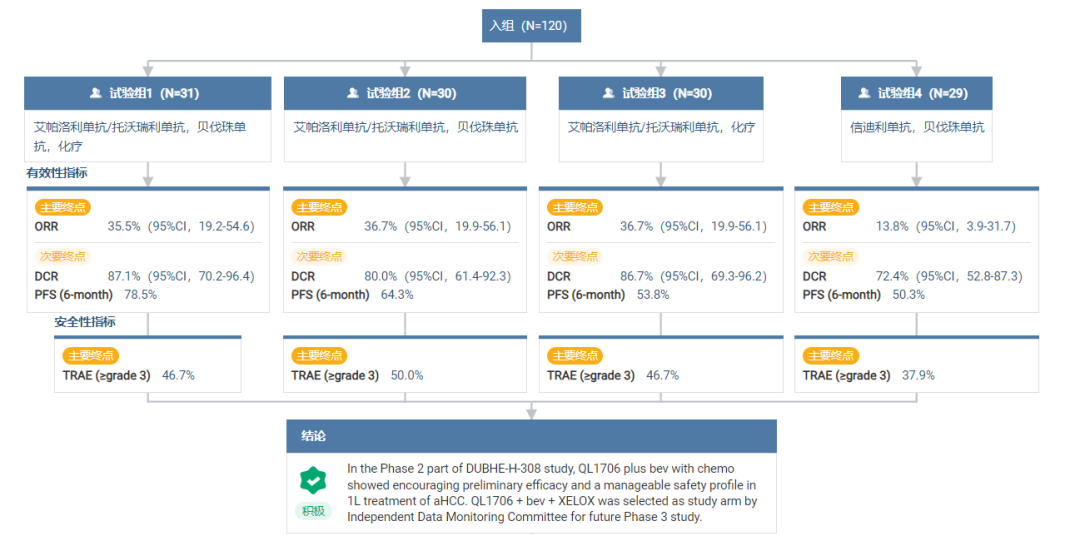
Screenshot source:Insight Database
The study suggests that in the Phase II part of the DUBHE-H-308 study, QL1706 + bevacizumab combined with chemotherapy showed encouraging preliminary efficacy and manageable safety in first-line treatment for advanced hepatocellular carcinoma. Among them, Group 1QL1706 + Bevacizumab + XELOX ChemotherapyPlan(Oxaliplatin + Capecitabine) has been selected by the Independent Data Monitoring Committee as the experimental group for future Phase III studies.
Insight DatabaseIt shows that, currently in China, there are quite a few companies exploring the effects of dual-target therapy targeting PD-1 and CTLA-4 for the treatment of hepatocellular carcinoma. Among them,The fastest progressing is Kangfang's PD-1/CTLA-4 bispecific antibody Cadonilimab, which has entered Phase III stage.; Secondly,Qilu's PD-1/CTLA-4 Combination Antibody QL1706, Phase Ⅱ/ Ⅲ Phase research. Others entering the clinical stage for liver cancer indications includeAstraZeneca'sPD-1/CTLA-4 DualAnti-Vosumab(Phase II),Merck's Pembrolizumab ( PD-1 Monoclonal Antibody)+ Zivolib (CTLA-4 Monoclonal Antibody) Combination Therapy(Phase II)。

One-Click Access to ESMO Congress Data
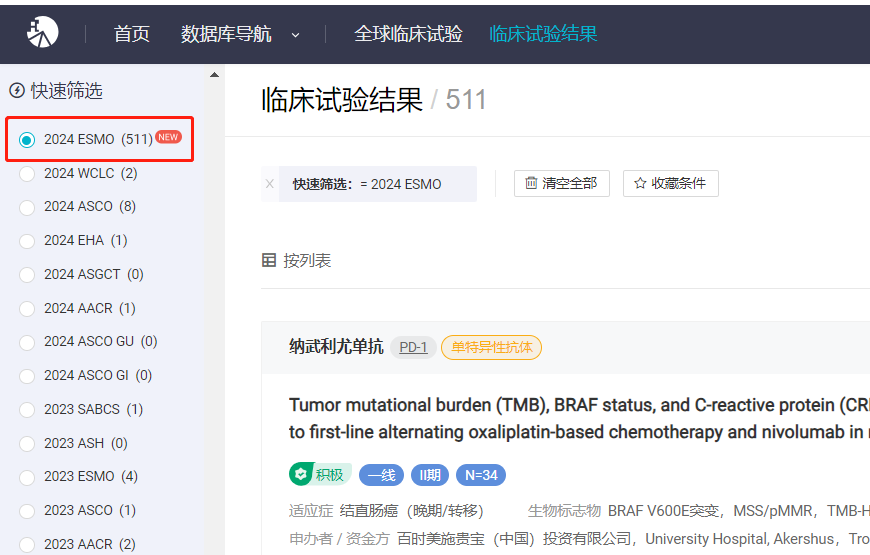 Screenshot source: Insight database
Cover Source:Corporate Logo