China's First High-Speed Vitrectomy Probe by JiaShi NuoDe Receives NMPA Approval

Brisight Nord
Ophthalmic Medical Device R&D Developer


Source:Instrument Family
Recently,Wuxi Brisight Nord Medical Technology Co., Ltd. (referred to as "Brisight Nord") has received approval from the China National Medical Products Administration (NMPA) for the market launch of its disposable vitrectomy probe., with the registration number GuoXieZhuZhun 20243161676. This is the first domestically developed vitrectomy probe made in China, and also the second dual-pneumatic vitrectomy probe in the world to achieve a basic cutting speed of 10,000 cuts per minute. Its successful development marks that China has reached an internationally advanced level in the field of vitrectomy surgical instruments, breaking the monopoly of domestic oligopolies.
After the cutter head pierces the eyeball, it can quickly remove the diseased vitreous body.According to the cutting speed, the current mainstream vitrectomy cutter heads are divided into 5000cpm, 7500cpm, and 10000cpm. The higher the cutting speed, the less disturbance to the retina during surgery, and the higher the safety. Vitrectomy cutter heads belong to Class III medical devices and are included in the list of medical devices exempt from clinical evaluation issued by the National Medical Products Administration, thus no clinical trials are required.
Calculated based on a single set of vitrectomy consumables for each surgery,The current vitrectomy market size in China has reached 3.5 billion yuan, 100% occupied by imported brands.Among them, the市场规模 of vitrectomy heads is about 3.2 billion yuan, with an annual usage of approximately 800,000 units; the市场规模 of vitrectomy machines is about 300 million yuan, with an annual sales volume of approximately 300 units. In the future, with the increase in surgical coverage and the entry of Chinese manufacturers into the market, the market capacity will further expand.
It is reported that the clean production workshop of Brisight Nord, located in Wuxi International Life Science Innovation Park, has been set up. The disposable vitrectomy cutter produced in China is expected to enter the market next month. It can be compatible with the most mainstream vitrectomy machines globally. The price is half that of imported products, which is expected to address the clinical pain point in China where high costs of imported medical devices have restricted the promotion of surgeries.At the same time, the vitrectomy machine independently developed by the company has also entered the application stage and is expected to be approved in early next year.
01
Fundus Diseases Generally Refer to Lesions Occurring in the Retina, Macula, and Optic Disc Within the Eyeball. Currently, China Has Over 40 Million Patients with Fundus Diseases. It Is Estimated That by 2025, the Market Size Related to Fundus Diseases in China Will Reach 26.9 Billion Yuan, with a Five-Year Compound Annual Growth Rate of Approximately 10.5%. The Main Treatment Methods for Fundus Diseases Include Drug Therapy, Vitrectomy, and Laser Therapy, Among Which Vitrectomy Is the Primary Method for Treating Fundus Diseases. As the Number of Patients with Fundus Diseases Increases, the Volume of Vitrectomies Will Also Grow.
In the field of ophthalmology,Vitrectomy is usually classified as a Level IV surgery, which is one of the highest-level surgeries in ophthalmology.This surgery involves operations on the posterior segment of the eye, including vitrectomy and possible retinal manipulations. Due to its complexity, risks, and high demands on technical equipment and the surgeon’s skills, vitrectomy is considered one of the most difficult surgeries in ophthalmology.
However, with the assistance of "high-tech" equipment such as vitrectomy machines and vitrectomy probes, ophthalmic treatment has broken through the once unreachable "forbidden zones" inside the eye. Today, vitrectomy is widely used to treat various blinding eye diseases, including but not limited to cortical cataracts, malignant glaucoma, and retinal detachment, among other anterior and posterior segment diseases.
Population aging will also create a huge market for vitrectomy devices in China. In 2022, the population aged 65 and above in China reached 200 million, accounting for 14.2% of the total population. It is estimated that by 2025, the population in this age group will reach 247 million. The prevalence of age-related ophthalmic diseases such as fundus diseases will expand the patient population and stimulate surgical demand.
As Chinese manufacturers accelerate the breakthrough of the high pricing restrictions of imported products, the phenomenon of reusing vitrectomy probes will also decrease. Currently, most hospitals do not have a charge catalog for vitrectomy probes, and due to the high pricing of imported products, it is common for vitrectomy probes to be reused 3-4 times. As domestically produced, cost-effective vitrectomy probes from manufacturers with strong R&D capabilities gradually enter the market competition, along with improved usage standards and expected price reductions, the phenomenon of reusing vitrectomy probes will further diminish.
At present, the field of vitrectomy instruments is basically monopolized by foreign brands, and the global manufacturers of vitrectomy instruments areAlcon (USA), Bausch&Lomb (USA), DORC (Netherlands), Oteri (Switzerland), Heidelberg AG (Germany)etc. The most commonly used in China are the American Alcon's Constellation vitrectomy machine and the American Baush&Lomb's Millennium vitrectomy machine, among which Alcon occupies 90% of the market share, belonging to a typical oligopoly market.
High-end medical devices produced in China started relatively late, and achieving breakthroughs in innovative technology is not an easy task. Taking vitrectomy probes as an example, each probe is assembled from 32 components including a handle, reversing valve, blade, and air and liquid tubing. The electromagnetic valve components within the device determine the speed of vitrectomy probe iterations. Fully realizing import substitution requires the joint efforts of upstream and downstream players in the industry chain. According to estimates by relevant industry experts, 30%-40% of the raw materials for vitrectomy probes and components for vitrectomy machines in China still need to be sourced through overseas procurement.
According toBrisight Nord General Manager Yang JianxinIt said that while independently developing, the company has increased efforts to cultivate and assist upstream manufacturers in overcoming the "bottleneck" issues of key components. Driven by Brisight Nord's R&D needs and collaborative cooperation, a domestic upstream supplier of vitrectomy machines successfully developed a component with a cost of only 1/20 of imported products.Currently, 70% of the core components of the vitrectomy heads developed by Brisight Nord have been replaced with domestically produced alternatives.
Brisight Nord's disposable vitrectomy cutter adopts a dual-airway drive design, offering three specifications: 23G (needle diameter 0.6 mm), 25G (0.5 mm), and 27G (0.4 mm). The cutting speed ranges from 2500, 5000, 7500 to 10000 cpm and is compatible with mainstream vitrectomy machines.This innovative product has not only broken the long-term dependence on imports in China's vitrectomy medical device market., which also helps reduce the cost of related surgeries and improve the treatment rate of fundus diseases.
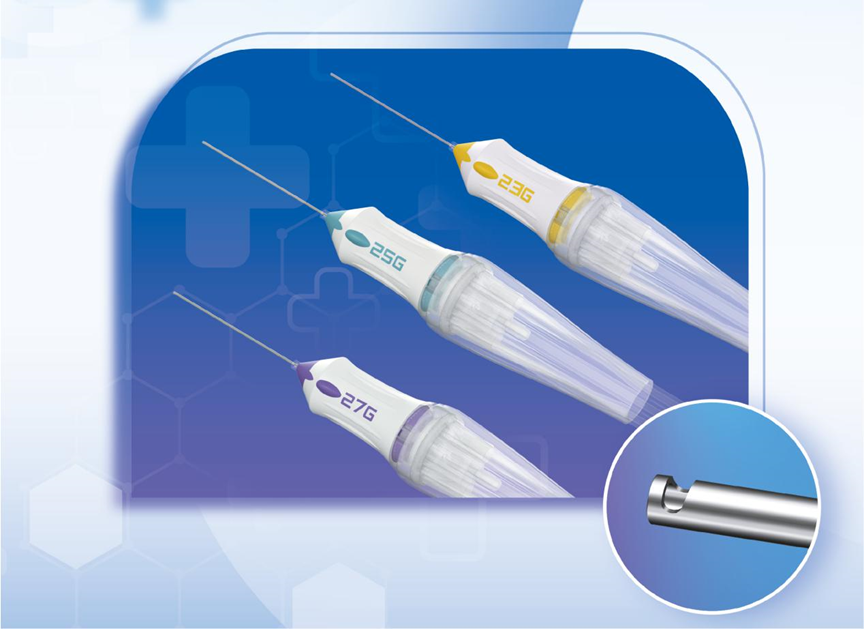
Brisight Nord Dual-Channel High-Speed Vitrectomy Probe
Product Features
High-Speed Vitrectomy Probe: World-leading 10,000 cpm cutting speed effectively reduces vitreoretinal traction and lowers surgical complications.
The retina is a delicate tissue inside the eyeball responsible for sensing light and transmitting visual signals. In vitrectomy, excessive traction may cause retinal damage or tearing, affecting postoperative visual recovery. Reducing traction can lower the risk of intraoperative and postoperative complications such as retinal detachment, retinal tears, and macular edema, while also promoting proper retinal alignment and shortening recovery time after surgery.
Dual-Pneumatic Drive System: The first vitrectomy probe in China and the second globally to adopt a dual-pneumatic drive.
Dual pneumatic drive is controlled by two air source systems, separately managing cutting and resetting. This allows the vitrectomy probe's reset function to no longer rely on the mechanical elasticity of a spring structure but instead be efficiently driven by the air source system, providing smoother and more predictable cutting movements, improving the surgeon’s operational experience. At the same time, it enables more effective control of the opening and closing ratio of the vitrectomy probe, allowing doctors to perform precise cutting and aspiration operations according to surgical needs and the patient's condition, optimizing surgical efficiency.
Minimally Invasive Surgery Capability: The system is equipped to perform 23G, 25G+, and 27G+ minimally invasive vitrectomies, meeting various minimally invasive surgery needs and reducing surgical trauma.
Precise Control: The automatic real-time intraocular pressure control system ensures accuracy within ±2mmHg, preventing local choroidal or retinal damage caused by high perfusion pressure.
Wuxi Brisight Nord Medical Technology Co., Ltd. was established in April 2021. As a modern medical technology enterprise integrating research and development, production, sales, and service, the company is deeply engaged in the ophthalmic medical field. It is committed to innovation and breakthroughs, focusing on the R&D and manufacturing of high-quality, high-precision, and highly safe ophthalmic medical devices. Its aim is to achieve import substitution and accelerate the development of ophthalmic medical technology in China.
The company has gathered elites and experts in the field of ophthalmic medical technology both in China and abroad, including specially appointed professors from Tsinghua University as guiding consultants, and a research and development team centered around PhDs from Beijing Institute of Technology and the Chinese Academy of Sciences.
The company focuses on the research and development of vitrectomy machines and matching consumables with internationally leading standards, while continuously expanding its product areas, which now coverProducts in multiple aspects such as vitrectomy machines, phacoemulsification machines, intraocular lenses, and excimer lasers, while paying attention to intellectual property protection, owning multiple patents and actively laying out intellectual property around the developed products.
In March 2023, Brisight Nord completed an angel round of financing worth tens of millions of RMB. This investment was exclusively provided by Yuanming Xinzhaoyuan. In August 2024, Brisight Nord completed its Series A financing. As of the date of this report, the company's financing history is as follows:

This article is reprinted, all views belong to the original author.Platform (Siyu MedTech), Medical DevicesThe Medical Business Review remains neutral on all viewpoints in the article and only shares for communication purposes.
*Advertisement

▼More Book Recommendations▼
In order not to miss any content, everyone remembers toMedical Device Business ReviewSet as starred? Oh,
Looking forward to meeting you at the first moment every time