Recently, Qilu Pharmaceutical's innovative research and development of Aipaloli-Tovorali Monoclonal Antibody (QL1706, trade name: Qibean, hereinafter referred to as "Aito Combination Antibody") has been approved by the National Medical Products Administration (NMPA) for the treatment of patients with recurrent or metastatic (R/M) cervical cancer who have failed previous platinum-based therapy. This is a MabPair independently developed by Qilu Pharmaceutical.®️The first bifunctional combination antibody targeting both PD-1 and CTLA-4 designed and produced by the technology platform has been approved for marketing. This is not only a significant breakthrough in the field of cervical cancer treatment in China, but also a leap forward in the immunotherapy of multiple solid tumors such as lung cancer and liver cancer. It marks a new phase in cancer immunotherapy and opens a new chapter in tumor treatment.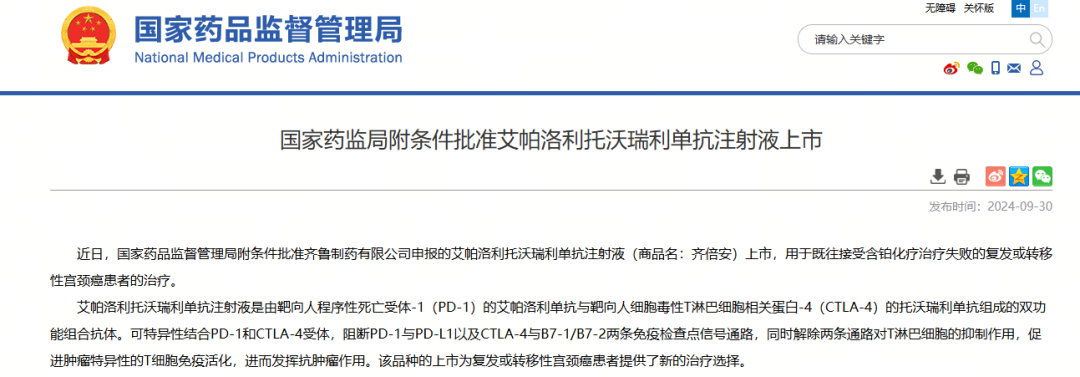
Screenshot of the National Medical Products Administration (NMPA)Aito Combination Antibody Approved for Cervical Cancer Indication, Advancing Immunotherapy to a New Stage
Aito Combination Antibody, the world's first combination antibody integrating dual mechanisms of anti-PD-1 and anti-CTLA-4, is also the world’s first MabPair.®️The first major breakthrough result born from the innovative technology platform, this antibody has taken the lead globally in tumor dual-immunotherapy strategies due to its unique mechanism.As is known to all, with the rapid development of immunotherapy technology, immune checkpoint inhibitors (ICIs) represented by PD-1 and CTLA-4 have profoundly transformed the landscape of cancer treatment. Consequently, immunotherapy has become another treatment option for tumors, following surgery, radiotherapy, chemotherapy, and targeted therapy. Nevertheless, clinical practice still faces challenges with existing ICIs treatments, such as limited benefits from single-agent therapies, poor tolerance and compliance with dual-immunotherapy combinations, and significant adverse reactions associated with bispecific antibodies. To achieve the goal of enhancing efficacy and reducing toxicity through dual-immunotherapy strategies, the field urgently needs innovative solutions.Currently, the clinically approved PD-1 and CTLA-4 dual immunotherapy regimens are limited by the toxic reactions caused by CTLA-4, and the benefits for cancer patients remain limited. In addition, issues such as treatment options after resistance, biomarker selection, and adverse reaction management still need further exploration.The design of Aito Combination Antibody breaks through the limitations of existing treatments with a unique dual immune checkpoint inhibition mechanism and the world's first MabPair.®️The application of the technical platform achieves the combination of anti-PD-1 monoclonal antibody and anti-CTLA-4 monoclonal antibody in a 2:1 golden ratio, which is expected to become a dual immunotherapy with lower toxicity and better tolerance. Therefore, the Aito combination antibody can achieve the goal of enhancing efficacy and reducing toxicity, becoming the key to further improving efficacy and prognosis on the basis of existing dual-immunotherapy regimens.Notably, to successfully develop qualified combination antibodies, MabPair®️The platform aims to solve two core problems. First, how to produce two antibodies with a single cell line, which is the first of its kind in the industry; second, how to ensure the functionality and product quality of combination antibodies during the production process, involving multiple technical challenges. Thanks to the strong expertise of Qilu Pharmaceutical's R&D team in the field of antibody engineering, MabPair®️The platform has overcome the aforementioned challenges.The approval of the Aito combination antibody for second-line and above treatment of R/M cervical cancer is mainly based on the pivotal registration study (DUBHE-C-206 study) data of the Aito combination antibody in R/M cervical cancer patients. In this multicenter, open-label, single-arm, Phase II trial, 148 R/M cervical cancer patients who failed first-line platinum-based chemotherapy (± bevacizumab) and had not received immunotherapy were treated with the Aito combination antibody (5mg/kg Q3W).As of October 28, 2023, the median follow-up time was 17.5 months, the objective response rate (ORR) was 33.3%, the median progression-free survival (PFS) was 5.4 months, and the median overall survival (OS) reached 17.1 months. In terms of safety, the incidence of grade ≥3 treatment-related adverse events (TRAEs) with the Aito combination antibody was 27.0%, with only 3.4% of patients discontinuing treatment due to TRAEs, and no treatment-related deaths occurred.Historical data from studies on immunotherapy for advanced cervical cancer show that the efficacy of the Aito combination antibody is significantly superior to that of single immune checkpoint inhibitors. The incidence of severe adverse reactions is comparable to PD-1 monoclonal antibodies and notably lower than approved dual immune antibody drugs. The approval of the Aito combination antibody provides a new treatment option for this patient population, which not only improves survival rates but also potentially enhances their quality of life.Exploring the Value of First-Line Treatment for Cervical Cancer: Research on the Aito Combination Antibody Continues to Advance
Notably, the significant efficacy and good safety demonstrated by the Aito combination antibody in later-line treatment of cervical cancer have also driven its continued exploration into first-line treatment.Results from an open-label, multicenter, non-randomized Phase II study (DUBHE-C-204) showed that with a median follow-up of 14.0 months, the patients' ORR reached 81% (95% CI, 68.6%-90.1%), and the disease control rate (DCR) was 98.3% (95% CI, 90.8%-100.00%). The median PFS was 14.3 months (95% CI, 9.2 months-NE), with a complete response (CR) rate of 10.3%. This study aimed to evaluate the efficacy and safety of Aito combination antibody plus chemotherapy ± bevacizumab as first-line treatment for R/M cervical cancer. The results confirmed that regardless of the patient's PD-L1 combined positive score (CPS) status, the Aito combination antibody demonstrated significant benefits in first-line treatment for R/M cervical cancer. These findings further improved patient outcomes compared to previous studies on immunotherapy combinations, providing strong momentum for the continued exploration of Aito combination antibody in the field of cervical cancer.On this basis, the Phase III clinical trial (DUBHE-C-301) for the first-line treatment of R/M cervical cancer with the Aito combination antibody is also proceeding at full speed. The study has now completed enrollment, and it is expected that its results will provide more solid evidence-based medical evidence for the application of the Aito combination antibody in the field of cervical cancer.World's First MabPair®️Technology Platform, Achieving Dual-Exemption Feature Advantages
Aito Combination Antibody is Based on the World's First MabPair®️Significant innovative achievements launched by the technology platform. Going back to 2015, when immune checkpoint inhibitors PD-1 monoclonal antibodies and PD-L1 monoclonal antibodies had just been approved, the entire industry was thrilled. Bispecific antibodies showed great potential in the field of cancer treatment. The R&D team of Qilu Pharmaceutical was eager to build on this new breakthrough to develop more effective products, especially multifunctional multi-target products, to meet pressing medical needs. Against this backdrop, MabPair®️Technical platforms have emerged accordingly.MabPair®️The core value of the technology platform lies in its ability to produce two different monoclonal antibodies from a single cell line. Compared with conventional bispecific antibody platforms, MabPair®️The product is structurally closer to natural antibodies and can further optimize its function and efficacy by adjusting the proportion of antibodies, introducing uniquely designed heavy chain pairing keys and light chain pairing keys to prevent antibody mismatch.It can be said that MabPair®️The technology platform not only makes it possible to implement the innovative dual-action mechanism of Aito's combination antibody, but also provides a solid guarantee for its clinical application stability and safety. The use of this platform marks an important step in the field of tumor immunotherapy in terms of precise control and personalized treatment. Meanwhile, the birth of Aito's combination antibody has also laid a solid foundation for the further development of this technology platform.It is worth mentioning that MabPair®️The potential of the technology platform goes far beyond this. Currently, Qilu Pharmaceutical's R&D team is utilizing the platform to develop other products, expanding into other fields such as immunology and geriatrics. As the first product, the Aito combination antibody, is about to enter clinical application, MabPair®️The application of the platform will also be expanded to more fields for in-depth research.Aito Combination Antibody Layout in Multiple Tumor Types, Bright Future Development Prospects
In the Phase Ⅰ/Ⅰb study, the Aito combination antibody also explored more than 10 types of tumors. It demonstrated a certain level of safety in a large sample size (518 cases) and did not increase the incidence of adverse events compared to single immune checkpoint inhibitors. In terms of efficacy, it showed good anti-tumor activity in the last-line treatment of various solid tumors. The safety and efficacy data revealed in the early clinical studies have laid a solid foundation for subsequent clinical research of the Aito combination antibody in other multiple tumor types.In addition to cervical cancer, the Aito combination antibody has also shown positive research progress in non-small cell lung cancer (NSCLC). A pivotal Phase II study (DUBHE-L-201 study) explored the Aito combination antibody in combination with a treatment regimen for EGFR-TKI resistant NSCLC, demonstrating significant efficacy. Furthermore, a Phase III trial comparing Aito combination antibody plus chemotherapy versus first-line immunotherapy combined with chemotherapy, known as the Tian Shu Xing DUBHE-L-303 study, is currently ongoing and is expected to become a strong candidate for first-line treatment of non-small cell lung cancer in the future.In the field of liver cancer treatment, a Phase II/III study presented at the 2024 ESMO Annual Meeting showed that the combination of Aito antibodies with bevacizumab and chemotherapy as first-line treatment for advanced hepatocellular carcinoma (HCC) achieved an ORR of 35.5%, a DCR of 87.1%, and a 6-month PFS rate of 79%. Reviewing previous studies, the ORR of immune combination regimens already marketed in China for first-line treatment of Chinese patients with advanced liver cancer was less than 30%, with a median PFS of less than six months (RECIST 1.1). The efficacy data of the Aito antibody combination regimen shows improvement over previous figures. Additionally, the safety profile of Aito antibody combination as first-line treatment for advanced HCC is favorable, with the incidence of Grade ≥3 TRAEs comparable to marketed immune combination regimens.In the exploration of first-line treatments for nasopharyngeal carcinoma, the Aito combination antibody plus chemotherapy has shown initial promise. In a multicenter, single-arm, Phase II study, the DCR for previously untreated R/M nasopharyngeal carcinoma was as high as 96.4%, with a median PFS of 12.5 months, presenting a positive therapeutic outlook.In addition, the Aito combination antibody is also expected to provide a more promising dual immunotherapy option for PD-L1 negative (expression below 1%) gastric (G)/gastroesophageal junction (GEJ) adenocarcinoma and esophageal squamous cell carcinoma (ESCC) patients.Unleashing China's Pharmaceutical Innovation Capability for a Healthy China through "Intelligent" Manufacturing
Aito Combination Antibody, with its high efficiency and low toxicity, has injected new vitality into tumor immunotherapy and opened a new chapter in China's cancer treatment. Recently, the research results of Aito Combination Antibody on multiple types of tumors were selected for presentation at top international oncology conferences such as CSCO, ASCO, ESMO, and ESMO ASIA, once again demonstrating its innovation and international influence in the field of cancer treatment.In the field of tumor immunotherapy, Qilu Pharmaceutical has extensively and cutting-edge laid out tumor immunotherapy drugs, used alone or in various combination immunotherapy regimens, providing more effective solutions to meet the survival needs of cancer patients.The "14th Five-Year Plan for the Pharmaceutical Industry" identifies innovation as the core mission to drive high-quality development in the pharmaceutical industry, accelerating the implementation of an innovation-driven development strategy. The successful launch of Aituo Combination Antibody demonstrates the enormous innovative potential and capabilities of China's pharmaceutical enterprises, represented by Qilu Pharmaceutical. To further strengthen its global innovative drug R&D capabilities, Qilu Pharmaceutical has established an independent innovation R&D system aligned with international standards, setting up six major R&D platforms linked between China and the United States, integrating high-quality global resources, and continuously developing "global new" and "global best" drugs, showcasing strong "China power."In the future, Qilu Pharmaceutical will continue to uphold the core values of "Great Medical Integrity, Family and Country as One," using innovative science and technology with warmth to continuously meet unmet clinical medication needs. In the field of major diseases, it will keep contributing "Chinese wisdom" and "Chinese solutions," making greater contributions to the development of Healthy China and even the global pharmaceutical health industry.First Trial | Huang Jia
Second Review | Li Fangchen
Third Review | Li Jingzhi