

ViaLase Receives CE Mark for World’s First Femtosecond Laser System to Treat Primary Open-Angle Glaucoma

ViaLase
Glaucoma Treatment Developer
On July 30, ViaLase announced that its ViaLase® Laser System had received CE (Conformité Européenne) certification from the European Union (EU) for the treatment of adult patients with primary open-angle glaucoma (POAG).It is reported that the ViaLase® laser system can achieve surgical results without the need to open the eyes, significantly reducing the risk of complications associated with traditional invasive surgeries.
As a rising star in the field of ophthalmology, ViaLase, founded by top scientist Professor Tibor Juhasz, is committed to revolutionizing traditional glaucoma treatment by introducing truly non-invasive image-guided femtosecond laser therapy. Moreover, with its groundbreaking technological concept, ViaLase has cumulatively raised $40 million in funding in the primary market.
There is no doubt that, with further research and product promotion, ViaLase will offer a revolutionary treatment option for glaucoma patients worldwide, with tremendous future potential.
"Femtosecond Laser + Micron-level Image Guidance" Provides Non-invasive Solutions for Glaucoma Treatment
In 2018, the Nobel Prize in Physics was awarded to American scientist Arthur Ashkin, French scientist Gérard Mourou, and Canadian scientist Donna Strickland for their joint invention of chirped pulse amplification technology. This breakthrough not only advanced the field of high-intensity ultrashort optical pulses but also led to the creation of the cutting-edge femtosecond laser technology "SMILE" (Small Incision Lenticule Extraction).
Compared with traditional surgical laser technology, chirped pulse amplification technology has brought revolutionary changes to the medical field with its higher safety, gentler operation method, and more precise cutting effect. Especially in ophthalmic surgeries such as LASIK and PRK refractive surgeries, the application of chirped pulse amplification technology has greatly improved the precision and safety of the procedures. The ultra-short pulse width and high peak power of femtosecond lasers minimize damage to surrounding tissues during surgery, significantly reducing the risk of surgical complications.
As one of the leading figures in this field, Dr. Tibor Juhasz, a co-founder of ViaLase, is not only a professor at the Gavin Herbert Eye Institute and the Department of Biomedical Engineering at the University of California, Irvine, but also achieved tremendous commercial success in the 1990s with femtosecond laser surgical equipment.As a co-founder of IntraLase and LenSX, two ophthalmic companies, he witnessed the widespread application of femtosecond laser technology in ophthalmic surgeries, with LenSX being successfully acquired by Alcon in 2010.
With the founder's deep accumulation in the field of femtosecond laser technology, ViaLase has been committed to combining laser technology with the precision of femtosecond laser technology and integrating the accuracy of micron-level image guidance since its establishment.The company has launched a non-invasive glaucoma treatment called Femtosecond Laser Image-Guided High-Precision Trabeculotomy (FLigHT).This innovative FLigHT procedure reduces intraocular pressure (IOP) through a non-invasive, non-surgical approach, providing doctors with greater precision and visibility in creating passages within the trabecular meshwork (TM), bringing breakthrough advancements to the field of glaucoma treatment.
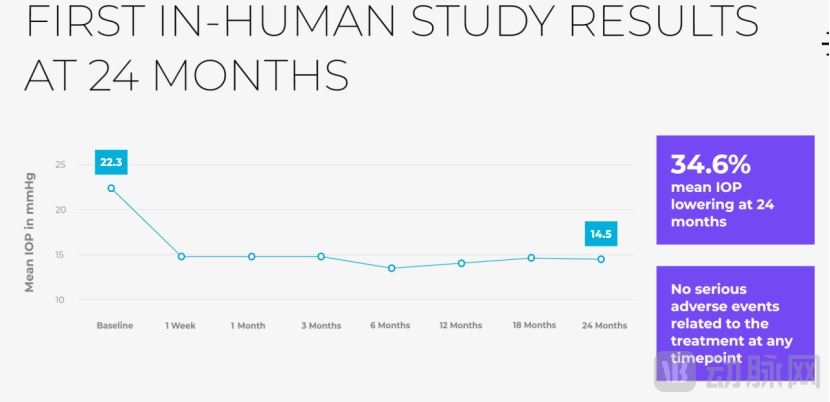
24-Month Safety Data from the FLigHT Human Study, Source: Company Official Website
In April 2023, ViaLase announced the 24-month safety data from its first-in-human FLigHT (Femtosecond Laser Image-Guided High-Precision Trabeculotomy) study. The research involved an in-depth evaluation of 11 patients with open-angle glaucoma (17 eyes in total). The results showed that at 24 months, the mean intraocular pressure significantly decreased from 22.3 ± 5.5 mmHg at baseline to 14.5 ± 2.6 mmHg, representing a reduction of 34.6%, fully demonstrating the safety and long-term efficacy of the FLigHT procedure.
In the same year, the Phase 1 VIA-001 trial results of ViaLase also brought good news. At all follow-up time points (1 month, 3 months, and 6 months post-operation), the average intraocular pressure of patients decreased by 20%, 25%, and 23%, respectively. Notably, 68% of the treated eyes achieved a ≥20% reduction in intraocular pressure at 6 months without the need for additional glaucoma medication, providing patients with a more convenient and effective treatment option.
At the 2023 American Glaucoma Society meeting, ViaLase also presented another 12-month study result. The results showed that after FLigHT surgery, the average intraocular pressure of patients was significantly reduced, and one year later, all patients no longer needed to use intraocular pressure-lowering medications. Meanwhile, gonioscopy revealed no scarring, further demonstrating the safety and efficacy of FLigHT surgery.
To further explore the clinical application of FLigHT surgery, in October 2023, ViaLase announced the completion of patient recruitment for the Phase 2 VIA-002 trial. The Phase 2 trial will focus on a comparative study between FLigHT surgery and Selective Laser Trabeculoplasty (SLT), further validating the advantages and potential of FLigHT surgery in glaucoma treatment.
Financing and product approval proceed simultaneously, with partnerships reached with two leading enterprises.
In April 2024, ViaLase, Inc. announced the successful completion of a Series C financing round worth approximately $40 million. This funding will significantly advance the development of its ViaLase femtosecond laser for glaucoma treatment. Just three months later, ViaLase, Inc. shared more good news as its ViaLase® Laser System successfully received CE certification from the European Union (EU).
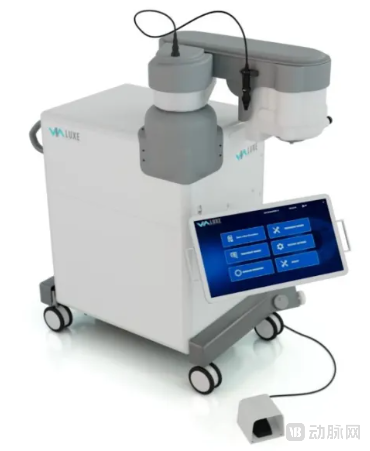
ViaLase® Laser System, sourced from the company's official website
The innovation of the ViaLase® laser system lies in its ability to create a precise, customized drainage channel through the trabecular meshwork at the iridocorneal angle, thereby increasing aqueous outflow without the need for invasive surgery.The patient is connected to the laser system through the proprietary ViaLens™ Patient Interface and stabilized by vacuum suction, which not only ensures stability during the procedure but also allows the surgeon to precisely control the patient’s eye, head, and body movements.
In addition, the proprietary gonioscopy function provides surgeons with real-time high-resolution video of the iridocorneal angle, allowing them to clearly examine the angle and accurately select the treatment location. The specially designed optical delivery system is capable of precisely delivering focused femtosecond laser pulses to the iridocorneal angle through the cornea while minimizing damage to adjacent tissues.
During the treatment process, the ViaLase® laser system creates a single channel measuring 500 microns wide and 200 microns high on the trabecular meshwork to treat an angle of just 5 degrees, enabling precise and effective treatment.After creating a drainage channel, OCT imaging technology allows users to visualize subsurface tissue structures relative to the channel position and record these critical imaging results, providing strong support for subsequent treatment evaluation.
At the same time, ViaLase also announced strategic distribution partnerships with Teleon and Global Surgical Service.
Teleon Surgical is a company focused on ophthalmic medical devices, with 30 years of industry experience and expertise, as well as advanced cataract and refractive intraocular lens (IOL) solutions. As one of the few independent IOL manufacturers globally, Teleon also has its own in-house R&D and recently completed state-of-the-art production facilities.
Global Surgical Service, a team of ophthalmology experts, is dedicated to providing high-quality and innovative ophthalmic medical solutions to customers. The addition of these two partners undoubtedly paves the way for the commercialization of ViaLase products in some European markets.
Foreign giants occupy the main market, and Chinese manufacturers have already entered the game.
QYResearch research shows that the global ophthalmic femtosecond laser market size was approximately 21 billion yuan (RMB) in 2022, and it is expected to reach 34 billion yuan by 2029, with a compound annual growth rate (CAGR) of 6.9% during the period from 2023 to 2029. The main global manufacturers of ophthalmic femtosecond lasers include Carl Zeiss Meditec, Alcon, Johnson & Johnson, Ziemer Ophthalmic, Bausch and Lomb, and Lensar. Among them, the top three global manufacturers account for about 73% of the global market share.
Specifically, according to the information disclosed by various companies and available data, Carl Zeiss's ophthalmic laser treatment device VisuMax is currently the only full femtosecond laser product on the market, with extremely high brand recognition and acceptance. It leads in both equipment sales and the number of surgeries performed. In the field of refractive surgery femtosecond devices, Carl Zeiss's VisuMax, Alcon's WaveLight FS200, and Ziemer's Da Vinci Z4 and Z6 occupy the top three market share positions. In the field of cataract surgery femtosecond devices, Johnson & Johnson's Catalys, Alcon's LenSx, and Ziemer's Da Vinci Z8 hold the top three market share positions.
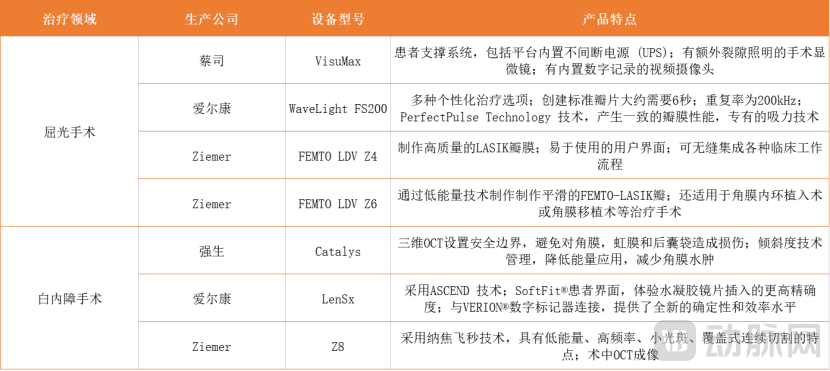
Representative products in the femtosecond laser field, data sourced from Frost & Sullivan.
The femtosecond laser market for ophthalmology is highly competitive, with multiple manufacturers offering similar products. Currently, many companies in China are also accelerating the research and development of fully femtosecond laser equipment.
Viko Photonics is a high-tech company specializing in the research, production, and sales of ultrafast lasers and specialty optical fibers. Its Surgery series includes: femtosecond ophthalmic surgery lasers, femtosecond cataract surgery lasers, and femtosecond dental surgery lasers. Xianwei Vision's "R&D Project of Full-Femtosecond Laser Corneal Refractive Surgery Device" has been selected for the 2022 National Key R&D Program. Dr. Sun Hui from the Wenzhou Institute of the Chinese Academy of Sciences is developing a femtosecond solid-state laser surgical device with independent intellectual property rights, which will soon undergo live monkey experiments. Meanwhile, domestic companies such as Shigu and Tupai are also conducting R&D on femtosecond laser-related products. In the future, whether in the field of myopia or cataracts, domestically produced femtosecond devices are expected to gradually occupy a certain market share and drive industry growth.