

Peking Union Medical College Hospital Licenses Ophthalmic Patent for Posterior Scleral Reinforcement Device to Vision-Bo Biological

Vesber
Ophthalmic Innovation Product Developer
Recently, Peking Union Medical College Hospital announced thatRMB 150,000 and sales commission of 5% for the first five years and 3% for the next five yearsThe proposed transaction price will"A Posterior Scleral Compression Device for Patients with High Myopia"The scientific and technological achievements were transferred toGuangzhou Vesber Biotechnology Co., Ltd.. The transaction has passed the public notice period.
The patent achievement was completed by Professor Dai Rongping, Deputy Chief of Ophthalmology at Peking Union Medical College Hospital. He currently focuses on clinical and fundamental work related to diabetic retinopathy, high myopia retinopathy, macular degeneration, and other fundus diseases.
The other party to the transaction, Guangzhou Vesber Biotechnology Co., Ltd., is an innovative enterprise focused on the research, production, and sales of ophthalmic products. Relying on the Zhongshan Ophthalmic Center, it vigorously promotes the successful transformation of scientific and technological achievements. It has core products such as the Foldable Capsule Balloon (FCB), Silicone Scleral Buckle (SSB), and High Myopia Scleral Reinforcement System (HM).
Currently, the prevalence of high myopia in China is increasing year by year and showing a trend of younger age. As the degree of myopia deepens, significant changes occur in the structure of the patient's eyeball. The axial length of the eye becomes longer, and the retina attached to the eyeball wall becomes increasingly thinner, which can easily lead to serious complications such as retinal detachment and macular degeneration, and even blindness.
Because the elongation and enlargement of the eyeball always extend backward, the posterior wall of the eyeball gradually becomes thinner, and a method has been clinically explored."Posterior Scleral Reinforcement", by implanting biological or non-biological materials, reinforces the posterior sclera of the eyeball, equivalent to adding a layer of "protective shield" for patients with high myopia, thereby strengthening the eyeball structure and preventing further elongation. It can also improve choroidal and retinal blood circulation to enhance visual function and reduce the risk of complications associated with high myopia.
Scleral Reinforcement Surgery Has a History of Several Decades Worldwide. A large number of studies both in China and abroad have shown that scleral reinforcement surgery, which adopts minimally invasive treatment, causes less damage to the eyes and has shown good efficacy in preventing and treating the progression of high myopia. Not only is it effective for high myopia, but scleral reinforcement surgery is also suitable for special pathological conditions such as pathological myopia and posterior scleral staphyloma.
The "Posterior Scleral Compression Device for High Myopia Patients" controls the further growth of the eye axis and reduces the risk of complications by physically compressing the posterior sclera to alter its mechanical state.The device includes key components such as a handheld mechanism, airbag mechanism, and compression mechanism, featuring simple operation, safety, and effectiveness.
When using this device, medical staff first place the airbag mechanism behind the patient's eyeball sclera through the handheld mechanism. By inflating and deflating, appropriate pressure is applied to the sclera behind the eyeball, prompting deformation of the sclera, thereby altering the mechanical state of the eyeball to achieve the purpose of controlling axial growth.
In this process, the pressing mechanism ensures the accuracy and stability of the pressure. The device also has a reset function, which can automatically or manually return to its original position after the pressure is completed, avoiding unnecessary damage to the patient. The device has been clinically applied in medical institutions such as Peking Union Medical College Hospital.
The Posterior Scleral Reinforcement System for Myopia is one of the core products of Guangzhou Vesber Biotechnology Co., Ltd., used to treat posterior scleral staphyloma and retinoschisis caused by high myopia.
In February 2024, Guangzhou Vesber Biotechnology Co., Ltd. and Shanghai Tongren Hospital launched a "Multi-Center Clinical Trial of Post-High Myopia Scleral Reinforcement System" to demonstrate the operability, safety, and effectiveness of the surgery through clinical research.
Aimeike also launched an NMPA clinical trial in 2023 for a "posterior scleral reinforcement biological patch" to evaluate the safety and efficacy of the product in treating progressive high myopia.
Due to its high growth and high technology attributes, the ophthalmology track has become a star track in recent years, with myopia prevention and control among children and adolescents receiving particular attention.
In the field of myopia prevention and control for children and adolescents, defocus soft contact lenses, orthokeratology lenses, and low-concentration atropine eye drops are the three main treatment methods. Among them, low-concentration atropine eye drops belong to the pharmaceutical field and will not be elaborated on in this article.
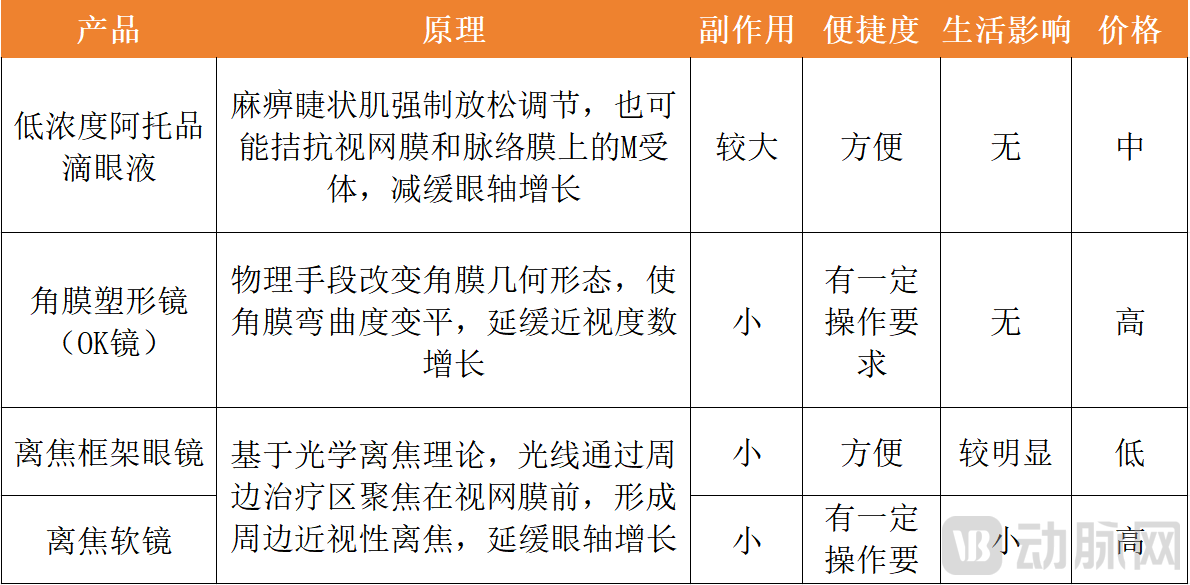
In the past, defocus eyeglasses were one of the most significant methods for myopia control. Defocus eyeglasses are convenient to wear, have a wide range of applications, effective control results, and are relatively affordable among myopia control products. However, they do pose some inconvenience for vigorous physical activities or other actions due to the frames.
OK Lenses, with their significant effect in myopia control and the convenience of only needing to be worn at night without affecting daily life during the day, have seen a rapid increase in penetration rate in the field of myopia prevention and control in recent years. However, strict examinations are required before fitting OK lenses, as not all patients are suitable; furthermore, OK lenses are made from rigid, highly oxygen-permeable materials and require an adaptation period for wearing, which some children may not be able to adjust to.
Defocus Soft Lenses Combine the Advantages of the Two Main Products While Avoiding Their Disadvantages. Defocus soft lenses are soft contact lenses worn during the day that do not alter the corneal shape. Through the "defocus ring" design of the lens itself, they change the peripheral optical imaging, thereby affecting the focal range of light in the peripheral part of the retina, creating a myopic defocus area to achieve the effect of slowing axial growth and controlling myopia progression.
Secondly, the material of defocus soft lenses is similar to that of ordinary contact lenses, mostly made of hydrogel or silicone hydrogel. They outperform OK lenses in terms of adaptation period and comfort, providing a new option for patients who cannot wear OK lenses and are unwilling to wear glasses.
Defocus soft lenses belong to Class III medical devices, and currently, multiple products have been approved for marketing in the Chinese market.
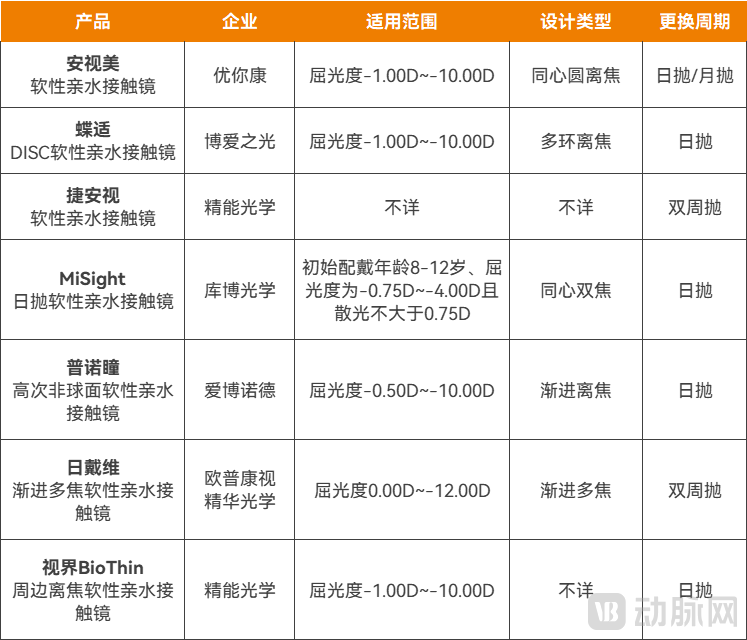
When choosing defocus soft lenses, it is necessary to comprehensively consider multiple dimensions such as myopia control effectiveness, safety, comfort and wearing convenience, scope of application and personalized needs, as well as price and cost-effectiveness. For example, from the perspective of safety, the material and oxygen permeability of defocus soft lenses are important factors affecting their safety. Silicone hydrogel material typically offers higher oxygen permeability, making it suitable for extended wear.
It should be noted that myopia is preventable, controllable, but irreversible. The principle behind various myopia control products is mostly to slow down the growth of the eye axis and control the deepening of myopia, which is unrelated to improving or enhancing vision itself. The most ideal approach to myopia prevention and control is early monitoring, early detection, and early intervention. Therefore, digital technology has begun to intervene in myopia prevention and control.
Hainan 12mm Collaborates with Hainan Province Eye Digital Therapy Clinical TrialsMyopia Risk Factor Monitor, combining 3D printing and sensor technology, monitors in real time the eye-use environment and behaviors of children and adolescents that contribute to myopia risk factors. It formulates personalized prevention and control plans and monitors their implementation.. Currently, the product has obtained classification definition and is undergoing innovative declaration and type inspection.
Guangzhou Vesber Biotechnology Co., Ltd.Using virtual reality technology to create training scenarios suitable for myopia prevention and control. Its VR holographic vision enhancement instrument is mainly used for the treatment of myopia and amblyopia and has obtained a Class II medical device registration certificate.According to different vision conditions, the built-in mechanical diopter adjustment system drives the electronic screen to move from far to near, while dynamic objects in the game also move accordingly from far to near. During the training process, the patient's eyes need to adjust the ciliary muscle and lens so that both eyes can follow the real changes in distance of the image (visual target) to complete the training, thereby exercising the ciliary muscle, improving its function, and enhancing the elasticity of the lens. Ultimately, this eliminates pseudomyopia, slows down myopia progression, and prevents the occurrence of myopia.
Shenzhen Huoyanjing Medical Technology Co., Ltd.Introducing Virtual Reality Technology in Myopia Prevention and Control: Beyond Replacing Outdoor Distance Viewing with Visual TrainingIt has also collaborated with Zhongshan Ophthalmic Center of Sun Yat-sen University to develop digital defocus technology based on ray tracing, targeting the choroid and ciliary muscle for treatment. By integrating defocus and accommodation theories, it has achieved significant results in clinical comparisons. In the phase one clinical trial, both axial length control and refractive control effects were outstanding.
Technological innovation has promoted the emergence of interdisciplinary technologies and new methods, bringing more and more innovative solutions to the field of myopia prevention and control, and demonstrating the great potential of digital technology in myopia prevention and control.
Myopia is a social issue of national concern in China, with a large market size that is expected to grow rapidly. From the characteristics of various products outlined earlier, current market offerings have certain limitations to varying degrees. The hope for the future market is the emergence of a myopia control product that is long-term stable, comfortable, and harmless, benefiting patients.