

Zhongshan Ophthalmic Center of Sun Yat-sen University Licenses Two Ophthalmic Patents for Over RMB 300,000

Zhongshan Ophthalmic Center
Ophthalmology Specialty Hospital

Moptim
High-end Ophthalmic Medical Device R&D, Production, and Sales
Recently, Zhongshan Ophthalmic Center, Sun Yat-sen University announced that it plans to "A Method, System, Device, and Medium for Calculating the Refractive Power of Intraocular Lenses"Invention patent, withRMB 250,000+ royalty on sales revenue after the contract product is launchedThe transaction price was transferred to Shenzhen.MoptimTechnology Co., Ltd.
The main inventor of this patent, Professor Luo Lixia, is the Chief Physician of Zhongshan Ophthalmic Center, Sun Yat-sen University, Director of the Cataract Department, and a doctoral supervisor. She was awarded the 11th "Outstanding Ophthalmologist in China" title. She has extensive clinical experience in complex cataract surgeries, including those for high myopia, post-excimer laser surgery, and post-vitrectomy, as well as in intraocular lens power calculations. She has led four General Projects of the National Natural Science Foundation of China and has published over 100 research papers in domestic and international medical journals.
The other party to the transaction, Moptim, is a leading domestic ophthalmic medical device company in China, focusing on three core ophthalmic subfields: ophthalmic diagnosis, ophthalmic surgery, and refraction testing. It is the third company globally and the first domestically in China to industrialize ophthalmic OCT technology. The company initiated IPO coaching in January 2024.
It is worth mentioning that, on the same day, the center also transferred a utility model patent right for "a type of intense pulsed light therapy eye patch" and a design patent to Guangzhou Huige Medical Technology Co., Ltd. at a transaction price of 62,800 yuan plus a royalty on sales revenue after the contract product's market launch.
Vitrectomy is currently the primary surgical method for treating fundus diseases. With the innovation of instruments and the advancement of surgical techniques, the number of vitrectomy procedures is increasing annually. Meanwhile, patients' surgical prognosis has greatly improved, and the demand for visual quality is also becoming higher.
However, cataracts remain the most common long-term complication after vitrectomy. Due to the alteration of the eye's anatomical structure caused by fundus diseases and surgery, patients who develop cataracts after vitrectomy experience greater variability in refractive status and are more prone to refractive prediction errors compared to ordinary cataract patients.
Accurate calculation of intraocular lens power is the key to achieving precise refractive surgery.Currently, there are many intraocular lens power calculation formulas being used internationally, such as the Kane and Emmetropia Verifying Optical formulas developed based on artificial intelligence, the Barrett Universal formula developed based on a thick lens optical model, and the Hagis, HofferQ, Holladay1, SRK/T formulas developed based on a thin lens optical model.
However, most of these have not disclosed specific details. Moreover, these calculation formulas have limitations such as large errors and being only applicable to ordinary cataract patients. Based on this, Zhongshan Ophthalmic Center, Sun Yat-sen University has invented this patent to achieve precise prediction of intraocular lens power for cataract patients after vitrectomy.
Compared with the existing technology, this patent performs excellently in the external validation set. This advantage is mainly related to the accurate prediction of the effective lens position.Unlike other intraocular lens power calculation formulas developed for ordinary cataract patients, the effective lens position prediction in this patent not only considers the unique correlation between the effective lens position of post-vitrectomy cataract patients and preoperative biometric parameters but also takes into account the medical history characteristics of post-vitrectomy cataract patients.
By screening out five regression models with relatively excellent performance and different principles, and integrating the predicted values of the five base models into a gradient boosting model, the prediction performance and stability for the effective lens position were further improved.By calculating the theoretical axial length and correcting the axial length according to the type of vitreous cavity fillers, this patent significantly reduces prediction errors in patients with long axial lengths in the internal dataset and demonstrates significant advantages in the long axial length subgroup of the external validation dataset.。
The artificial lens used for cataract treatment is one of the main biomaterials in the ophthalmology field, which can be divided into rigid intraocular lenses, foldable intraocular lenses, specially treated intraocular lenses, aspheric intraocular lenses, and yellow intraocular lenses, among others. With the increasing number of ophthalmic patients in China currently, along with people's growing attention to visual health, the demand for intraocular lenses in China continues to rise, leading to an expansion in market size.
The continuous iteration of intraocular lenses (IOLs) has been driven by advancements in material science, shifting the focus from "seeing" to "seeing clearly." The design of IOLs is also constantly evolving. IOLs have expanded from single-focus to multifocal and trifocal options, with extended depth-of-field intraocular lenses (EDoF) now available.
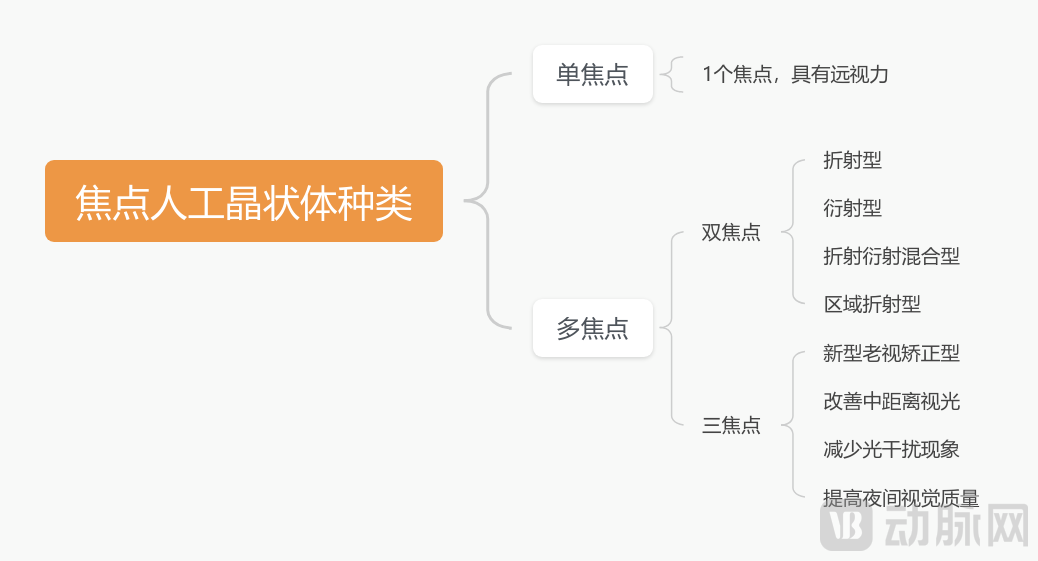
Bifocal intraocular lenses have two main focal points, which are used to improve distance and near vision respectively. However, they have limitations in intermediate vision. To address this shortcoming, trifocal intraocular lenses were developed, but they introduced new issues: the broader distribution of light may lead to optical phenomena and damage to contrast sensitivity.To achieve good visual quality at all distances while avoiding these adverse optical phenomena, practitioners have introduced Extended Depth of Focus (EDOF) technology. This technology provides an uninterrupted range of vision by extending the distance over which the eye remains in focus.
In terms of market structure, single-focus intraocular lenses have become the largest segment in China's intraocular lens market, accounting for 66.7% of the market share; followed by multifocal intraocular lenses, with a market share of 18.2%; and ranking third is the Toric intraocular lens (toric refractive IOL), with a market share of 9.3%.
From the perspective of market competition, foreign enterprises in China's intraocular lens market, such as Alcon, Zeiss, Bausch + Lomb, and Johnson & Johnson, occupy a significant market share. However, with the continuous development of domestic companies, their market share has notably increased, with Aibomed, Haohai Biotech, and GVS Medical also gaining a foothold in the industry.
Against the backdrop of an intensifying aging population trend, the volume of cataract surgeries continues to increase globally, and the demand for the intraocular lens market will further expand.According to the data from the "White Paper on the Current Status and Future Development of China's Ophthalmology Industry," in 2020, the cataract surgery rate (CSR) per million people in China exceeded 3,000 cases. According to a report released by the New Think Tank Industry Research Center, the global number of retinal surgeries reached approximately 1.765 million in 2023, and in 2024, there will be 2.2 million vitrectomies performed globally.
Aiborn Medical is the first high-end refractive intraocular lens manufacturer in China and one of the major manufacturers of foldable intraocular lenses in the country. In the first half of 2024, Aiborn Medical's intraocular lens business achieved 319 million yuan, representing a year-on-year increase of 30.2%. The intraocular lens business accounted for 46.49% of total revenue and was the core source of the company’s profits.
Previously, domestic companies mainly produced and sold mid-to-low-end products such as single-focus aspheric lenses, hard lenses, and spherical lenses, while the high-end market was monopolized by international manufacturers. However, based on the financial reports of various companies, it can be discovered thatChinese companies are actively deploying high-end artificial crystal products, successively launching functional artificial crystals such as toric, toric + multifocal types, achieving a full range of high, medium, and low market layouts. It is expected that the artificial crystal market in China will accelerate the increase in the localization rate.
For example, Aiborn Medical's products under research and development include phakic intraocular lenses, extended depth-of-focus (EDOF) intraocular lenses, and aspheric trifocal toric intraocular lenses, some of which have entered the product registration stage.
Haohai BioScience owns a full range of intraocular lens product lines, from popular foldable single-focus intraocular lenses to high-end foldable functional intraocular lenses. Among them, the sales volume of Haohai BioScience's high-end zonal refractive bifocal intraocular lens product SBL-3 increased by 69.37% compared to the previous year. The company’s 2024 semi-annual report revealed that its hydrophobic molded toric aspheric intraocular lens is also in the process of registration for market launch.
With the support of policies, the revenue of artificial crystal businesses of relevant companies in China is expected to maintain rapid growth.Since July 2019, almost all provinces and cities across China have implemented (or participated in implementing) volume-based procurement for intraocular lens products. An increasing number of domestically produced enterprises have successfully won bids. Meanwhile, the intraocular lens products of domestic companies such as Aibomed, GoLight Medical, and Haohai Bio-Tech have rapidly gained market share and earned recognition from clinicians due to their product performance, distribution channels, and cost advantages following the volume-based procurement.
In addition, the "14th Five-Year Plan" National Eye Health Plan (2021-2025) issued by the National Health Commission proposed that by 2025, China strives to achieve a cataract surgery rate of over 3,500 per million people, with the effective cataract surgery coverage continuously increasing. The rapid increase in cataract surgery penetration will drive high growth in the intraocular lens market.