

World's First Non-Viral, PD-1 Site-Specific Integrated CAR-T Therapy for Lupus Receives IND Approval in China

BRL Medicine
Cell and Gene Therapy Drug Developer
November 5, 2024, BRL Medicine Inc. (hereinafter referred to as "BRL Medicine"), which focuses on gene and cell therapy, announced,ItsBased on Non-Viral Site-Specific Integration with Independent Intellectual Property RightsCAR-T Platform Development Named"Targeted CD19 Non-viral PD1 Site-specific Integration CAR-T Cell Injection" (Pipeline Code: BRL-203) Clinical Trial Application (IND), officially approved by the Center for Drug Evaluation (CDE) of the China National Medical Products Administration.The IND targets the indication of "moderate or severe refractory systemic lupus erythematosus (SLE)." This is an innovative CAR-T product developed by BRL Medicine in the field of treating autoimmune diseases. It is also the world's first non-viral, site-specific integrated PD1-CAR-T product approved for IND for the treatment of autoimmune diseases, offering diversified options for the treatment of such conditions. Notably, BRL Medicine’s non-viral, site-specific integrated PD1-CAR-T therapy (pipeline code: BRL-201) has previously demonstrated excellent clinical safety and efficacy in treating relapsed or refractory B-cell non-Hodgkin lymphoma (r/r NHL), with related research findings published in top-tier international academic journals.Nature, and was rated as "Top Ten Research Advances in Hematology in China 2022" and "Important Medical Advances in China 2022".
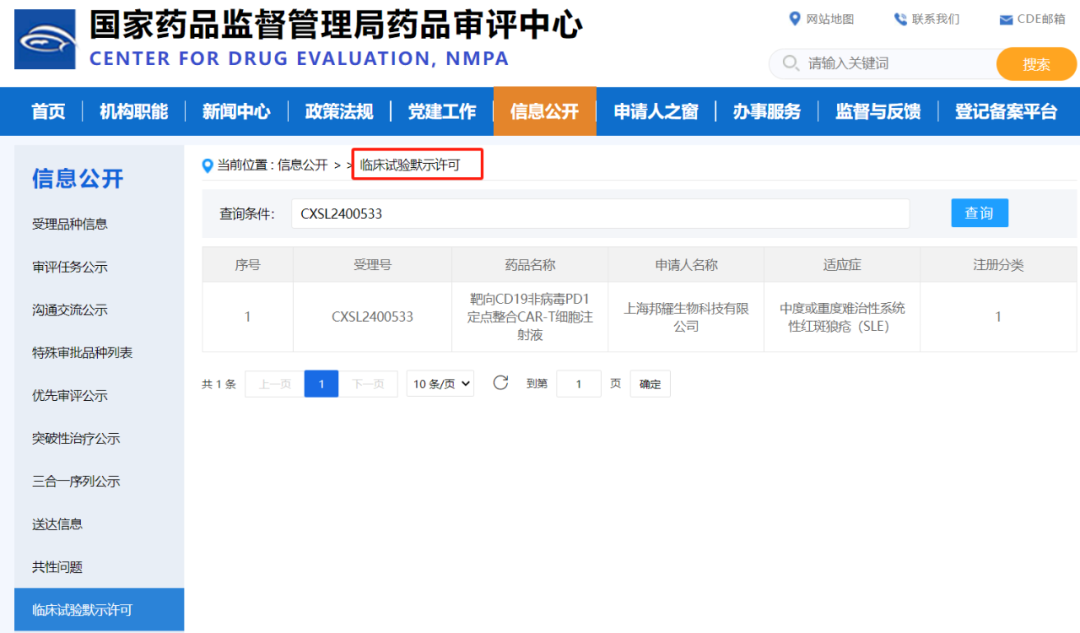
CDE Official Website Approval Screenshot
CAR-T Therapy Becomes a "New Option" for Treating Autoimmune Diseases
Systemic Lupus Erythematosus (SLE)Systemic Lupus Erythematosus (SLE) is a severe autoimmune disease. In recent years, although the long-term survival of SLE patients has improved, inevitable disease relapses and the resulting irreversible organ damage remain significant causes of mortality, with their death rate being 3-4 times higher than that of the general population. Recently, news about lupus patients has sparked social attention and discussion: a Shanghai-based young woman named "Shabai Bai," who suffered from SLE, decided to seek euthanasia in Switzerland to avoid the lifelong pain of dialysis, choosing to "leave the world with dignity." In December 2023, well-known Hong Kong actress Haimei Zhou also passed away due to lupus, bringing the "uncurable cancer" into the public eye. These consecutive incidents have triggered heated discussions, reflecting the current difficulties and helplessness faced by lupus patients. Therefore, there is an urgent need for new treatment methods to achieve sustained remission, control organ damage, improve long-term survival, and even achieve a complete cure.
Autoimmune diseases are a group of heterogeneous diseases with a common basis of impaired immune tolerance. Currently, immunosuppressants are commonly used in clinical practice to treat autoimmune diseases, but they present challenges such as long treatment cycles, high risk of recurrence, increased risks of infection and tumors, and some patients being unable to tolerate the treatment or experiencing poor efficacy. Targeted B-cell monoclonal antibodies offer new therapeutic options, but issues like post-treatment recurrence, infections, and suboptimal efficacy in some patients still persist. Given the crucial role of B cells in autoimmune diseases, teams both within and outside China have attempted to apply CAR-T therapy to autoimmune diseases. This approach has already demonstrated excellent clinical outcomes in treating diseases such as systemic lupus erythematosus, idiopathic inflammatory myopathy, systemic sclerosis, and myasthenia gravis.
BRL Medicine Non-Viral Targeted IntegrationPD1-CAR-T Therapy for Autoimmune Diseases: Safer, More Effective, and More Accessible!
However, whether for oncology or autoimmune disease indications, the marketed or investigational products still predominantly focus on autologous CAR-T therapies utilizing viral vectors. These inevitably present challenges such as potential tumorigenic risks, long manufacturing times with low accessibility, and high production costs. Notably, the FDA has increasingly required "black box warnings" for marketed viral vector-based CAR-T products. On April 18, 2024, the FDA officially announced that patients treated with marketed CAR-T products and clinical trial participants should be "lifelong" tracked for the potential development of secondary T-cell cancers. Additionally, on February 7, 2024, China’s National Medical Products Administration (NMPA) responded by stating that, considering the characteristics of Chimeric Antigen Receptor (CAR)-T cell immunotherapy products (referred to as "CAR-T products"), when approving the four CAR-T products in China, it was also required to include a warning in the "Precautions" section of the product insert. This warns of the possibility of secondary malignancies following treatment and advises patients to undergo lifelong monitoring for secondary malignancies. Therefore, it is evident that CAR-T treatments for autoimmune indications will likely face even stricter requirements.
By comparison,BRL Medicine’s CD19-targeted non-viral PD1-CAR-T product “BRL-203,” developed using its proprietary non-viral targeted integration CAR-T platform (Quikin CART), is able to address the existing pain points of viral CAR-T and demonstrates significant advantages:Safer, More Effective, More Accessible。
Product Advantages:
Fast preparation, low cost, and more accessible to patients
Ensure Product Uniformity, Clinically Safer
Non-viral targeted integration technology ensures that each CAR sequence is precisely inserted into a specific site of the genome, avoiding the oncogenic risks associated with random insertion and maximizing the safety and efficacy of CAR-T products. In the earlier clinical trial of BRL-201 for treating relapsed/refractory non-Hodgkin lymphoma using this innovative technology, no CAR-T-related neurotoxicity or cytokine release syndrome above grade 2 was observed in 21 treated patients, demonstrating the exceptional clinical safety of non-viral targeted integration PD1-CAR-T therapy.
Break the Shackles of Relapse and Refractory, More Effective Treatment
Moreover, the existing clinical research data of BRL-201 show that the objective response rate (ORR) reaches 100%, and the complete response rate (CR) is 85.7%. The long-term benefits for patients are significantly higher than those of existing similar virus-based CAR-T products. As of February 10, 2024, the median overall survival (mOS) has reached 39 months, and the median progression-free survival (mPFS) has reached 20 months, which represents the best clinical outcomes in terms of high remission rates and low toxic side effects achieved so far globally in CAR-T cell therapy for refractory and relapsed lymphoma. Single-cell sequencing results indicate a high proportion of memory T cells in the BRL-201 cell product with enhanced anti-tumor immune function, and the infused CAR-T cells demonstrate long-term persistence. This confirms that non-viral targeted integration PD1-CAR-T therapy exhibits excellent clinical efficacy and will also demonstrate long-term benefits in the treatment of autoimmune diseases, benefiting patients.

E.N.D

Statement:The content is sourced from the company's official channels. This article aims to share knowledge, and all content is for reference only and does not constitute any advice.