

Chinese Domestic Surgical Microscopes Break Into the High-End Market Long Dominated by Zeiss and Leica

Carl Zeiss
Manufacturer of Optical Systems, Industrial Measurement, and Medical Devices

TowardPi
High-end Ophthalmic Medical Device Developer

Leica Biosystems
Cancer Diagnosis Solutions Provider
The market for domestically produced surgical microscopes in China is witnessing numerous breakthroughs on the product front.
In September this year, the digital holographic intraoperative OCT navigation microscope developed by TowardPi was launched for sale; in the same month, the fluorescence microscopic surgical system all-in-one machine under Haihong Jiye obtained a medical registration certificate; in July, Yide Medical obtained the patent for the "4K Touch Screen Imaging System for Surgical Microscopes"…
At the same time, capital is also betting on Chinese-produced surgical microscope-related R&D and manufacturing enterprises., including this year, TowardPi and SiAiRan Medical have received financing. Behind them is a group of star institutions such as Matrix Partners, GaoTJia, Boxin Capital, Aibo Qing Shi, Aier Eye Valley, Hony Capital, Jialong Capital, and Apricot Capital.
As a medical device track that was once monopolized by international giants such as Carl Zeiss and Leica, the voice of domestic brands in the surgical microscope market has been growing louder: according to statistics from VCBeat,In 2023, the localization rate (percentage of units) of surgical microscopes sold in China reached 45.16%, approaching half.This indicates that the production of domestically-made surgical microscopes is rapidly increasing.
But behind the data is the fact that Chinese brands still need to make breakthroughs in the mid-to-high-end market.——If calculated by sales amount, among the top five brands, the imported brands Carl Zeiss and Leica occupy the first two positions, respectively.Carl Zeiss's sales revenue accounts for over 70%, holding an absolutely leading position.; Domestic brands Summi Medical, Yide Medical, and Ximo Medical ranked third, fourth, and fifth, respectively.
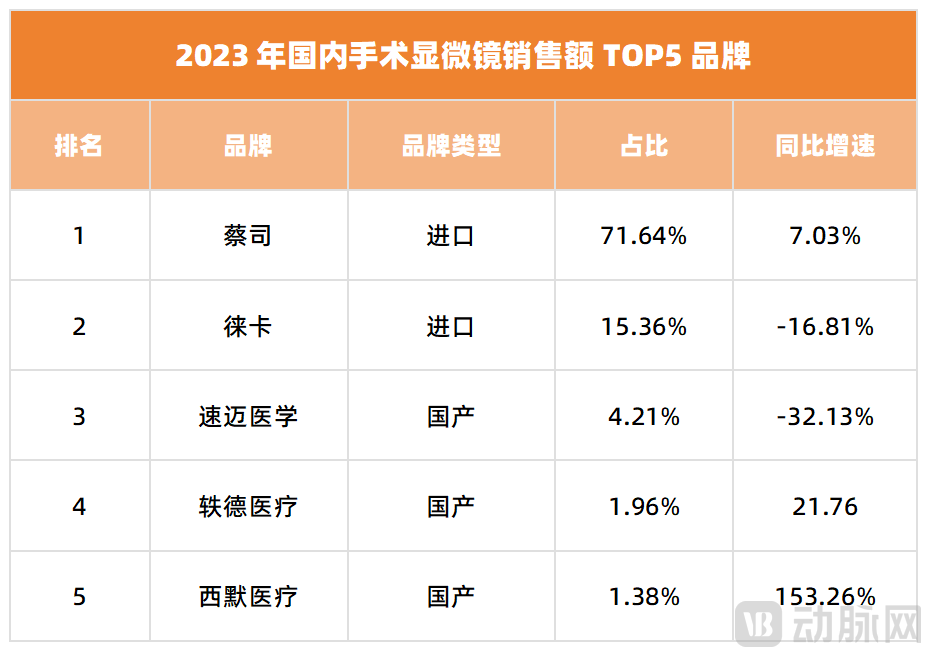
▲Data Source: Zhongcheng Data Technology VCBeat Chart
There is no doubt that domestically produced surgical microscope brands have achieved certain results, but in the high-end field, there are still many bottlenecks and difficulties. At present, how is the industry solving these problems? And what new variables are currently taking place?
Since Carl Zeiss introduced the world's first commercial surgical microscope, the OPMI 1, in 1953, clinicians have gradually transitioned from traditional naked-eye procedures to micro-level operations, significantly improving the efficacy of related surgical treatments and providing solutions for more complex and difficult medical conditions.
For instance, in the extremely complex surgery of repairing cerebral aneurysms, clinical doctors can accurately locate, suture, and clip the aneurysm with the help of a surgical microscope, thereby preventing the rupture and bleeding of the aneurysm in patients.
It is precisely because of the tremendous value brought to the clinical end that surgical microscopes are increasingly favored by more departments.So far, surgical microscopes have been widely used in neurosurgery, ophthalmic surgery, oral and maxillofacial surgery, vascular surgery, plastic surgery, and otolaryngology surgery.
At the same time, a wealth of application scenarios has supported a considerable market space for surgical microscopes. According to statistics from market research firm QYResearch, the global market size for surgical microscopes was approximately $2 billion (about 14 billion RMB) in 2022. By 2027, the overall market size will exceed $3 billion (about 21 billion RMB).
"Surgical microscopes vary in application across different departments, so the microscopes used in each department will differ in form and some functions," Ma Xu, a senior investment manager at a US dollar fund, told VCBeat. "Currently,Surgical microscopes can generally be divided into two types: ophthalmic and non-ophthalmic. Among the non-ophthalmic surgical microscopes, dental and neurosurgical microscopes are often discussed separately.”
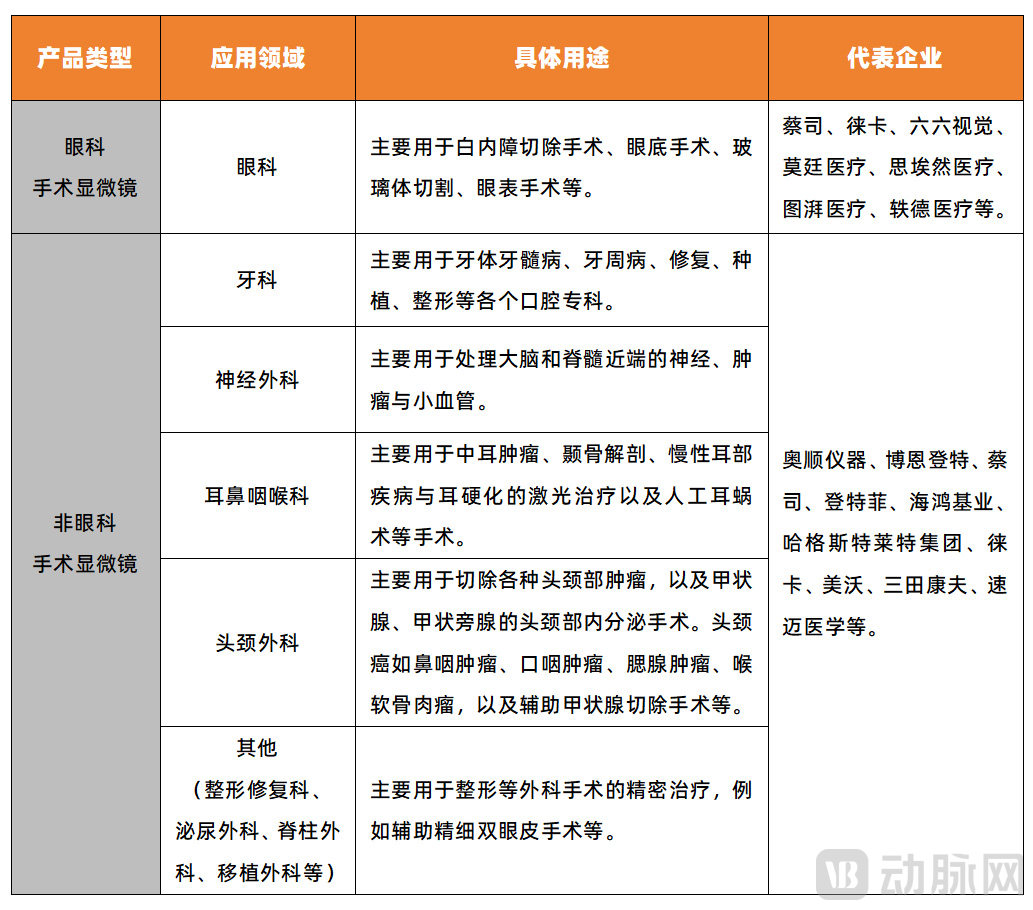
▲General Classification of Surgical Microscopes VCBeat Mapping
In other words, in the global market exceeding tens of billions, surgical microscopes have currently split into two mainstream camps based on the application dimension of the products.
One category is surgical microscopes specifically used for ophthalmology, with representative companies including Carl Zeiss, Leica Biosystems, 66 Vision, Morcher Medical, SierAn Medical, TowardPi, and Yide Medical (sorted by the initial letters of the company abbreviations). As an essential device in ophthalmology, ophthalmic surgical microscopes have seen rapid development over the past 30 years. Gradually evolving from equipment primarily used for magnified observation during surgeries, they have now become comprehensive surgical platform devices capable of providing clear imaging as well as recording functions.
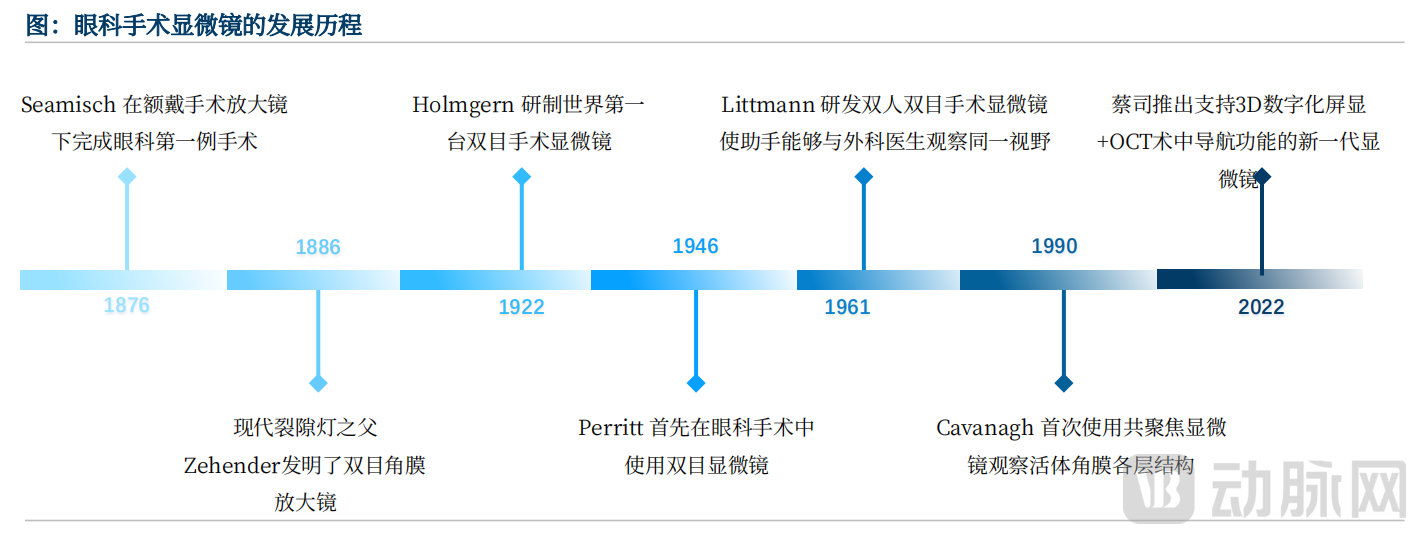
▲Image Source: "2024 Blue Paper on the Status Quo and Future Development Trends of the High-End Ophthalmic Medical Device Industry"
Another category is non-ophthalmic surgical microscopes, with representative companies including Aoshun Instruments, Bondent, Carl Zeiss, Dentaphi, Haihong Jiye, Haag-Streit Group, Leica, Mevo, Mikihisa Mitani, and Zoom Medical (sorted by the initial letters of company abbreviations). Most of the products under these companies can be used for a wide range of non-ophthalmic surgeries, while some products are specifically designed for single departments such as dentistry, neurosurgery, otolaryngology, and gynecology.
What is the respective market share of these two types of products in China? VCBeat searched the keyword "surgical microscope" through the National Medical Products Administration's database for domestic medical device (registration) and found that, as of October 22, 2024, the number of approved surgical microscopes (registered domestic medical devices) reached 74. Among them, 3 are supporting equipment for microscopes, meaning a total of 71 surgical microscopes have been approved.Among the 71 surgical microscopes, 15 are specifically designed for ophthalmology, accounting for 21%; 56 are focused on non-ophthalmic surgeries, making up 79%.

▲Source: National Medical Products Administration, Chart by VCBeat
"In the past, domestically produced microscopes were indeed relatively marginalized. Products from related brands were rarely installed or applied in mainstream hospitals, mostly used for teaching or animal experiments. Very few were used in human-related surgeries, which led to the market share of domestically produced microscopes (calculated by sales revenue) being basically within 5%," said Wang Yingqi, CEO of TowardPi.
This is backed by domestically produced surgical microscopes in optical structure design, mechanical structure design, electrical control, and digitalization.There is a relatively large gap in functions and other aspects, as well as in the structural design and assembly debugging of core components compared to imported products. At the same time, composite talents closely related to the industry are also very scarce.
Facing challenges, China's innovative enterprises have started to gain momentum in recent years and achieved breakthroughs in multiple aspects.
As mentioned earlier, although the localization rate (number of units) of surgical microscopes in China last year approached half, the overall sales revenue share was still relatively small, indicating that there is still a considerable gap in the high-end field for Chinese surgical microscopes.
Taking ophthalmic surgical microscopes as an example, the statistical data from the "2024 Blue Book on the Current Status and Future Development Trends of the High-End Ophthalmic Medical Device Industry" shows that, based on the average winning bid price (public hospital bidding and tendering), the average winning bid price for various models of Leica is 1.765 million yuan, while the average winning bid price for Carl Zeiss products is 1.534 million yuan. In contrast, the average winning bid prices for domestically produced brands are generally much lower, mostly ranging between 200,000 to 300,000 yuan, showing a significant difference.
"Surgical microscopes have the typical characteristics of the medical device industry, which is 'low-end with low barriers, high-end with high barriers'," said Ma Xu. He noted that over the past decade or so in China, there has been a gradual evolution from low-end surgical microscopes to mid-range and then to high-end.
According to feedback from multiple industry insiders, the threshold for ophthalmic surgical microscopes is high; among non-ophthalmic microscopes, the threshold for dental microscopes is relatively low, while the threshold for neurosurgical microscopes is the highest.
For this reason, domestic brands have rapidly made breakthroughs in the field of dental microscopes, with numerous companies entering the market. Among them, Zoom Medical has launched a range of dental surgical microscope products, including the OMS2000/2350/2380/3200 series, which have seen the fastest growth: According to data from the BiaoZhaoZhao platform, between 2020 and 2022 in China’s dental surgical microscope bidding market, Zoom Medical ranked first in both the amount and number of winning bids for its dental surgical microscopes. As mentioned in the company's prospectus, its self-owned brand "ZUMAX" has gained global influence.
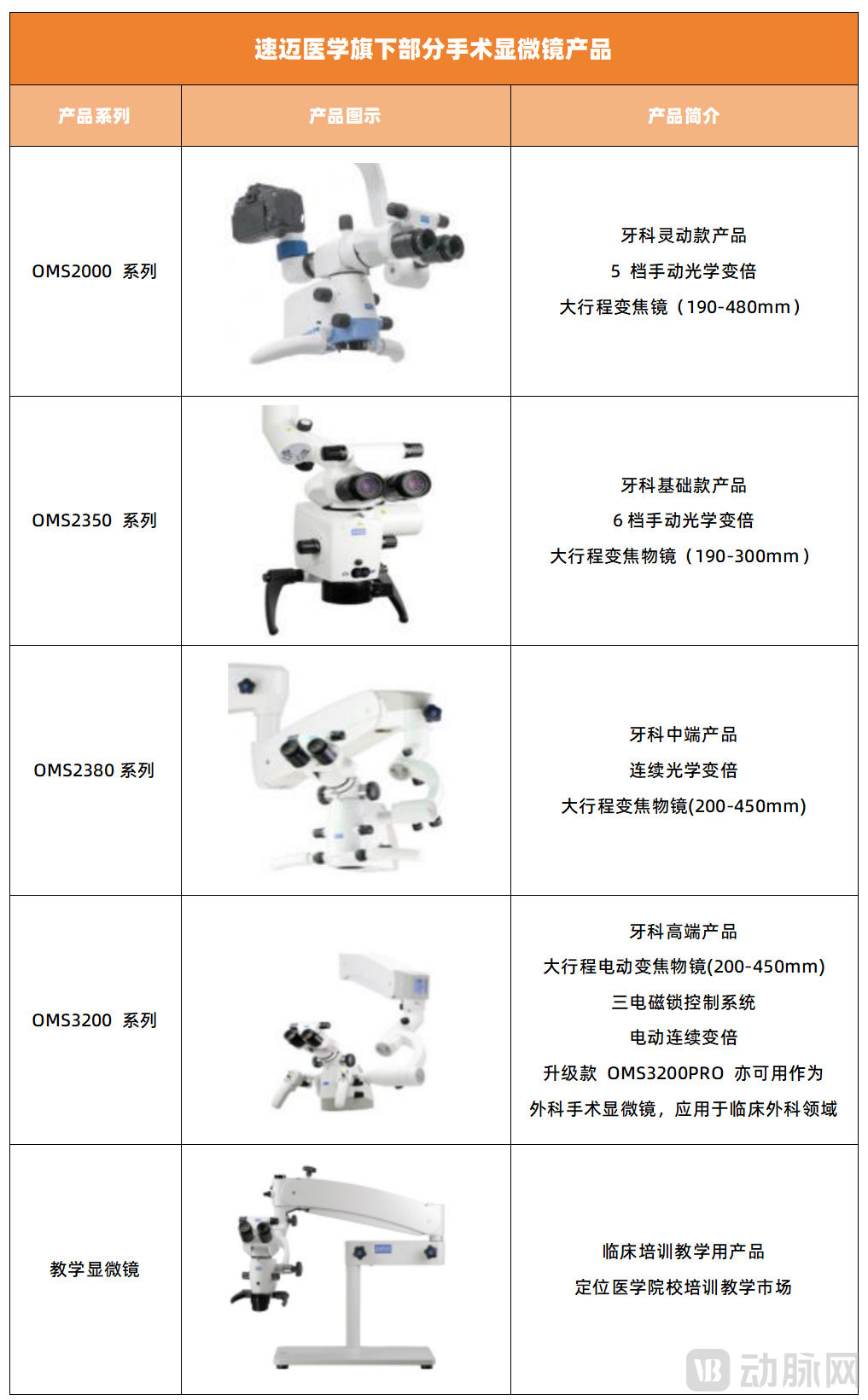
▲ Source: Prospectus VCBeat Mapping
As more companies flood into the dental surgical microscope market, industry competition continues to intensify, and the price level of dental surgical microscope products (especially mid-to-low-end products) and the industry's profitability face the risk of decline. In response, Suzhou Speed Medical mentioned in its prospectus that the company is actively expanding into surgical microscope products for applications such as otolaryngology and neurosurgery. It already has related products, such as the OMS3500 series of surgical microscopes.
It is important to note that the development of neurosurgical microscopes is extremely challenging, with only a very small number of laboratories or companies in China currently engaged in research and development. Some companies that previously entered this field have already "withdrawn in defeat." In this area, international brands represented by Carl Zeiss and Leica continue to dominate: recently, Carl Zeiss launched the new Kinevo 900 S robotic surgical microscope system for neurosurgery, which features 4K 3D digital imaging and intelligent collaboration functions to enhance the precision and efficiency of surgeries.
Why is it so difficult to make the leap from mid-to-low-end to high-end surgical microscopes? In response, TowardPi's CEO, Wang Yingqi, told VCBeat,To manufacture high-end surgical microscopes, companies need to invest substantial human and material resources, employing a forward-development approach to meticulously clarify the design, assembly, and adjustment of optics and mechanics step by step.
Taking TowardPi as an example, since 2021, the company has invested half of its R&D resources into the ophthalmic surgical microscope project, spending nearly four years to achieve satisfactory results in the mechanical and optical components of the microscope. "Optical and mechanical capabilities are fundamental and a prerequisite, but excelling only in optics and mechanics merely produces a 'passable product,' which is insufficient to compete in the high-end market," said Wang Yingqi. "The trend towards digitization and intelligence has already emerged, and leading international brands are already making significant advances in this area."
Specifically,Relevant companies are integrating intraoperative imaging modules and advanced imaging technologies, such as Optical Coherence Tomography (OCT), fluorescence imaging, and Augmented Reality (AR), into surgical microscopes. This adds more creative functionalities to the products and provides clinicians with more comprehensive multimodal imaging information and a safer, more comfortable operating experience.
For example, VCBeat learned that Carl Zeiss launched the high-end ophthalmic microscope model ARTEVO 800 in 2022. In addition to excellent optical and mechanical performance, this product is also equipped with intraoperative OCT navigation, a 3D digital display, and more. It allows doctors to observe OCT cross-sectional images during surgery without relying on an eyepiece, thereby providing a better surgical view and improving the quality of the surgery.
Wang Yingqi introduced that in the development of surgical microscope products, TowardPi Medical has leveraged the company's advantages in imaging speed, depth, and clarity based on swept-source OCT technology. By integrating OCT technology with microscope technology, the company has creatively achieved "4D-OCT intraoperative navigation," providing doctors with powerful imaging evidence and intelligent algorithm solutions for precise analysis of lesion structures during surgery. Additionally, the product features a fully digital design and supports 3D display at 4K resolution.
It is reported that the two series of surgical microscopes, "Boyun" and "Fuxue," from TowardPi Medical, have officially been on the market for sale since September this year and are being installed in major hospitals.
Apart from TowardPi, SiAiRan Medical, which announced the completion of a new round of financing amounting to hundreds of millions in September this year, is also accelerating the advancement of its self-developed high-end ophthalmic surgical instruments such as digital surgical microscopes.
It is not difficult to find that Chinese innovative brands have made significant inroads in the surgical microscope market, from achieving ultra-high domestic market share with non-ophthalmic surgical microscopes represented by dental surgical microscopes, to advancing ophthalmic surgical microscopes into a high-end era.
As domestically produced surgical microscope brands continue to advance from the R&D end to the market sales end, challenges such as supply chain and industrial ecosystem are beginning to emerge.
For exampleSurgical microscopes are characterized by multiple varieties, small batch sizes, and customization. Therefore, high-precision assembly and calibration processes are crucial for achieving final mass production and ensuring product quality.According to VCBeat, some domestically produced products previously had issues with excessively low delivery pass rates.
Currently, there have been some attempts at business models within the industry. Taking Zoom Medical as an example, the company adopts the approach of "independent design + customized procurement + component processing + whole machine assembly and debugging." This involves four core technology systems: medical microscopic optics, precision mechanics and automation, digital imaging, and surgical navigation for surgical microscopes. By utilizing a production model that focuses on the assembly and debugging of core components and whole machine production, alongside customized procurement of parts, the company continuously enhances the efficiency, accuracy, and stability of the assembly, testing, and debugging of core components.
Moreover, since the annual sales volume of surgical microscopes is relatively low, belonging to a "niche demand," it is necessary for companies entering the market to build up the industry ecosystem. By closely collaborating with downstream supply chain industries, they can jointly develop various components compatible with new equipment. This approach not only breaks through product performance bottlenecks but also drives the overall development of the domestic industrial chain.
"Centering around ophthalmic microscopes, we have developed over a dozen very core suppliers whose craftsmanship has significantly improved in recent years. I believe that as these suppliers grow in scale, they will not only serve TowardPi Medical in the future but also drive the entire upstream industry into a virtuous cycle of the industrial chain," said Wang Yingqi.
Of course, breakthroughs in research and development need to continue, as this is the foundation for domestic brands. Therefore, it remains to be seen whether innovative brands can achieve more breakthroughs in fields such as neurosurgery and ophthalmic microscopy, as well as the actual performance of their high-end products.
From this perspective, the rise of Chinese-produced surgical microscopes is just beginning.