Frontera Therapeutics Receives FDA Clearance for Phase II Clinical Trial of FT-003 in Neovascular Age-Related Macular Degeneration

Frontera Therapeutics
Innovative Gene Therapy Drug R&D and Producer

On November 11, 2024, Frontera Therapeutics announced that its self-developed recombinant adeno-associated virus (rAAV) gene therapy product (product code FT-003) for the treatment of neovascular age-related macular degeneration (nAMD) received Investigational New Drug (IND) approval from the U.S. Food and Drug Administration (FDA) for Phase II clinical trials. The approval of this IND once again marks the recognition by the FDA of the CMC, preclinical, and clinical research results conducted by Frontera Therapeutics in China, and also signifies an international breakthrough in the field of common chronic diseases for AAV products developed by Frontera Therapeutics.
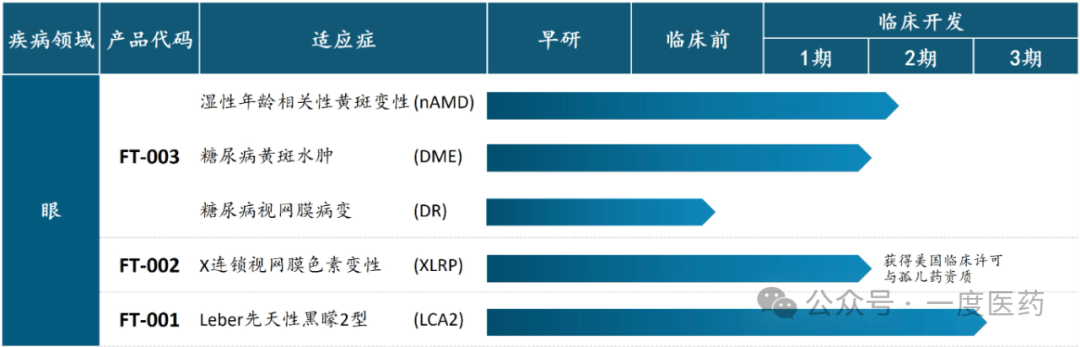
Source: Frontera Therapeutics Official Website
"At present, patients with nAMD need to regularly receive intravitreal injections of anti-VEGF agents every 2-3 months. In the real world, the majority of patients have poor compliance due to the inconvenience caused by frequent injections, which seriously affects the efficacy of anti-VEGF treatment, leading to long-term poor visual prognosis until blindness, along with a heavy treatment burden," introduced Dr. Xinyan Li, Co-founder and CEO of Frontera Therapeutics. "Gene therapy can deliver the target gene fragment into the retinal cells at the bottom of the patient's eye, turning the retinal cells into a biological factory that continuously expresses and secretes functional proteins, thereby achieving the purpose of treating the disease. The sustained expression of gene drugs, on one hand, has the potential to achieve long-lasting efficacy with a single administration, and on the other hand, can maintain a stable level of functional protein, avoiding the exacerbation of the disease pathology due to concentration fluctuations. AAV gene therapy is expected to become a first-line treatment for nAMD, providing patients with a more convenient and longer-lasting treatment option."
About Neovascular Age-Related Macular Degeneration
Age-Related Macular Degeneration (AMD) is an irreversible eye disease that causes severe vision loss and even blindness in middle-aged and elderly individuals. It is the third most common cause of blindness globally and the fourth leading cause of visual impairment. Neovascular AMD (nAMD) accounts for approximately 10% to 20% of AMD patients. Its clinical features include rapid onset of metamorphopsia and central vision loss over a period of weeks to months. The main pathological changes are characterized by choroidal neovascularization, vascular leakage, hemorrhage, edema, and eventually the formation of fibrous scars, which progressively damage central vision and lead to severe blindness.
With the increasingly prominent trend of aging population, the prevalence of nAMD will also rise year by year. It is estimated that the number of nAMD cases in China will increase from 4.5 million in 2024 to 5.5 million in 2030.
About FT-003
FT-003 Injection, as a novel recombinant adeno-associated virus gene therapy product, has a very clear mechanism of action: preclinical data show that after FT-003 is injected into the fundus, it can efficiently transfect multi-layer retinal cells, enabling them to express and secrete a humanized recombinant fusion protein homologous to the aflibercept sequence, inhibiting vascular endothelial cell division and proliferation, reducing vascular permeability, and producing comprehensive therapeutic effects. It is expected that a single injection will treat nAMD and DME patients with long-term efficacy.
In China, FT-003 Injection has obtained clinical approval for two indications: neovascular age-related macular degeneration (nAMD) and diabetic macular edema (DME). Both have completed Phase I clinical studies and entered the subject recruitment stage of Phase II clinical trials. The Phase I clinical study results of FT-003 for the two indications preliminarily confirmed the safety and efficacy of FT-003. After nAMD and DME patients received intravitreal injections of FT-003, both vision and retinal structure significantly improved, and the need for anti-VEGF treatment was reduced by more than 80%, greatly alleviating the treatment burden for nAMD and DME patients.
References:
Frontera Therapeutics