

Horizon Surgical Systems Files for IPO Following $30M Series A to Revolutionize Cataract Surgery with Polaris Robotic Platform
Horizon Surgical Systems
Developer of Advanced Microsurgical Robotics

ExSight Ventures
Ophthalmology Venture Capital Firms
In the field of surgical operations, the era of adopting robotic technology has arrived.
Since the da Vinci robotic surgical system by Intuitive was officially approved for use in laparoscopic surgery in 2000, robotic surgery technology has undergone significant development and has become highly influential in ophthalmic surgery.
In October 2024, Horizon Surgical Systems, Inc., a company focused on the development of automation and artificial intelligence robotic tools for ophthalmic surgery, successfully completed a $30 million (approximately RMB 210 million) Series A financing round.. This Series A financing was led by ExSight Ventures, with Main Street Advisors and UC Investments, a division of the University of California system, also participating.
The reason why Horizon Surgical Systems was able to secure such substantial financing lies in itsPolaris PlatformIt is reported that the platform has not only significantly improved the precision and efficiency of ophthalmic surgery, but also brought safer, more reliable, and predictable treatment outcomes for a large number of patients.
Spun off from UCLA, developing cataract surgery robots
In 2021, Horizon Surgical Systems was incubated by the University of California, Los Angeles (UCLA) with the goal of reducing natural hand tremors while integrating artificial intelligence and computer vision to assist surgeons in decision-making. It also helps automate and standardize repetitive steps required in surgeries, including incisions, fragmentation, and removal of cataracts, as well as injection and alignment of intraocular lenses.
In the field of cataract treatment, Dr. Jean-Pierre Hubschman, founder of Horizon Surgical Systems and associate professor of ophthalmology at the Stein Eye Institute of UCLA's David Geffen School of Medicine, publicly stated that currently, there are 28 million cataract surgeries performed globally, with over 4.5 million in the United States. The market size has reached 8 billion US dollars. As the aging population continues to grow (with a growth rate of about 4%-5%), it is expected that by 2027, the market size will reach 10 billion US dollars. However, the number of doctors and nurses still cannot meet such a huge surgical demand.
At the same time, traditional ophthalmic surgery faces many challenges, including limited feedback mechanisms, insufficient spatial resolution, lack of depth perception, absence of tactile feedback, and low integration of optical coherence tomography (OCT). In addition, hand tremors that are difficult to avoid during human surgery also pose significant challenges to delicate tissue manipulation.
In response to these challenges,Dr. Jean-Pierre Hubschman envisions an innovative semi-autonomous surgical system starting from robotics.In this system, the surgeon will be located in the surgical cockpit, receiving rich visual and tactile sensory feedback through the robotic controller. This robotic-assisted technology can not only filter hand tremors and scale movements to improve the precision and accuracy of the surgery but also enhance the surgeon’s operational capabilities through collaborative functions. At the same time, it provides enhanced depth perception, augmented reality visualization, and haptic feedback from virtual fixtures, offering surgeons a more comprehensive and meticulous surgical experience.
As early as 2018, Dr. Hubschman had already been involved in the development of intraocular robotic interventional surgical systems, aiming to improve the precision and efficiency of surgeries while providing patients with safer and more predictable treatment outcomes.
It is reported that the system adopts a communication remote control operation design and integrates Optical Coherence Tomography (OCT) technology. Compared with other systems that only rely on surgical microscopes for visual feedback, this system can collect and process data in real time and provide enhanced visual and tactile feedback to surgeons through a surgical controller. More advanced is that it can also perform semi-automatic tasks guided by OCT, ensuring safe and precise surgical trajectories within the workspace.
Below-micron sensing precision, enabling micro-precision and tremor-free surgery
In terms of technical approach, Polaris integrates the latest robotics technology, advanced medical imaging technology, and artificial intelligence technology.
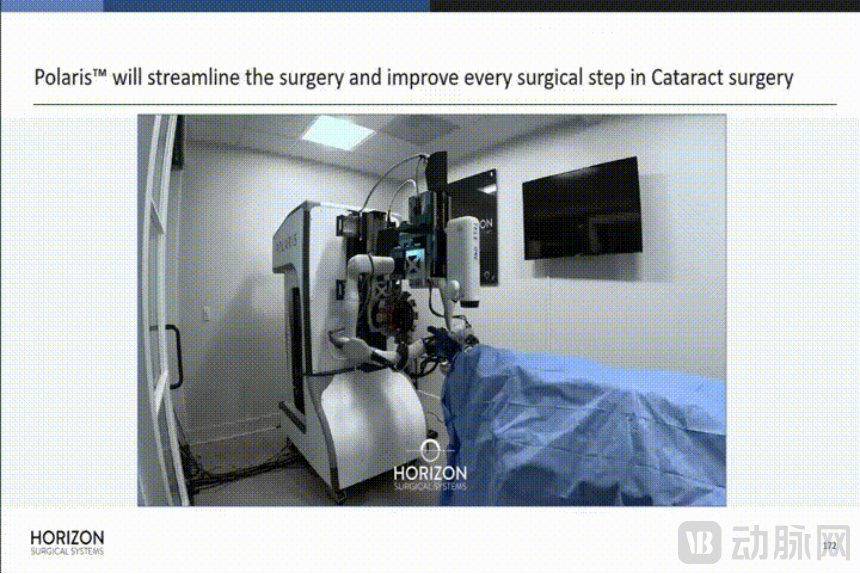
Specifically, in terms of robotic technology, Polaris adopts a high-precision and highly flexible robotic arm design, capable of achieving precise operation and positioning during surgery; in terms of medical imaging technology, Polaris is equipped with advanced digital microscopes and image processing systems, able to capture real-time images of the surgical area and provide high-resolution, high-definition visual feedback.
The introduction of artificial intelligence technology has further enhanced Polaris with intelligent decision-support capabilities. Through deep learning algorithms, Polaris can analyze surgical data, predict surgical risks, and provide doctors with scientific surgical recommendations. At the same time, artificial intelligence technology can also enable automated and intelligent control of the surgical process, further improving the efficiency and success rate of surgeries.
Notably, the tool exchange feature of Polaris ophthalmic surgical robot's digital microscope and robotic arm represents a key technological advancement, allowing the robot to automatically switch between different tools during surgery to perform various tasks.
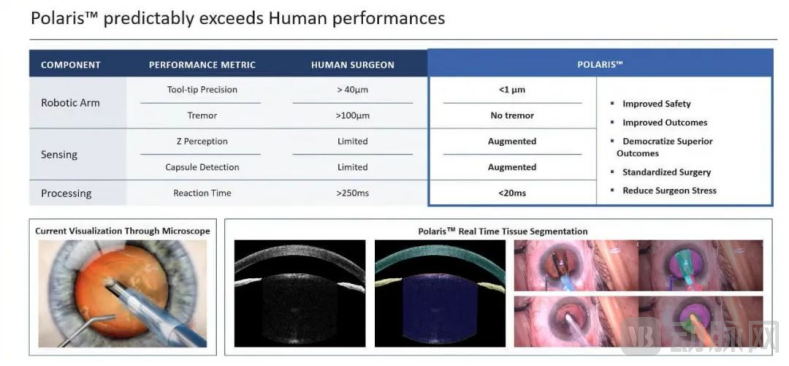
According to officially disclosed experimental data, the Polaris surgical robot system enhances the stability and safety of surgeries with a tool tip accuracy of less than one micron and tremor-free robotic arms. Meanwhile, PolarisTM technology improves surgical outcomes through enhanced perception capabilities and standardized surgical procedures, making capsule detection more accurate and reliable. Additionally, it features a rapid response time of less than 20 milliseconds, high-precision visual effects under a microscope, and real-time tissue sectioning capabilities.
Multiple Competitors, with Products Already in Clinical Trial Stage
Overall, due to the unique nature of ophthalmic surgical procedures, the development of robotics in the ophthalmology field has been relatively slow. However, internationally, some robotic systems assisting in ophthalmic surgeries have begun to emerge. For example, the da Vinci Surgical Robot is capable of performing ocular surface surgeries such as corneal laceration suturing, full-thickness corneal transplantation, and pterygium excision. The Dutch company Preceyes BV's ophthalmic surgical robot has been successfully applied in vitreoretinal surgery. Additionally, the Israeli company ForSight has developed the Oryom microsurgical robotic platform, which features a 14-degrees-of-freedom movement structure, allowing it to reach any corner of the human eye.
In China, although the development started relatively late, the field of ophthalmic surgical robotics is also showing a vigorous growth trend.
Currently, the R&D teams in universities are mainly concentrated at Beihang University and Sun Yat-sen University. Among them,Professor Lin Haotian's team from the Zhongshan Ophthalmic Center of Sun Yat-sen University has developed a "5G Remote Micron-Level Ophthalmic Surgery Robot" through multidisciplinary integration and collaborative software-hardware development.The surgical robot features a unique serial-parallel hybrid mechanical arm structure, enabling remote center of motion (RCM) control and end-effector repositioning with micron-level precision. Additionally, it can simulate and replace human hand operations, filter out hand tremors and shaking, and achieve high-precision surgical procedures across spatial and temporal limitations through 5G remote communication technology.
AndProfessor Yang Yang from Beihang University founded Xianwei Medical.Its self-developed ophthalmic surgical robot and intelligent ophthalmic device projects integrate advanced robotic mechanisms, precision drive technology, artificial intelligence algorithms, and advanced control technology, achieving full independent research and development from structure to algorithm. The initial research and development focuses primarily on subretinal and retinal vascular puncture injection, with type inspection expected to be completed by 2024, providing new solutions for related indications in ophthalmic microsurgery.
At the same time, innovative companies such as DS Medical and Antai Microelectronics are also driving the innovation and development of ophthalmic surgical technology.
In 2024,Disi Medical's self-developed "Disi Microblade" ophthalmic surgical robot has officially entered the multi-center registration clinical trial stage, becoming the first ophthalmic surgical robot product in China to reach this stage.Previously, "Di Shi Wei Feng" successfully performed the first robotic-assisted ophthalmic surgery in Asia and demonstrated excellent results in early animal clinical data: compared to the 85.5% success rate of manual operations by clinicians, the subretinal injection success rate with the assistance of "Di Shi Wei Feng" ophthalmic surgical robot reached 100%.
Antmicro's self-developed ophthalmic surgical robot also successfully completed product type inspection in 2024 and has successfully entered the clinical trial stage.As the world's first robotic platform builder focusing on small-scale precision surgery, Antai Microjing has successfully achieved full non-tremor operation of the surgical robot system, overcoming the core challenges in product development. Its end-effector wrist-like structure instruments have a diameter of less than 3mm and feature multiple degrees of freedom, enabling precise anastomosis of blood vessels, lymphatics, and nerves as small as 0.3mm.
With the continuous advancement of technology and the deepening expansion of applications, the field of ophthalmic surgical robots will embrace broader development prospects. In the future, we look forward to the emergence of more innovative ophthalmic surgical robot products, providing safer, more efficient, and more precise surgical treatment options for ophthalmic patients.