

Intense Competition in China's $10B+ Bevacizumab Market: Hualan Gene’s Anbeiyou Approved as Domestic Biosimilar Price War Heats Up

Hualan Genetic
Monoclonal Antibody Drug Research, Development, and Production
Biosimilars as an important category in the monoclonal antibody market track, againstThe hot field of VEGF drugs has already attracted numerous large pharmaceutical enterprises to gather here.
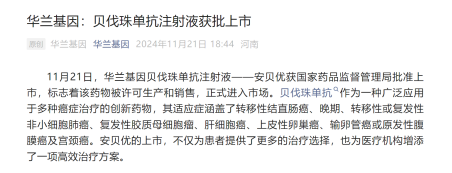
Recently, Hualan Genetic officially announced that its developed Bevacizumab Injection (trade name: Anbeiyou) has been formally approved. The indications cover metastatic colorectal cancer, advanced, metastatic or recurrent non-small cell lung cancer, recurrent glioblastoma, hepatocellular carcinoma, epithelial ovarian cancer, fallopian tube cancer or primary peritoneal cancer, and cervical cancer.
Notably, thanks to the outstanding achievements of Roche's original biologic drugs in the field of cancer treatment, biosimilars of bevacizumab have gradually become a classic blockbuster in the market. Prior to this, several pharmaceutical companies in China have been approved for their bevacizumab biosimilars, including some domestic giants, making the market competition extremely intense.
Industry analysts believe that, in terms of the general environment, the market for bevacizumab biosimilars has enormous potential. As the domestic patent for the originator drug is about to expire, many pharmaceutical companies in China, such as Hengrui, Innovent, Luye, Zhengdatianqing, and Fosun Henlius, have increased their efforts in this niche market. They aim to further expand the advantage of bevacizumab in the Chinese market within the field of biosimilars, reflecting the intense competitive landscape in this specific sector.
Super Heavyweight with Strong Attraction
How Much Potential Does the Giant's Entry Hold?
Bevacizumab, as a globally significant product, has attracted the attention of many enterprises both in China and abroad due to the enormous profits it generates, prompting them to commence the research and production of biosimilars.
Bevacizumab, the original biologic drug (Avastin, trade name Avastin), is a humanized monoclonal antibody IgG1 developed by Roche in Switzerland. It exerts its anti-tumor effects by specifically targeting VEGF and has demonstrated definitive efficacy in various malignant tumors. It was the first drug in the world to be approved for marketing for anti-tumor angiogenesis and is one of the representative targeted drugs.
VEGF, or Vascular Endothelial Growth Factor, also known as Vascular Permeability Factor (VPF), is a highly specific pro-vascular endothelial cell growth factor. It induces angiogenesis in the body and promotes vascular leakage, increasing vascular permeability. VEGF is secreted by various cells, including tumor cells, macrophages, and smooth muscle cells. Under pathological conditions, the overexpression of VEGF may promote pathological angiogenesis and leakage, leading to disease progression.
Avastin was approved for marketing by the U.S. FDA in 2004 and received approval in China in February 2010 for the treatment of advanced metastatic colorectal cancer. It has now been approved for various indications, including metastatic colorectal cancer, advanced/metastatic or recurrent non-squamous non-small cell lung cancer, recurrent glioblastoma, hepatocellular carcinoma, renal cell carcinoma, cervical cancer, ovarian cancer, fallopian tube cancer, peritoneal cancer, breast cancer, etc. The current manufacturer in China is Shanghai Roche Pharmaceuticals (Switzerland) Co., Ltd.
As one of Roche's top three heavyweights in oncology, the performance and revenue of Bevacizumab have always been highly watched by the industry. As early as 2019, the global sales of Bevacizumab had already exceeded $85.9 billion. However, the "patent cliff" has also become a challenge that Bevacizumab has to face. From $6.8 billion in 2017 to $6.9 billion in 2021, the compound annual growth rate (CAGR) was only 0.2%; in 2022, the global market size of Bevacizumab grew to $7.3 billion; according to data from Menet, in 2023, the overall sales of Bevacizumab injection in China were approximately 10.7 billion yuan.
The European patent protection for Bevacizumab expired in 2018, the US patent protection expired in 2019, and the patent protection for Bevacizumab in China also expired in 2018. Due to factors such as patent expiration and generic competition, numerous companies have entered the market with biosimilars, gradually eroding Roche's market share. The revenue of the original Bevacizumab drug has been on a continuous decline.
Facing this billion-dollar market, the competition is bound to be fierce, and the domestic market space in China is also growing rapidly. Domestic players are using all their expertise to seize a share. Hualan Genetic Engineering Co., Ltd. was established in June 2013, with a registered capital of 200 million yuan, and is a subsidiary partially owned by Hualan Biological Engineering Inc. The company mainly engages in the production and research of monoclonal antibody drugs, recombinant human coagulation factor drugs, and hormone-based medicines. Its pipeline is extensive, covering disease areas such as cancer, autoimmune diseases, diabetes, ophthalmology, and reproductive health. As a partially owned subsidiary of Hualan Biological Engineering Inc., Hualan Genetic provides strong support and complements Hualan Biological’s efforts in the genetic engineering pharmaceuticals field; at the same time, Hualan Biological's brand influence and overall strength offer robust backing for Hualan Genetic’s development.
After more than a decade of efforts, Hualan Genetic's Bevacizumab Injection has been approved for marketing, marking an important breakthrough in the company’s listed products. Currently, Hualan Genetic has obtained clinical trial approvals for 10 products, among which Adalimumab, Trastuzumab, Rituximab, and Denosumab are in Phase III clinical trials; Ipilimumab and Panitumumab are in Phase I clinical trials; Recombinant Anti-Claudin18.2 Fully Human Monoclonal Antibody Injection, Recombinant Anti-PDL1 and TGFβ Bifunctional Fusion Protein Injection, and Recombinant Anti-BCMA and CD3 Fully Human Bispecific Antibody Injection are preparing to enter Phase I clinical trials.
China's Subdivided Track Giants Gather
A Battle for Inclusion in Centralized Procurement?
With the successive launches of biosimilars produced in China, this has also triggered a dramatic change in the bevacizumab market.Currently,BevacizumabThe market competition has entered a fever pitch, and domestic pharmaceutical companies are actively making a name for themselves.Numerous companies in China have already developed and laid out plans for biosimilar Bevacizumab.Including Qilu Pharmaceutical's"Anke Da," "Da You Tong" by Innovent Biologics, "Bo You Nuo" by Luye Pharma, and "Ai Rui Tuo" by Hengrui Medicine, etc.,Hope to stand out in the fierce competition。
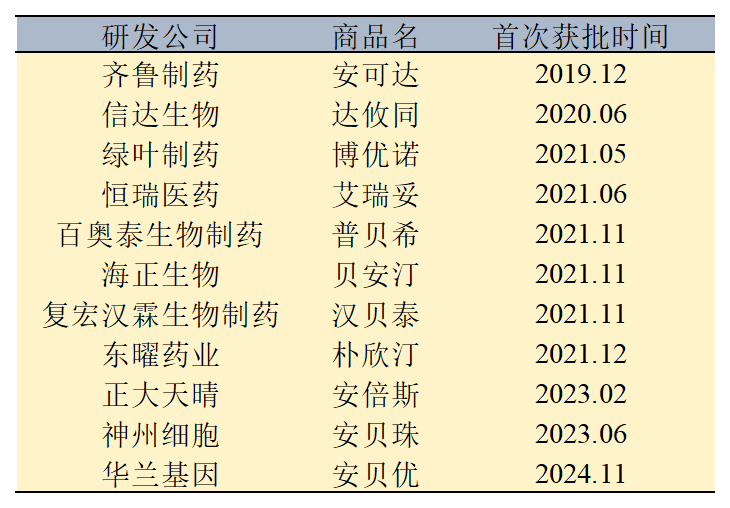
The细分赛道 of biosimilar Bevacizumab witnesses the gathering of pharmaceutical giants. In response to the "patent cliff" challenge faced by Roche, domestic biopharmaceutical companies in China have long been ready to seize the opportunity. As of now, including Hualan Genetic, 12 Bevacizumab products have been approved for marketing in China, forming a market structure of 1 original research (Roche) + 11 domestically produced. Among them, Qilu Pharmaceutical, Innovent Biologics, and Luye Pharma lead in terms of market share in Chinese medical institutions.
As Roche's Bevacizumab patent protection in China expired in 2018, in the same August, Qilu Pharmaceutical's application for recombinant anti-VEGF humanized monoclonal antibody injection was accepted by the CDE and received NMPA approval in December 2019 for the treatment of advanced, metastatic, or recurrent non-small cell lung cancer and metastatic colorectal cancer patients. This also signifies that Qilu Pharmaceutical not only secured the first Chinese-produced Bevacizumab biosimilar but also took the lead in gaining a first-mover market advantage.
· As the market sales increase, more and more companies in China are competing for a share of this market. Innovent Biologics' Bevacizumab Injection followed closely and was officially approved for marketing in June 2020, indicated for advanced non-small cell lung cancer and metastatic colorectal cancer.
Innovent Biologics' self-developed DaYouTong took eight years to establish a scientifically rigorous target through extensive research. In December 2020, DaYouTong's new indication was approved in China for the treatment of adult recurrent glioblastoma (GBM), marking its third approved indication. In March 2022, DaYouTong received approval from the National Medical Products Administration (NMPA) for two additional indications: in combination with carboplatin and paclitaxel for first-line treatment of patients with stage III or IV epithelial ovarian cancer, fallopian tube cancer, or primary peritoneal cancer after initial surgery; and in combination with paclitaxel and cisplatin or paclitaxel and topotecan for the treatment of patients with persistent, recurrent, or metastatic cervical cancer.
Hengrui Medicine is also a strong competitor in the Bevacizumab market. In June 2021, Hengrui Medicine's Bevacizumab Injection (Airetuo) was approved for marketing in China, with indications for metastatic colorectal cancer and advanced, metastatic, or recurrent non-small cell lung cancer. In September of the same year, Hengrui Medicine announced that its subsidiary, Shengdiya Bio, had received the "Drug Supplemental Application Approval Notice" issued by the National Medical Products Administration for Bevacizumab Injection. On the basis of the already approved indications, the indication for recurrent glioblastoma was added.
Boyouno (Bevacizumab Injection), developed and produced by Boan Biotech, a subsidiary of Luye Pharma Group, received marketing approval in May 2021 for the treatment of advanced, metastatic, or recurrent non-small cell lung cancer and metastatic colorectal cancer. After head-to-head comparison, Boyouno met equivalence standards in two key clinical studies compared with the original drug Avastin, as well as in pharmacokinetic (PK) comparison studies in healthy volunteers and in efficacy, safety, and immunogenicity comparison studies in patients with metastatic or recurrent non-squamous non-small cell lung cancer.
Since Qilu Pharmaceutical fired the first shot for Bevacizumab biosimilars in 2018, the research and development of domestically produced Bevacizumab biosimilars also witnessed a boom in 2021, with six products approved for marketing, including those from Boan Biotech, Shengdiya Biotech (a wholly-owned subsidiary of Hengrui Medicine), Bio-Thera Solutions, Betta Pharmaceuticals, Toga Biotech, and Henlius. The market landscape suddenly turned into "A Game of Thrones," with increasingly fierce competition in this niche track. Now, the contest in the Bevacizumab market has entered the second half. Tianqing’s Abece and Sino Biological’s Anbeizhu were respectively approved for marketing in February and June 2023. Coupled with the arrival of “new star on the field” Hualan Genetic's “Anbeiyou,” it means that China-produced Bevacizumab biosimilars have expanded to 11 varieties, breaking the situation where original drugs monopolized the market, forming a “11+1” market pattern.
Because the number of approved companies continues to increase, clinical options are becoming increasingly diverse, and the call for including biosimilars in bulk procurement is growing louder. Notably, the National Healthcare Security Administration has repeatedly announced its intention to "include biosimilars in centralized bulk procurement." As competition in the biopharmaceuticals market heats up, the inclusion of biologics in bulk procurement is also becoming an inevitable trend.
According to incomplete statistics, there are 7 varieties of biologics and biosimilars approved by ≥3 companies in China, including Bevacizumab Injection, Trastuzumab for Injection, Rituximab Injection, Adalimumab Injection, Infliximab for Injection, Denosumab Injection, and Tocilizumab Injection. Data shows that the sales scale of Bevacizumab Injection in China's public medical institutions exceeded 7.7 billion yuan in 2022. "Large market volume and saturated competition make these varieties obvious top choices for inclusion in a new round of national procurement."
Prior to this, the inclusion of Bevacizumab in the tenth round of China's national procurement seemed somewhat anticipated within the industry. However, in the recently published information on the tenth round of national procurement, this product is not listed. Market observers believe that although it has avoided this procurement round, as volume-based procurement deepens and becomes more firmly established, there will not be many companies truly capable of supplying a "basket" of biosimilars at low cost over the long term—major players are already taking shape. In the future, having a wide variety of products, large production capacity, and low costs will become the winning formula in China’s biosimilar market.


www.yyjjb.com.cn
Insight into Industry Trends

"Pharmaceutical Economy Newspaper"
Academic Official Account
Focus on the Frontier of Oncology Academia

Terminal Official Account