Iaso Bio Presents at ASH 2024: Equecabtagene Autoleucel Demonstrates Significant Impact of CAR T-Cell Persistence on Clinical Outcomes in Relapsed/Refractory Multiple Myeloma

IASO Biotechnology
Cancer Treatment New Drug Developer


On December 10, 2024, IASO Bio presented a poster at the 66th American Society of Hematology (ASH) Annual Meeting in 2024, showcasing the impact of CAR-T cell persistence of its fully human BCMA-targeted CAR-T product, Equecabtagene Autoleucel Injection, on clinical outcomes in patients with relapsed/refractory multiple myeloma. The research findings confirmed thatThe effector-to-target ratio has a significant impact on the control of multiple myeloma, and further reveals that CAR-T therapy for multiple myeloma requires the selection of CAR-T drugs with long persistence of CAR-T cells, and their persistence is not affected by the baseline level of soluble B-cell maturation antigen (sBCMA).。
Report Title:Impact of CAR T-Cell Persistence on Clinical Outcomes in Relapsed/Refractory Multiple Myeloma: Insights from the Phase 2 FUMANMA-1 Study
Report No.:4761
Display Time:December 9, 2024, Monday, 6:00 PM - 8:00 PM (PST) / December 10, 2024, Tuesday, 10:00 AM - 12:00 PM (CST)
Research Conclusion
The efficacy-to-target ratio is a key determinant of clinical outcomes for patients treated with Icaritin injection, underscoring the importance of CAR-T cell persistence.
Effector-to-target ratio may become a biomarker for future treatment planning, emphasizing the necessity of prolonging CAR-T cell persistence for optimal disease control.
At the same time, the baseline sBCMA level of patients did not affect the persistence and efficacy of Icarusel.
This retrospective analysis of the FUMANBA-1 Phase 2 study primarily explores the relationship between CAR-T cell persistence and progression-free survival (PFS) as well as time to progression (TTP), and analyzes the impact of baseline soluble B-cell maturation antigen (sBCMA) levels from the perspective of the effector-to-target ratio, defined as the duration of vector copy number (VCN) to baseline sBCMA. With a median follow-up of 24.67 months, 107 subjects from 14 treatment centers received IASO Bio's Equecabtagene Autoleucel Injection.
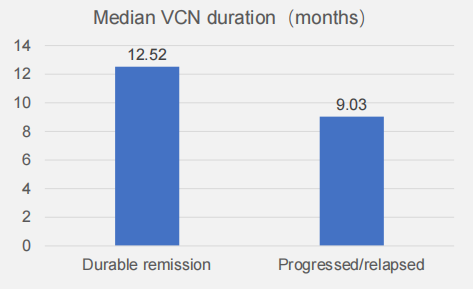
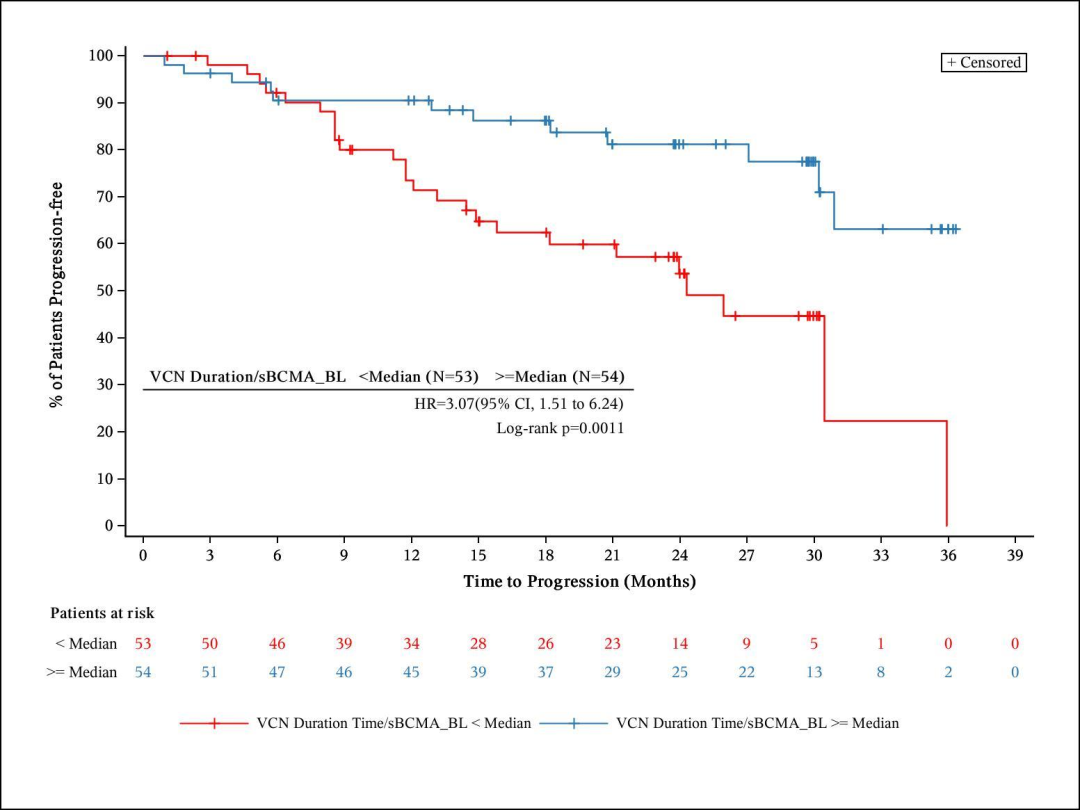
At the data cutoff, the median VCN duration in the sustained response group tended to be longer than that in the progression or relapse group (12.52m vs 9.03m), as shown in Figure 1. The median efficacy-to-target ratio of the 107 subjects was 1.05 (day*mL/ng). As shown in Figure 2, subjects with lower efficacy-to-target ratios had a significantly higher risk of disease progression, with a hazard ratio (HR) for time to progression (TTP) of 3.07 (95% CI: 1.51–6.24, p=0.0011) and an HR for progression-free survival (PFS) of 2.3 (95% CI: 1.27–4.14, p=0.0045), both indicating a significant correlation between the efficacy-to-target ratio and the risk of disease progression.
Swipe left or right to view more
Among baseline characteristics, including ECOG score, R-ISS and ISS disease staging, tumor BCMA expression, tumor burden, baseline sBCMA levels, prior autologous stem cell transplantation (ASCT), third-line treatment exposure, bridging therapy, prior CAR-T therapy, and lymphodepletion pretreatment, only prior autologous stem cell transplantation (n=30) and anti-drug antibodies (ADA, as a post-infusion factor) were significantly associated with the persistence of Icaroten-cel, with hazard ratios (HR) of 0.35 and 5.79, respectively, as shown in Table 1.
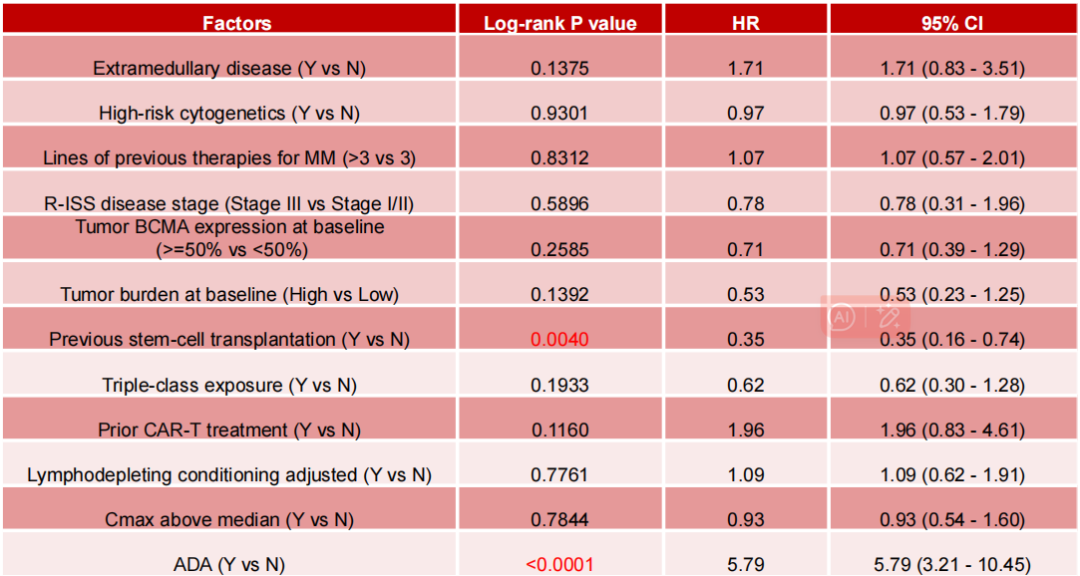
Table 1 Analysis of Factors Affecting CAR-T Cell Persistence
Among 107 subjects, only 14 exhibited neutrophil recovery障碍, characterized by neutrophil counts remaining below 500/μl for 14 days or longer. Compared with subjects without this manifestation, there was no significant difference in VCN duration, indicating that the long-term persistence of Icarus does not increase hematological toxicity.