

Chinese Ophthalmic Device Makers Challenge Zeiss with Comprehensive High-End Product Rollout

Carl Zeiss
Manufacturer of Optical Systems, Industrial Measurement, and Medical Devices
In the field of ophthalmic equipment, Carl Zeiss Meditec is a globally recognized "full-platform" developer and manufacturer of high-end ophthalmic medical devices: it has successfully completed the layout across several advanced ophthalmic device sectors, including surgical microscopes, femtosecond lasers, phacoemulsification and vitrectomy machines, ophthalmic OCT, ultra-widefield fundus cameras, and biometers.
In addition to a comprehensive range of equipment, Carl Zeiss Medical's product competitiveness is also outstanding.Specifically, in the three products of ophthalmic surgical microscopes, femtosecond lasers, and biometers, Carl Zeiss Meditec holds an absolute advantage with more than half of the market share; the market shares of phacoemulsification and vitrectomy machines, ophthalmic OCT, and ultra-widefield fundus cameras also rank among the top five.
More importantly, in the global market, the distribution of market share for the vast majority of brands shows differentiation between regions. However, Carl Zeiss medical products rank among the top in market share across all major countries globally, demonstrating their strong market position.
As an industry-recognized benchmark, Carl Zeiss Medical has always been the object of learning and catching up for domestically produced ophthalmic equipment brands in China.Since the beginning of the 20th century, domestically produced brands have been focusing on the research and development of ophthalmic OCT, biometers, femtosecond lasers, phacoemulsification and vitrectomy machines, surgical microscopes, and fundus cameras.After 20 years, domestically produced products have finally broken through in all the aforementioned fields (from nothing to something), and in the high-end sectors of some products, Chinese alternatives have successfully replaced imports (from something to excellence).
Especially this year, China-produced ophthalmic equipment companies have witnessed a major product boom, making greater progress on the path to fully catching up with Carl Zeiss Meditec:
In January, the assembly of the SMILE laser surgery equipment under Xianwei Vision was completed.
In May, Intalight Saiwei released a visual swept-source biometer;
In June, the BVB2000 series of ophthalmic optical biometers under Bigwood were approved for marketing;
In September, the digital holographic intraoperative OCT navigation microscope developed by Tupai Medical was launched for sale.
In September, Jia Shi Nuo De's dual-channel high-speed vitrectomy cutter was approved;
In October, Fuhuan Medical's CreoTome Ultra Wide-field Imaging System (CreoTome Ultra) was approved.
In October, Hunan Huoyan Medical's optical biometer was approved for marketing;
In November, Velite series ophthalmic optical coherence tomography scanner from Weiren Medical obtained EU CE certification.
Behind the strong momentum of domestic brands lies the relentless efforts of generations of Chinese R&D teams and entrepreneurs who have continuously strived and carried the torch forward.
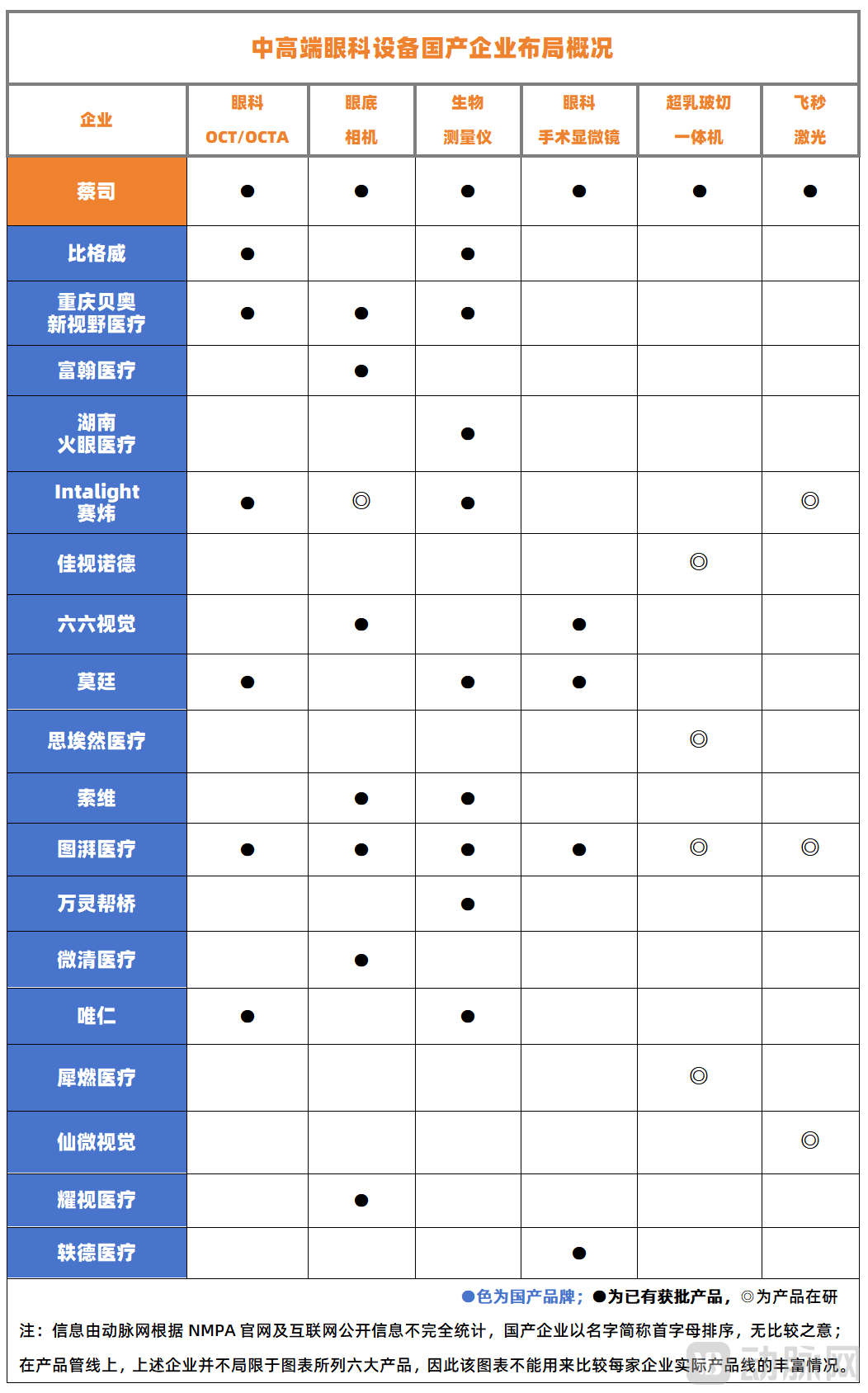
In addition to comprehensive product coverage, a group of domestically innovative companies are also advancing towards becoming full-platform enterprises. They have already deployed multiple mid-to-high-end ophthalmic devices, aiming to become the next Carl Zeiss Meditec.
Of course,In the grand narrative of the rise of Chinese products, new entrants must clearly recognize the gaps that still exist between them and global giant enterprises.(Such as the frontier nature of technological innovation, the international recognition of brand influence, and the sophistication of supply chain management, etc.), only by facing up to and striving to narrow these gaps can domestic brands ensure they "break through the encirclement" in fierce international competition.
From scratch,
Products made in China have achieved full coverage.
As one of the departments with the most extensive variety of equipment, the main equipment in ophthalmology (mainly including diagnostic and therapeutic devices) comprises over 30 types, whereas the main equipment in general departments typically ranges from 5 to 10 types.
There are so many devices, but China's ophthalmic medical device industry has an extremely high import monopoly rate.: Even in 2022, the market share of imported ophthalmic equipment suppliers accounted for more than 90% based on sales revenue. Among them, mid-to-high-end equipment is concentrated in secondary and higher-level hospitals, occupying the majority of the ophthalmic equipment market capacity.
This has led to two major issues: On one hand, the procurement prices for ophthalmic equipment at hospitals are excessively high, reducing accessibility. On the other hand, it compromises the stability and safety of the mid-to-high-end ophthalmic equipment industry chain. This is especially concerning as mid-to-high-end ophthalmic medical devices play a crucial role in precise diagnosis and treatment of various eye conditions, including diabetic retinopathy, glaucoma, age-related macular degeneration, cataracts, dry eye syndrome, and refractive errors. The ability to produce such equipment domestically with self-sufficiency is particularly vital for China.
Therefore, the substitution of domestically produced products is imminent.
But nothing can be achieved overnight. To realize the comprehensive development of mid-to-high-end ophthalmic equipment from scratch, domestic brands have spent nearly 20 years.For instance, as one of the earliest domestic innovative companies to enter the market, Mo Ting Medical, founded in 2003, initially broke through with ophthalmic OCT products. Between 2006 and 2010, it successively launched China's first posterior segment time-domain OCT with independent intellectual property rights, China's first anterior segment time-domain OCT, and China's first spectral-domain OCT, successfully filling the gap in the domestically produced OCT market.
As an important tool for ophthalmic diagnosis/screening, the ultra-widefield fundus camera was first developed by the British brand Optos, with deeper market presence from international brands such as Carl Zeiss Meditec and Nidek. Since its establishment in 2011, MicroClear Medical has been advancing the localization of ultra-widefield cameras in China and, a decade later, launched the first generation of MicroClear ultra-widefield laser fundus camera, achieving the milestone of producing China-made ultra-widefield fundus imaging devices from scratch.
Ophthalmic optical biometers are widely used in clinical fields such as preoperative examinations for cataract surgery and axial length measurements for refractive errors. Domestic brands have made significant efforts over the years and achieved a major breakthrough in 2021, with companies like Suowei Electronics and Motic Medical receiving approvals for related products that year, marking the beginning of their competition with international brands.
Another heavyweight product, the domestic production of ophthalmic surgical microscopes, started very early — in the early 1980s, Suzhou Medical Instrument General Factory (later restructured into LiuLiu Vision) developed the first ophthalmic surgical microscope in China. However, there is a significant gap between domestically produced ophthalmic surgical microscopes and international giants, with almost no presence in commercial applications. In 2022, VCBeat conducted research on the ophthalmic equipment industry and found that, based on public hospital bidding data, the market share of domestically produced ophthalmic surgical microscopes was less than 2%. In September this year, the digital holographic intraoperative OCT navigation microscope developed by the domestic innovative brand Tupai Medical was officially launched, marking a surge in high-end domestically produced ophthalmic surgical microscopes.
In addition to the mid-to-high-end ophthalmic equipment mentioned above, which has already entered the market competition stage in China, the all-in-one phacoemulsification and vitrectomy machine and femtosecond lasers, due to their high R&D difficulty, are currently in a critical R&D stage for domestically produced products.
In the phacoemulsification and vitrectomy field, Jia Shi Nuo De's disposable vitrectomy cutter received NMPA marketing approval in September this year. This is the first domestically developed vitrectomy cutter produced in China, and the world's second dual-pneumatic vitrectomy cutter with a base cutting speed reaching 10,000 cuts per minute. Meanwhile, Jia Shi Nuo De’s self-developed vitrectomy machine has also entered the application phase and is expected to be approved early next year. In the phacoemulsification and vitrectomy field, products made in China are carving out a niche.
In the field of femtosecond lasers, the first domestically produced "Femtosecond Laser Corneal Refractive Surgery Device" (Finevision2000), developed by the Chinese brand Xianwei Vision with 100% independent intellectual property rights, went into mass production in Nanjing this May. It has now completed nearly a thousand animal experiments and laboratory studies and is advancing into the registration clinical trial phase.
It is not difficult to find that domestically produced brands have now fully realized the transition from nothing to something in the mid-to-high-end ophthalmic equipment field.Once the phacoemulsification and vitrectomy integrated machine and femtosecond laser are successfully launched and sold, it will initiate "full competition" between Chinese domestic brands and global giants.
From Existence to Excellence,
China-made needs to face up to the gap with giants
After achieving the leap from nothing to something, it often means that the competition between domestic brands and global giants has just begun.
"Chinese brands have made significant progress in recent years, but there are still obvious gaps between them and imported brands in some products," the founder of a chain of ophthalmic hospitals told VCBeat.The main reason still lies in the insufficient accumulation of technology."As far as I know, the common R&D path for domestically produced ophthalmic equipment in China is to first review foreign literature, observe if there are any experiences worth referencing, and purchase foreign brand equipment for disassembly and study, then reassemble and adjust it themselves. Therefore, the final performance of the product is significantly related to how thoroughly the enterprise's R&D team has mastered the technology."
A closer look reveals,Chinese-produced ophthalmic equipment still lags behind global giants in optical structure design, mechanical structure design, electrical control, structural design of core components, and assembly debugging.
For example, in optical structure design, aberrations are crucial factors that affect the imaging quality of optical systems. Therefore, the R&D team needs to understand the mechanisms behind various aberrations and their correction methods, and control and correct aberrations through precise optical design to achieve optimal imaging performance. Additionally, optical performance, manufacturing costs, and process feasibility also present challenges in optical design.
To address the aforementioned issues, a large number of outstanding interdisciplinary talents closely related to the industry are required.Due to the overseas optical industry's development over a century, there is a large pool of experienced talent, whileThe ophthalmic equipment industry in China has not been developed for a long time, and such talents are very scarce at present.
The founder of the aforementioned chain of ophthalmic hospitals used an optical biometer as an example, stating: "In the work of myopia prevention and control for children and adolescents, the changes in biological parameters between multiple measurements are very subtle, especially for axial length—changes of a dozen micrometers may indicate a shift in refractive status. Therefore, the accuracy and fixation of the biometer are crucial to us. Previously, a domestic brand invited us to use their latest biometer, but overall, there is still a noticeable gap in these two metrics compared to international brands."
Taking the Master series products (including Master 500 and Master 700) from Carl Zeiss Meditec, which are still the gold standard for ophthalmic biometry, as an example—Master 700 can measure six sets of numerical values instantly, automatically calculate the average, and has a very high repeatability rate for measurement data. Even with limited cooperation from children, it can obtain reliable axial length parameters, ensuring stable and accurate ocular biometric data.
As a result, Carl Zeiss Medical's Master 500/700 still holds an absolute advantage in market share, and "Master" has almost become synonymous with biometers.
The price also reflects the market's recognition of the value difference between domestically produced and imported products. According to the public bidding data compiled by VCBeat, the selling price of biometry products such as Carl Zeiss' Master ranges from 400,000 to 1.8 million yuan per unit in public hospitals, with an average selling price of about 500,000 yuan per unit; whereas the selling price of various domestically produced biometry products ranges from 50,000 to 300,000 yuan per unit, with an average selling price of about 100,000 yuan per unit, showing a difference of an order of magnitude.
Another example is the ophthalmic surgical microscope, which features multiple varieties, small batch production, and customization.High-precision assembly and calibration processes are critical for the final mass production and quality assurance of surgical microscopes.According to VCBeat's previous understanding, the product had issues with some Chinese brands having too low a delivery yield of good products.
In addition, the annual sales ofOphthalmic Surgical MicroscopeThe number of units is not large, belonging to "niche demand," thusIt is necessary for companies to establish an industry ecosystem by closely collaborating with downstream supply chain industries to jointly develop various components compatible with new equipment. Only in this way can we break through product performance bottlenecks while driving the overall development of China's industrial chain.
Therefore, to move from existence to excellence remains a long journey.
Fortunately, in recent years, the gradual rise of domestic brands has accumulated a wealth of experience for the industry and nurtured a group of versatile talents. This provides significant momentum for the further development of domestically produced ophthalmic equipment.
For instance, in the field of ophthalmic OCT, domestically produced products have improved significantly from existence to excellence in recent years: since the development of the first commercial ophthalmic OCT device in 1996, ophthalmic OCT has undergone three generations of technological iterations over 28 years—time-domain OCT, spectral-domain OCT, and swept-source OCT. Currently, multiple companies in China are at the forefront of the latest technology, matching or even surpassing foreign devices in various performance metrics. They have positioned themselves among the industry leaders and become an important force in the export of mid-to-high-end ophthalmic equipment from China.
There is no doubt that domestic brands, which have been working hard for decades, are gradually making breakthroughs one by one. Starting with ophthalmic OCT, they are determined to bridge the gap with international giants and achieve parity in all mid-to-high-end ophthalmic product fields, from catching up to running neck-and-neck, and eventually taking the lead globally in the future.
Shatter the Preconceived Notion of Low-End Chinese Products
It takes time, but more importantly, the product needs to speak for itself.
In China's medical device industry, adopting a low-price strategy to quickly capture the market has been a repeatedly successful experience for many domestic brands in various niche sectors, leading to the rise of several listed companies. These listed enterprises, benefiting from sufficient "ammunition" in the capital market and strong profitability, have reinvested in research and development, achieving a product layout logic that progresses from "low-end to mid-end to high-end."
However, in VCBeat's past communication with professionals in the ophthalmic equipment industry, most practitioners believe,Low-price strategy makes it extremely difficult for domestic brands to gain traction in the ophthalmic medical device market, and the market performance of the ophthalmology industry over the past two decades (the market share of domestically produced products has consistently struggled to grow) has repeatedly proven this issue.
Therefore, for domestically produced ophthalmic equipment enterprises in China, it is crucial to enhance product quality, enabling them to compete on par with or even surpass imported products. Only then can they break through the barriers and gradually dismantle the monopoly of imported products. In other words, domestically produced ophthalmic equipment needs to follow a product development path that progresses from "mid/high-end to low-end."
This is because only by positioning in the mid-to-high-end market can Chinese-produced brands truly establish a brand effect and break the entrenched perception of low-end Chinese ophthalmic medical device brands in the domestic market; only by establishing a brand effect can products achieve better gross profit margins, thereby supporting the high investment demands of continuous optimization, upgrades, and new product development, ultimately forming a positive cycle.
Positioning in the mid-to-high-end market is not easy — as mentioned earlier, there is still a considerable gap between domestic brands and imported brands in terms of overall strength. Therefore, it remains essential for domestic breakthroughs to continue intensifying the cultivation of versatile industry talent.
In addition,Chinese brands should focus on forward research and development from the underlying technology to break through the restrictions and blockades of ophthalmic patents, and truly stand shoulder to shoulder with imported brands., this is the most crucial "battlefield" for domestic brands at present and in the future.
It can be foreseen that in the process of advancing into the future, domestically produced ophthalmic equipment brands are continuously narrowing the gap with imported brands and taking an important step toward becoming global enterprises.