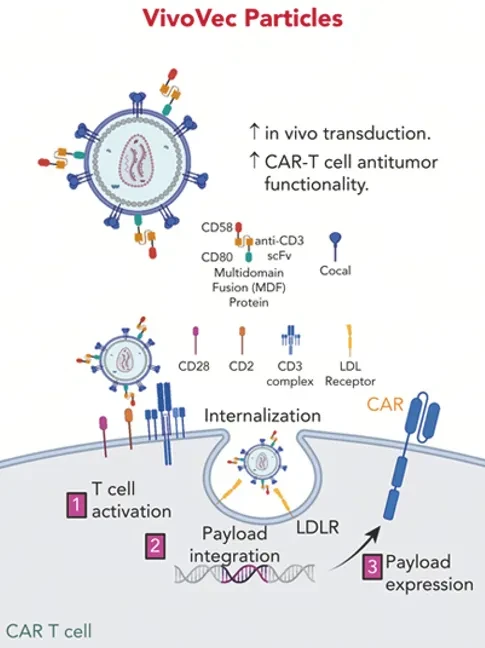
On January 14, Umoja Biopharma, a leader in in vivo CAR-T cell therapy, announced the completion of a $100 million Series C financing round. This round was co-led by Double Point Ventures and DCVC Bio, with participation from both new and existing investors including ARK Invest, Cormorant Asset Management, MPM Capital, and Qiming Venture Partners USA.The financing proceeds will be used to advance Umoja Biopharma's in vivo CAR-T cell therapy pipeline, including clinical studies of its lead UB-VV400 program targeting CD22 in various cancers and autoimmune diseases.Umoja Biopharma, Inc. was founded in 2019 and is committed to developing in vivo cell therapies to enhance the coverage, efficacy, and accessibility of CAR-T cell therapies in the fields of oncology and autoimmune diseases. The company completed a $53 million Series A financing in November 2020 and a $210 million Series B financing in June 2021.CAR-T Cell Therapy has not only revolutionized the treatment of blood cancers but also demonstrated unprecedented potential in combating autoimmune diseases. However, current autologous CAR-T therapies are personalized treatments that require collecting cells from patients, modifying and culturing them in a lab, and then reinfusing the CAR-T cells back into the patient’s body. This process faces multiple challenges, including production, transportation, and high costs. How can CAR-T cell therapy be made easier to produce, more convenient to use, and less expensive? Companies like Umoja Biopharma are exploring "in vivo CAR-T therapy."The development of in vivo CAR-T involves a wide variety of vectors. Umoja Biopharma employs a third-generation engineered lentiviral vector (VivoVec™), which can permanently modify immune cells.Source: BloodOn June 11, 2024, a study published in the journal Blood showed that injecting VivoVec particles (VivoVec particles, VVP) into non-human primates without lymphodepletion chemotherapy resulted in substantial production of CD20 CAR-T cells and complete B-cell depletion lasting more than 10 weeks. These data support further clinical development of the VivoVec platform.On July 31, 2024, Umoja Biopharma announced that the FDA had approved the IND application for its in-situ generated CD19 CAR-T cell therapy UB-VV111 for the treatment of hematologic malignancies. This Phase I study (NCT06528301) will enroll patients with relapsed/refractory large B-cell lymphoma (LBCL) and chronic lymphocytic leukemia (CLL) to evaluate the safety, tolerability, and clinical anti-tumor activity of UB-VV111.By the end of 2024, UB-VV400, an in vivo CAR-T cell therapy targeting CD22 developed through the collaboration between Umoja Biopharma and Icarus Bio, will enter Phase I clinical trials (NCT06743503).In terms of giant collaborations, AbbVie announced in January 2024 a collaboration with Umoja Biopharma to develop in vivo (in situ) CAR-T therapy, with a potential total value of $1.44 billion.Umoja Biopharma's co-founder and CEO, Dr. Andrew Scharenberg, stated: "We are thrilled to have completed our Series C financing with the strong support of both new and existing investors. They believe that UmojaInstrumentPotential for Developing the Industry's First In Vivo CAR-T Cell Therapy。”It is worth mentioning that, in addition to Umoja, there are several companies in China and internationally that have entered the in vivo CAR-T field, including Interius, Kelonia, Capstan, Orbital, Jiyin Biotech, Yuantai Biotech, SaneBio, PersonGen, BetterGene Bio, and Unicar-Therapy. (Recommended reading:In Vivo CAR-T, Gaining Momentum)References:[1]https://www.globenewswire.com/news-release/2025/01/14/3009150/0/en/Umoja-Biopharma-Announces-Oversubscribed-100-Million-Series-C-Financing-to-Advance-In-Vivo-CAR-T-Pipeline-through-Key-Oncology-Clinical-Milestones.html[2]https://www.umoja-biopharma.com/news/abbvie-and-umoja-biopharma-announce-strategic-collaboration-to-develop-novel-in-situ-car-t-cell-therapies/[3]https://www.umoja-biopharma.com/news/iaso-bio-announces-new-development-partnership-with-umoja-biopharma-to-develop-ex-vivo-and-in-vivo-cell-and-gene-therapies/[4]https://www.clinicaltrials.gov/study/NCT06743503