

Xinhua YingTai and Dr. Zhao Xueqiang: Pioneering STAR-T Innovation for Cancer and Autoimmune Diseases

BriSTAR Immunotech
Cellular Immunotherapy Product Developer
I had been wanting to arrange an interview with Huaxia Yingtai (Beijing) Biotechnology Co., Ltd. and Dr. Zhao Xueqiang, but the timing never worked out. A couple of days ago, late at night, while sharing my new book "I Know You're PUA-ing Me" on my WeChat Moments, Dr. Zhao instantly left a comment below, and we ended up scheduling the interview for the next day through the comment thread—what a serendipitous turn of events.
Like the offices of many startup founders, Dr. Zhao's office is not very spacious, with just a desk and a small sofa. Dr. Zhao invited me to sit on the sofa, then moved his office chair in front of me, creating an atmosphere reminiscent of a heart-to-heart conversation. And so, we began our interview face-to-face.
Artery New Medicine:Dr. Zhao and Huaxia Yingtai(Beijing)Biotechnology Co., Ltd. have always been very low-key. Could you please give us a brief self-introduction?
Zhao Xueqiang: I have a typical background of a scientist turned entrepreneur, though I wouldn't really call myself a scientist, more of a researcher (chuckled modestly). "Answering the call of the 21st century as the century of life sciences," I studied biology for my undergraduate degree at Sichuan University. Later, I developed an interest in tumor immunology and earned my Ph.D. from the Institute of Biophysics at the Chinese Academy of Sciences. In early 2010, after completing my Ph.D., I was fortunate to work as a postdoctoral fellow under Professor Xin Lin at the MD Anderson Cancer Center in the United States. At the end of 2013, I returned to China to conduct research at Tsinghua University, and by the end of 2017, Professor Lin and I co-founded Huaxia Yingtai(Beijing)Biotechnology Co., Ltd. During this time, to quickly transition into a managerial role, I also pursued an MBA at the Tsinghua School of Economics and Management. Now, the company has been operating for six years. Along the way, I've transformed from a researcher into an entrepreneur, experiencing a great deal. The company has obtained two IND approvals for new drug clinical trials in China, attracted significant investment, navigated global changes and industry cycles, and faced numerous challenges in product development and enterprise management internally. However, above all, it's been a journey of growth and gratitude.
VCBeat:The STAR-T technology is still very unfamiliar to the vast majority of people. Would you be so kind as to help everyone understand it? How is it different from CAR-T and TCR-T?
Zhao Xueqiang: STAR-T technology was pioneered and named by the laboratory of Professor Lin Xin, the founder of our company from Tsinghua University. It combines the dual advantages of CAR-T's target recognition and TCR-T's natural signal transmission, featuring high sensitivity, strong tissue and organ infiltration ability, and mild yet long-lasting effects. It is especially suitable for solid tumors and autoimmune diseases such as SLE. Its high sensitivity enables it to effectively identify and eliminate target cells with low antigen expression, its strong tissue infiltration allows it to penetrate deep into solid organs for thorough clearance of target cells, and its mild and sustained nature indicates better safety as well as improved and longer-lasting efficacy.
We know that CAR-T therapy relies on artificially designed chimeric antigen receptors (CAR) to recognize tumor antigens and has been clinically proven to be significantly effective in treating B-cell lymphoma and multiple myeloma. However, it may carry the risk of non-target-dependent activation and expansion as well as a high risk of cytokine release syndrome (CRS). On the other hand, TCR-T therapy uses natural T-cell receptors (TCR) to recognize mutated or foreign peptide fragments presented by antigen-presenting cells. Although it can recognize intracellular antigens, it is limited by the type of major histocompatibility complex (MHC), which greatly restricts the proportion of patients who truly meet the treatment conditions. In addition, currently approved autologous CAR-T and TCR-T therapies require personalized manufacturing, producing one product for each intended patient, which leads to high costs and relatively large batch-to-batch variations compared to antibody drugs.
STAR-T therapy combines the dual advantages of CAR-T and TCR-T. Before 2022, we focused on developing autologous products; in the past two years, we have made breakthroughs in the direction of universal products. Through a one-step targeted integration technology, we have achieved precise editing of STAR into the TCR site, improving preparation efficiency and reducing costs.
VCBeat:STAR-T technology sounds very innovative and interesting, but new technologies are a double-edged sword for pharmaceuticals. The good aspect is its innovativeness, which makes it difficult to imitate, while the other side of the coin involves greater uncertainty, including whether there will be an opportunity for drug development, safety concerns, and so on. How do you view this issue? Are there any academic articles that can provide evidence?
Zhao Xueqiang: How do I feel that your question is a trap? (Big laugh) From an academic perspective, high-level articles are indeed very good proof. A completely new technology must be rooted in solid scientific foundations. However, for drug development, academic articles alone are far from enough; real clinical data is essential. Regarding the STAR-T technology, we conducted extensive scientific experiments on cell lines, primary cells, and experimental animals in the early stages, with the first publication appearing in a subsidiary journal of *Science* in 2021. In the product development phase, through Investigator-Initiated Trials (IIT), we treated 18 patients with relapsed or refractory B-cell leukemia using autologous CD19 STAR-T cell therapy. All patients achieved complete remission (CR) within two weeks after infusion, showing sustained efficacy and good safety. These results were published at the American Society of Hematology (ASH) Annual Meeting in December 2020 and in the journal *Am J Hematol* in 2022. By the end of 2024, the Tsinghua University team further published research findings on the high antigen sensitivity of STAR-T in the journal *Cell Reports*. The scientific basis and innovative nature of STAR-T are very robust. From the perspective of drug development, different STAR-T products have already accumulated efficacy data from sixty to seventy patients through IIT clinical studies. Additionally, IND approvals for Phase I clinical trials were obtained for two autologous STAR-T products in September 2021 and January 2024.
Artery New Medicine:This data is very impressive, but, as far as I know, it still targets the CD19 antigen and is aimed at patients with hematological tumors. Now, CAR-T technology is very mature and has been successfully commercialized in China. Does Huaxia Yingtai(Beijing)Biotechnology Co., Ltd.'s pipeline, which relies on STAR-T technology, still have commercial value?
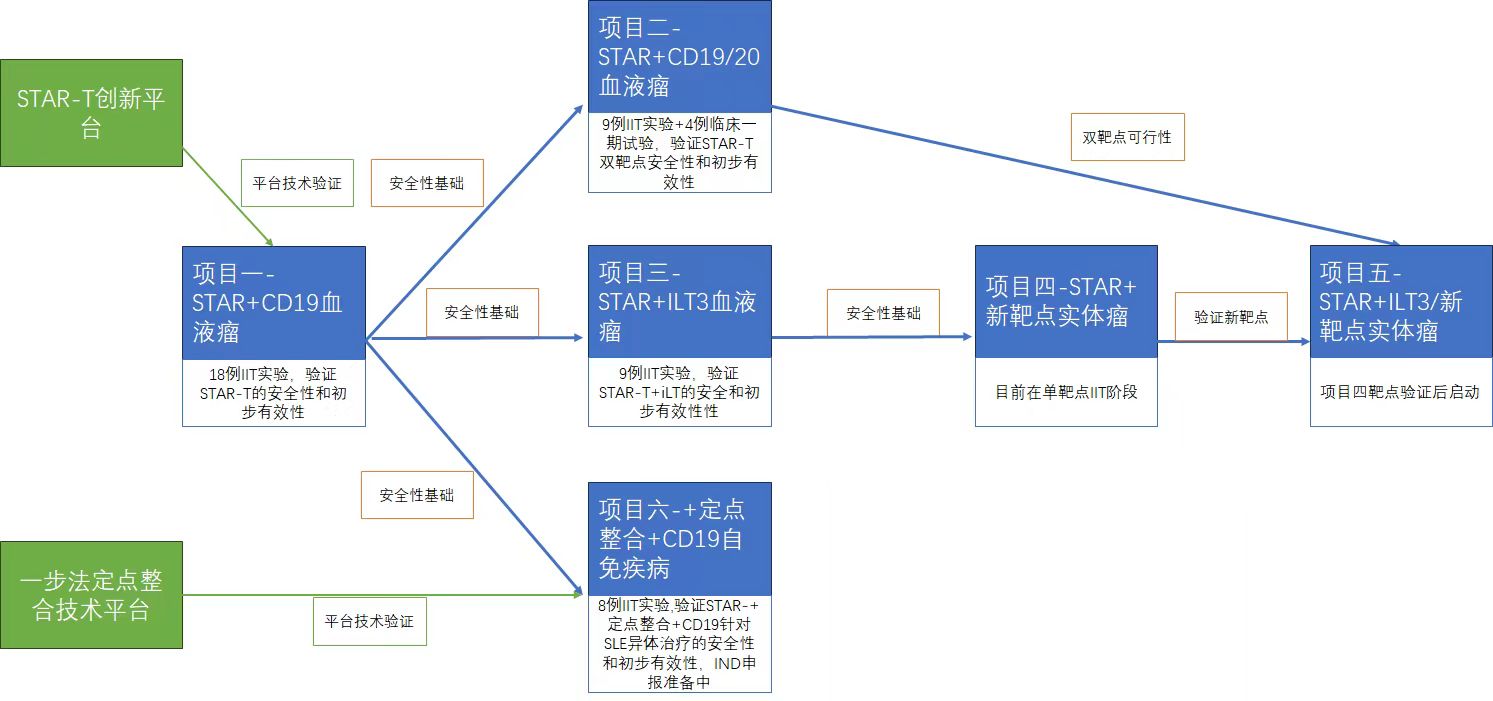
Teacher Zhao: Your questions are becoming more and more like traps (followed by loud laughter). You're right. Before we conducted this IIT, we didn't carefully consider the commercialization aspect, thinking that combining a mature target with a new platform to create a product would be the safest approach. Later, we discovered that the market was saturated with competing products, making it very difficult for this product to achieve further improvements on the basis that the existing clinical efficacy had already reached its ceiling. It was through this learning process that we decided to terminate the CD19 single-target pipeline in a timely manner. Although it was terminated, the clinical data from these 18 cases fully demonstrated that the STAR-T technology route is highly safe, and its effectiveness has also been somewhat validated. As we just discussed, STAR-T has the natural advantage of recognizing dual targets. Almost simultaneously, we initiated IIT experiments using the STAR-T platform for a project targeting both CD19 and CD20 dual targets. We achieved good clinical results in nine patients with B-cell leukemia, and subsequently filed for IND. After obtaining clinical tacit approval, we enrolled three patients in the low-dose group and one patient in the second dose group for Phase I clinical trials.
I know you might ask, "Aren't CD19 and CD20 just the two common targets we've been talking about? Where is the real innovation?"
(Teacher Zhao, seeing that I was about to ask a question, continued directly)
Indeed, the first two products were both positioned as me-better innovations. We validated the STAR technology using well-established targets, and subsequently, the third project focuses on a novel target. Through the IIT and IND clinical data obtained from the first two projects, we have already demonstrated the safety and initial efficacy of both single-target and dual-target STAR-T therapies. For the third project, we decided to explore a new, high-potential target—LILRB4 (also known as ILT3). LILRB4 is a myeloid immune checkpoint receptor primarily expressed on monocytes and monocyte-derived cells. It is highly expressed in certain hematologic malignancies, such as monocytic acute myeloid leukemia (AML) blasts, making it an ideal therapeutic target for monocytic AML. Currently, CAR-T treatments for AML show limited efficacy due to the heterogeneity of AML cells and the lack of specific targets; chemotherapy, targeted drug therapy, and hematopoietic stem cell transplantation have been some of the commonly attempted approaches. Given the relatively low competition for this target, with only one monoclonal antibody drug currently in Phase I clinical trials with the FDA, Huaxia Yingtai (Beijing) Biotechnology Co., Ltd.'s LILRB4-specific STAR-T project is currently the fastest advancing cell therapy project.
Regarding LILRB4 STAR-T, the results of the IIT clinical trial conducted on nine patients have been published at the 2024 American Society of Hematology (ASH) Annual Meeting in December 2024. In terms of registered clinical trials, in January 2024, we also received the IND tacit approval from the CDE for this project, which had previously been granted "Orphan Drug" designation by the U.S. FDA. This target is also quite interesting, as LILRB4 can serve as a target for myeloid checkpoint inhibitors, combining with tumor cell-specific targets to improve the tumor microenvironment.
In addition, we look forward to STAR-T also adapting better solutions for solid tumors and autoimmune disease indications.
(Speaking of which, Dr. Zhao took out a piece of white paper and began to draw a mind map while introducing the R&D and pipeline strategy of Huaxia Yingtai (Beijing) Biotechnology Co., Ltd., as shown in the figure below.)
Artery New Medicine:I can't help but admire the very clear strategic thinking on your part, which is also quite different from many Biotech company founders I know. Dr. Zhao, you also come from an academic background—what kind of experiences helped you develop such clear strategic thinking?
Dr. Zhao: Thank you for your recognition. In fact, it is very difficult for Biotech companies to engage in original innovation. They face many unknown challenges and have to stand at the crossroads every day to think about decision-making. In recent years, we have been exploring, reflecting, and summarizing. For myself, I have undergone significant changes and growth not only in understanding the policy environment, capital operations, and company management but also in my personal thinking patterns. It’s worth mentioning that this change in my way of thinking, aside from practical experience, has benefited from my pursuit of an MBA starting in 2021. At that time, I passed the national joint entrance exam and entered Tsinghua University's MBA program with a freshman scholarship. During my MBA studies, I not only improved my management and business skills but also learned leadership knowledge, and understood how to read human nature in the most efficient and least energy-consuming way. More importantly, I learned to return to the essence of business and realized that the commercial value of a product is different from what scientists consider valuable. Scientists often think from a technical route perspective, believing that as long as the technology is proven effective, it is sufficient. However, the commercial value of a product must also consider factors such as the target audience, payment ability, competitive landscape, and whether it can rank among the top three in terms of development speed. This requires a shift from technical route thinking to indication-based thinking, or as commonly referred to in business, moving from product thinking to customer thinking. These learnings and reflections have allowed me to weigh the pros and cons more rationally and comprehensively when facing strategic decisions for the company.
During the development of Huaxia Yingtai, this strategic thinking has played a crucial role. For instance, we initiated research on STAR-T in 2019 with the idea of creating a CAR-like structure based on TCR-T for use in scenarios that mirror CAR-T (using TCR for signal transduction). Although the STAR-T technology platform has been validated in terms of safety and efficacy, and achievements such as the IIT data from the first two projects and the approval of the first IND all demonstrate this, in 2023, we proactively terminated related projects. From a commercial perspective, the commercial prospects for autologous CAR-T therapies in treating hematologic tumors are unclear. To avoid wasting money and resources, we decisively made this decision. It was a difficult choice at the time, but it was precisely based on an accurate assessment of commercial value that we dared to terminate.
After going through this process, we have gained a clearer understanding of the company's strategic direction. Having proven the feasibility of the platform, we now need to explore new application directions, namely new indications and targets. Therefore, in 2024, we advanced and obtained our second IND approval — LILRB4-specific STAR-T for indications such as acute myeloid leukemia. This target is relatively new; although there are already antibody-based technology approaches targeting this point that have entered Phase I clinical trials, our project on this target is the first IND project in the field of cell therapy. Moreover, leveraging the dual-target advantage of STAR-T, we can adopt a design that targets two epitopes of the same target. First, we use one target to demonstrate efficacy in treating hematologic tumors, and subsequent projects can be designed as dual targets aimed at both the tumor itself and its microenvironment. This approach also holds significant potential for application in solid tumors. We believe this product has commercialization potential, and data on patient numbers and market value indicate that this remains a worthwhile autologous product application project for us to invest in.
In addition, the company has experienced a transition from simply pursuing innovation to precisely positioning commercial value, moving from rapid development with annual rounds of financing from 2019-2021 to truly returning to a rational product development logic from 2022-2024. Throughout this process, my MBA studies have allowed me to continuously apply knowledge to practice, bringing Huaxia Yingtai (Beijing) Biotechnology Co., Ltd. closer to the essence of business.
Artery New Medicine:Thank you, Teacher Zhao, for helping us review Huaxia Yingtai's strategy once again. As a company with strong innovative capabilities, what new technologies has Huaxia Yingtai developed in recent years?
Zhao Xueqiang: That's right. Relying on the strong scientific research capabilities of Professor Lin Xin's team from Tsinghua University, Huaxia Yingtai (Beijing) Biotechnology Co., Ltd. has never lacked original innovation. Our key pipeline for development in 2024 is STAR-T for autoimmune diseases, especially an allogeneic universal product that uses new technology. Our technical approach is based on the site-specific integration technology recently developed by Professor Lin Xin at the national laboratory, using AAV viruses instead of lentiviruses, combined with the STAR-T platform and the CD19 target for the treatment of SLE. As we all know, lentiviral vectors use non-site-specific integration methods, and their risks of insertional mutagenesis and transcriptional activation have always been highly controversial. In contrast, AAV viruses are widely recognized for having relatively higher safety and production costs several orders of magnitude lower than lentiviruses, making them very suitable to replace lentiviruses in new projects. We also look forward to this project starting IND clinical trials as soon as possible. Currently, through the accumulation of IIT trials, we have disclosed data from eight patients, with very impressive results.
Artery New Medicine:Huaxia Yingtai is really a very low-key company. If it weren't for this exclusive interview with you today, we wouldn't have known that you have so many good technologies and such a large number of products with great potential.
Zhao Xueqiang: We also feel very fortunate to have such a strong original research and innovation team led by Professor Lin Xin. As for myself, I am an entrepreneur with some scientific knowledge. The cooperation between Professor Lin, myself, and the rest of the company's management team has been seamless. We are highly confident that whether it is the STAR-T+ILT3 target project for acute myeloid leukemia, the STAR-T+AAV+CD19 project for SLE, or the potential STAR-T+ILT3+cancer-specific target project for solid tumors, all of them hold significant commercial potential. Earlier, the two pipelines—STAR-T+CD19 for hematological tumors and STAR-T+CD19/CD20 for hematological tumors—have made substantial contributions to our subsequent pipelines. It can be said that Huaxia Yingtai(Beijing)Biotechnology Co., Ltd. has certainly taken some detours along the way, but the direction of product development has been correct, and the path forward has been firm and clear.
VCBeat saw the confidence of Dr. Zhao, a scientist-entrepreneur, in Huaxia Yingtai and STAR-T technology through his resolute eyes. VCBeat also brought a newly published psychology novel titled "I Know You're PUA-ing Me" and gave it to Dr. Zhao. We look forward to Huaxia Yingtai, under the leadership of Professor Lin Xin and Dr. Zhao Xueqiang, using scientific innovation and solid data to bring more effective new drugs to patients.
Column Author: Xiao Bo
A warrior who has risen and fallen in large foreign enterprises for about twenty years;
A person with taste, with interest, and with a medicinal touch;
A generalist with a background in chemistry, biology, finance, psychology, strategy, and an MBA degree;
The media person who proposed "No need to be overly competitive, act for the long term," and looks forward to the long-term sustainable development of the innovative drug industry;
My main job is the BD leader of a PDMO company.
Hope to explore the essence from a different perspective, and use humor to keep difficulties at bay.