Maze Therapeutics Submits IPO Filing to Advance Precision Kidney Disease Therapies

Maze Therapeutics
Developer of Therapeutic Drugs for Genetic Diseases

On January 7, just one month after securing Series D financing,Maze TherapeuticsSubmit to the U.S. Securities and Exchange Commission (SEC)ListedApplication. The Bay Area-based biotech did not disclose the number of shares or the price it plans to issue, but mentioned that it hopes to further advance the development of its renal disease candidate drug through the IPO.
The application documents show,Maze Therapeutics, Inc. Applies for NASDAQ Listing, with the stock code MAZE. As with the previous D-round financing,The proceeds from this fundraising will be used to advance the clinical development of MZE829 and MZE782.。
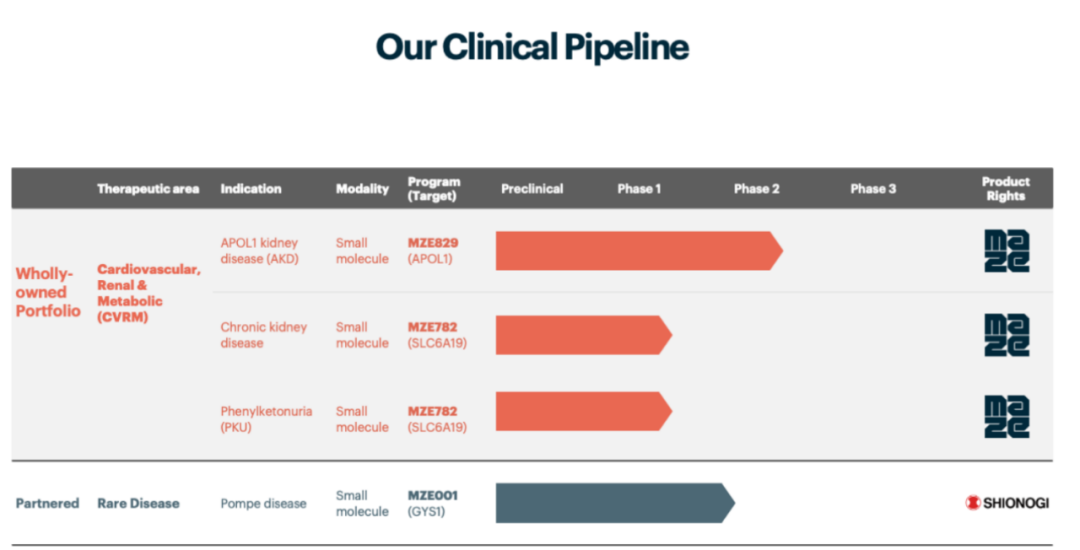
MZE829 isOral APOL1 Inhibitor, and the trial for APOL1 nephropathy is currently underway, with plans to commence Phase II trials no later than the first quarter of 2025.
MZE782 isOral SCL6A19 Inhibitor, and is currently in Phase I trials for healthy subjects. The filing shows that Maze plans to continue developing the drug in the fields of chronic kidney disease and phenylketonuria.
The remaining funds will be used to further develop "other common disease programs" in the cardiovascular, renal, and metabolic indications space (Maze’s focus areas), "including preclinical studies, IND-enabling studies, and initiating clinical trials."
01
Founded in 2018, it is a clinical-stage company developing small-molecule precision medicines for common diseases.With 3 clinical-stage projects, and is developing multiple drug research projects through the Compass™ platform. Maze Therapeutics' drugs under development are designed to mimic the effects of rare, naturally occurring protective genetic variants, helping to halt the progression of kidney diseases and potentially reverse their impact. The most advanced program is MZE829 for the treatment of APOL1 nephropathy.
There are two projects underway: MZE829 and MZE782.。
02
On December 3 last year, MazeIn the press releaseAnnounces $115 Million Series D Financing, co-led by Frazier Life Sciences and Deep Track Capital, with participation from Janus Henderson Investors, Logos Capital, and existing investors including Third Rock Ventures, ARCH Venture Partners, and Matrix Capital Management.
Maze CEO Jason Coloma, Ph.D., stated, "With the additional resources from this financing, we are able to optimize the upcoming Phase II trial of MZE829 and further unlock the potential of our two lead programs. This financing marks a significant step in the company’s growth and for the patients we aim to serve."
03
When it comes to major events in the pharmaceutical industry in 2023, one of them is definitely the U.S. Federal Trade Commission (FTC) rejecting the collaboration between Sanofi and Maze Therapeutics.
On May 1 of the same year,Sanofi Proposes to Acquire Maze Therapeutics’ Glycogen Synthase 1 (GYS1) Program, Including a Recently Completed Phase I Trial for Pompe Disease`, with upfront cash and biobonus amounts totaling up to $750 million.`
This authorization could have added a clinical-stage rare disease drug to Sanofi’s pipeline. Rare diseases currently account for about 15% of Sanofi's pipeline. In exchange, Maze Therapeutics could receive $150 million in upfront cash and equity, as well as up to $600 million in milestone payments.
Not long ago, Maze reported the conduct in healthy volunteersMZE001The latest data from Phase I trials show that the drug is well-tolerated at doses of up to 720 mg twice daily. Maze also found that the drug reduces blood glycogen and muscle glycogen levels, two potential biomarkers indicating a therapeutic effect on Pompe disease. According to the agreement at that time, Sanofi will be responsible for initiating the Phase II trial of the drug.
In addition to MZE001, Sanofi can also acquire intellectual property or "proprietary technology" for other indications or the GYS1 backup program and may decide whether to expand the use of MZE001.
But as the saying goes, "Man proposes, God disposes." On December 12, 2023,FTC Blocked This Authorization Deal。Facing the FTC, which is taking action to block the deal,Sanofi's choice is to exit, instead of putting effort into resolving the antitrust issues between it and Maze Therapeutics, Inc. (MZE001).
The FTC said in a statement disclosing its intention to block the transaction that,The agreement will “Eliminate a New Competitor, and the competitor is able to challenge Sanofi's monopoly地位 in the Pompe disease treatment market," and elaborated further on this in a heavily redacted complaint.
In response, Sanofi expressed disagreement, stating that the deal with Maze could have leveraged Sanofi's "resources, knowledge, and expertise to accelerate the development of MZE001"… The FTC's decision "has delayed potential progress and may impact patient lives."
However, Sanofi chose not to contest the FTC's move to block the deal. According to Sanofi, the agreement was terminated because "a prolonged litigation process would not be in the best interest of patients."
This case also marks a shift in the types of deals the FTC is targeting. Previously, companies often only had to worry about antitrust issues derailing large acquisitions, such as Amgen's $278 billion purchase of Horizon Therapeutics. In contrast, smaller acquisitions and licensing deals, which serve as major revenue sources for biotech firms and primary exit routes for venture capital firms, have faced significantly less scrutiny from the FTC.
In the FTC's view, "Sanofi attempted to acquire Maze instead of competing with Maze," recognizing that this biotech's "innovative product could potentially replace its own dominance." The redacted sections of the complaint discussed Sanofi’s prediction on how much market share MZE001 might capture in the hands of competitors and evaluated the extent of the threat posed by Amicus Therapeutics' recently approved Pompe disease drug to Sanofi.
04
However, for Maze, every cloud has a silver lining. Just five months after the FTC blocked Sanofi's acquisition of Maze Therapeutics' Pompe disease program,Japan's Shionogi Successfully Acquires This Asset. Dreams Shattered at Sanofi, Blossoms Faded at Yanoichi.
On the morning of May 10 last year, Shionogi revealed that it had acquired MZE001 for an upfront payment of $150 million. This amount far exceeds the upfront payment Shionogi made to Japanese biotech FunPep in March last year. FunPep developed an anti-IgE antibody-inducing peptide for the treatment of seasonal allergic rhinitis, for which Shionogi paid an upfront fee of 300 million yen (approximately $1.9 million) as part of a licensing deal.
Dr. Tatsumori Yoshida, CEO of Shionogi, said that Maze's MZE001 is "strategically highly aligned" with Shionogi.
"This will help to effectively advance our commitment to developing innovative drugs, addressing unmet medical needs, and complementing Shionogi's rapidly expanding product pipeline in the key areas designated in its mid-term business plan."
Shionogi pointed out,MZE001 Could Become the First Oral Medication for Treating Pompe DiseaseIf approved, the GYS1 inhibitor could be used both as a monotherapy and as an add-on therapy to enzyme replacement therapy, which is currently the standard treatment for the disease.
Perhaps Sanofi's CEO Paul Hudson is also pleased with this deal, as he previously expressed concerns that Sanofi's failure to obtain authorization might jeopardize the future of the drug.
05
In 2024, only five pharmaceutical companies successfully went public on China's A-share market.These are Hisun Pharmaceuticals, AIDET, Xiaofang Pharmaceutical, Innost and Jianerkang. This number was 22 in 2023, 50 in 2022, and 63 in 2021. Some of the reasons are that some companies have shifted to the Hong Kong Stock Exchange or the Beijing Stock Exchange, but this still does not change the overall difficult situation. As for the U.S. stock market, 2024 has seen some recovery compared to 2023. Will 2025, which begins with the listing of Maze Therapeutics, be better?
The answer to this question is tied to the prospects of countless drug candidates and the livelihoods of biotech professionals. Analysts have already made predictions in their 2025 outlook:Anyone hoping for a dramatic turnaround should now "take a long-term perspective."。
In 2024, despite the IPO investment scale being far lower than the boom years of 2020 and 2021, and the venture capital fundraising amount continuing the downward trend that began in 2022, analysts described deal activity as "sluggish." However, compared to the catastrophic years of 2022 and 2023,Signs of Recovery Have EmergedThe number of IPOs and the amount of financing have increased, and the number of venture capital rounds has also risen. Companies that faced challenges in recent years are on the verge of gaining approval. In analysts' eyes, Cytokinetics’ aficamten and Insmed’s brensocatib are among the list of potentially most important new drug launches in 2025.
Analysts believe that IPO activity paused around the time of the U.S. election at the end of last year. This year, IPO activity is expected to pick up pace again. These analysts stated that there is a long-suppressed huge demand among "private companies," but only the safest applications and companies with strong support from existing investors are expected to go public in the first few months of this year.
Analysts also believe that although many people predict the statistics of IPO in 2025 will rise again,Few people predicted that the floodgates would suddenly open.Analysts said, "The stock market is unpredictable, and blowouts like BioAge in early December do nothing to enhance the reputation of biotech."
In order to further open the IPO window, market conditions must change. Analysts said that "this shift is unlikely to occur before the Trump administration takes office and establishes a firm policy direction," indicating thatIPO activity will remain subdued until at least late 2025.。
In conclusion
Maze Therapeutics’ IPO has not only injected fresh blood into its own development but also set a good start for biotech IPOs in 2025. "When the moon is full, it begins to wane; when it is lacking, it starts to wax," reflects the ancient wisdom on cycles.Things will transform into their opposites when they reach a certain stage of development."The Count of Monte Cristo" has a passage in the last chapter: "There is neither happiness nor unhappiness in this world; there is only the comparison of one state to another, that's all. Only those who have experienced extreme misfortune can taste extreme happiness." Facing frozen rivers, snow-covered mountains, difficult paths, and many forks in the road,The wisdom we need is simply to hold hope and wait for the right moment.。
Build a Biomedical Innovation Ecosystem Together!
How to Join BiG Membership?