

Qilu Pharmaceutical Pioneers Domestic Market with Approval of Pertuzumab Biosimilar, Reshaping the 'Dual HER2-Targeted Therapy' Landscape

Qilu Pharmaceutical
Specialty Formulations and Active Pharmaceutical Ingredients (API) Developer
With the approval and market launch of domestically produced pertuzumab biosimilars in China, Qilu Pharmaceutical, holding the "dual-target therapy" (pertuzumab and trastuzumab), will bring the HER2 market competition into a new phase!
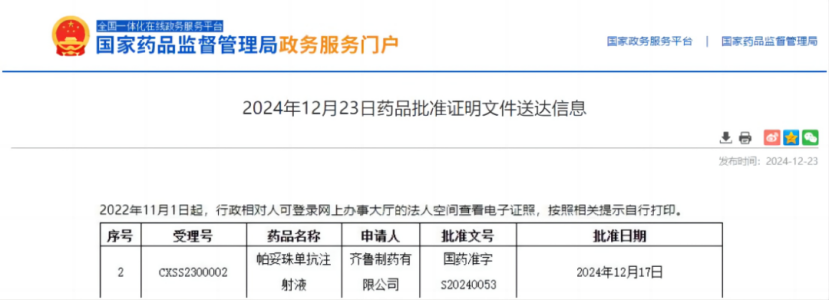
On December 23, 2024, the official website of the National Medical Products Administration (NMPA) announced that Qilu Pharmaceutical's Pertuzumab (QL1209, trade name: Ansaizhu) has officially received marketing authorization approval. In the treatment of early breast cancer: it is used in combination with trastuzumab and chemotherapy as neoadjuvant therapy for patients with HER2-positive, locally advanced, inflammatory, or early breast cancer (tumor diameter >2cm or lymph node-positive); and as adjuvant therapy for patients with HER2-positive early breast cancer at high risk of recurrence.
Notably, at the end of June 2023, Qilu Pharmaceutical's Trastuzumab for Injection (brand name: Anqulot) officially received marketing approval. This drug will be used to treat HER2-positive early breast cancer, metastatic breast cancer, and metastatic gastric cancer. Thus, Qilu Pharmaceutical has become the first company to obtain approval for biosimilars of both trastuzumab and pertuzumab, providing breast cancer patients with more diversified and accessible treatment options.
Industry insiders said that the combination of trastuzumab and pertuzumab further optimizes the diagnosis and treatment model for breast cancer, making it one of the important current anti-HER2 treatment options. With the support of the "trastuzumab and pertuzumab dual-target" biosimilar product portfolio, Qilu Pharmaceutical has officially entered its commercial harvest period. In addition, the "trastuzumab and pertuzumab dual-target" field has already attracted a group of companies, including Zhengda Tianqing and BriBiopharm, and the curtain on market competition is rising. A new market competition landscape is beginning to take shape.
Increase the Development of Targeted Drugs for HER2-Positive Breast Cancer
Pertuzumab Competition Intensifies
In breast cancer patients, HER2-positive breast cancer accounts for approximately 15%-20% of all breast cancer cases [1]. Due to its aggressive nature and poor prognosis, there is an urgent need for specific targeted therapies to improve patient outcomes. Since the market launch of trastuzumab in 1998, it has paved the way for targeted treatment of HER2-positive breast cancer. Subsequently, multiple targeted drugs against HER2 have emerged, fundamentally transforming the treatment landscape for HER2-positive metastatic breast cancer. Among them, pertuzumab, as a leading anti-HER2 drug, has played a pivotal role.
It is understood that HER2, a member of the receptor tyrosine kinase family, is mainly involved in the regulation of cell growth and differentiation. Its mutation or overexpression may lead to abnormal cell proliferation, thereby forming tumors. The mechanism of action of pertuzumab lies in blocking HER2 from forming heterodimers with other receptors, reducing intracellular signal transduction, thus slowing down or stopping the growth of HER2-positive breast cancer.
Qilu Pharmaceutical was the first to invest heavily in R&D resources for pertuzumab, an important breast cancer treatment drug, and became one of the pioneering companies to develop a biosimilar of pertuzumab. On December 17, 2024, Qilu Pharmaceutical's pertuzumab biosimilar, Ansaizumab, was approved for marketing by the National Medical Products Administration.
According to reports, this approval was based on a multicenter, randomized, double-blind, parallel-controlled Phase III clinical trial targeting HER2-positive, ER/PR-negative patients with early or locally advanced breast cancer. The study further evaluated the equivalence of Ansaizumab (QL1209) and the original drug Pertuzumab in the target indication.
The study results showed that Ansaizhu (QL1209) was equivalent to the original Pertuzumab in clinical efficacy, with safety and immunogenicity similar to the original Pertuzumab. The proportion of total pathological complete response (tpCR) assessed by IRC in the QL1209 group and the original Pertuzumab group were comparable (42.75% vs 45.17%), with a relative risk (RR) of 0.95 (90% CI, 0.80-1.11), and the confidence interval (CI) fully within the predefined equivalence range. In terms of drug safety evaluation, the incidence of treatment-emergent adverse events (TEAEs) in the QL1209 group and the Pertuzumab group were close (95.3% vs 96.1%).
Notably, Qilu Pharmaceutical is not the only company developing a biosimilar of pertuzumab.
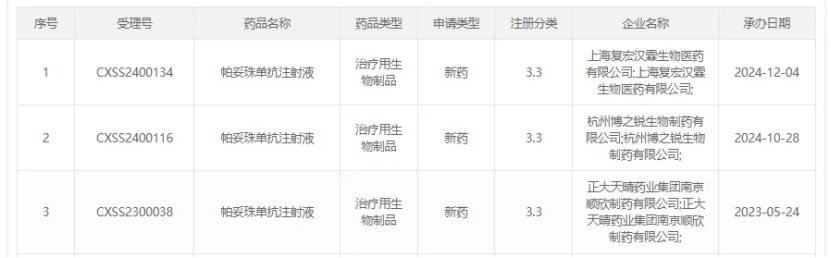
(Screenshot source: CDE official website)
According to incomplete statistics, other companies under research include Bright Biology, Henlius, etc. In October 2024, Bright Biology announced that the CDE had accepted the marketing application for Pertuzumab Injection independently developed by its wholly-owned subsidiary, Bozhi Rui. In December 2024, the marketing application for a related product submitted by Henlius was also accepted… Besides, companies such as CSPC and Double-Crane have made strategic moves, indicating an upcoming intense competition.
Industry insiders said that the emergence of biosimilars has enriched clinical treatment options and better met patients' personalized treatment needs. At the same time, biosimilars are expected to reduce treatment costs and improve treatment compliance. For enterprises, with the successive market launch of related products, head-to-head competition is about to begin.
Multiple Players Layout "Quppa Dual-Target"
Qilu Pharmaceutical Crosses the Finish Line First
In the actual clinical treatment of HER2-positive breast cancer, pertuzumab is often used in combination with trastuzumab. The combination of the two, known as "trastuzumab and pertuzumab dual-target," has achieved significant success in the comprehensive disease management and prognosis of HER2-positive breast cancer.
Researchers have found that pertuzumab and trastuzumab are synergistically complementary in mechanism of action. The combination of the two can more comprehensively block HER2 pathway signaling, enhance antibody-dependent cell-mediated cytotoxicity (ADCC effect), and activate immune NK cells to completely eliminate tumor cells. Therefore, the "pertuzumab and trastuzumab dual-target regimen" has been unanimously recommended by guidelines both in China and internationally, gradually becoming the preferred treatment for HER2-positive breast cancer.
Facing significant clinical efficacy and patient benefits, major pharmaceutical companies are accelerating their product portfolio layouts around the "Trastuzumab-Pertuzumab dual-target" biosimilars. Among them, Qilu Pharmaceutical, as the first Chinese manufacturer to hold the "Trastuzumab-Pertuzumab dual-target," is exerting considerable pressure on other participants in the HER2 breast cancer field.
In addition to Qilu Pharmaceutical, other companies such as Henlius, Bright Exploration, and Zhengda Tianqing, which have also developed pertuzumab biosimilars, have similarly launched trastuzumab biosimilars, accelerating the competition in the "dual-target of trastuzumab and pertuzumab." Moreover, Anke Bio, Hualan Biological, and Shanghai Institute of Biological Products have also made their moves.
Industry insiders believe that the overall landscape of "Quppa dual-target" biosimilars in China is currently characterized by diversification, intense competition, and rapid development. As more biosimilars are developed and produced, they can offer patients a wider range of treatment options, significantly improving drug accessibility and affordability.
But correspondingly, it also means that the market may enter the "involution" red ocean phase. As the pioneer in developing the pertuzumab biosimilar and the owner of the "dual-target trastuzumab and pertuzumab," Qilu Pharmaceutical's top priority now is time: on one hand, to accelerate the expansion into the commercial market, and on the other hand, to be vigilant against the "ambitious" latecomers.
[1] Tarantino P, Hamilton E, Tolaney SM, et al. HER2-Low Breast Cancer: Pathological and Clinical Landscape. J Clin Oncol. 2020;38(17):1951-1962.
Editor: Allen



www.yyjjb.com.cn
Insight into Industry Trends

《China Prescription Drug》
Academic Official Account
Focus on Pharmaceutical Academics and Evidence-Based Research

Terminal Official Account