Industry insiders say: "Most people who need hearing aids won't buy them due to factors like price, socio-psychological barriers, or convenience in daily life. There's also a well-known phenomenon in the hearing aid industry called 'in the drawer,' meaning people buy hearing aids but don't use them." According to statistics from the U.S. National Institute on Deafness and Other Communication Disorders, only 16% of adults aged 20 to 69 have ever used hearing aids.
"Hearing Glasses" aim to make hearing aids a fashionable, convenient, and economical invisible part of glasses.
Recently, EssilorLuxottica, the leader in the European eyewear industry, announced the acquisition of Pulse Audition, a French start-up audio technology company. Pulse Audition specializes in developing AI software for hearing glasses products. Its core technology provides excellent noise reduction and voice enhancement capabilities, helping individuals with hearing impairments better understand speech in noisy environments.
By integrating optics and audio, EssilorLuxottica may develop products that offer a completely new experience, further increasing its market share. This transaction marks another significant expansion by EssilorLuxottica in the eyewear manufacturing sector, aiming to further unlock the vast potential of the underserved hearing market and enhance its competitiveness in the smart wearable devices market.
Interestingly, after the acquisition news was announced, the stock prices of long-established hearing aid companies such as Oticon, ReSound, and Sonova all fell to varying degrees. This acquisition could be good news for other companies dedicated to integrating "audio-visual models" like hearing aids and glasses.
#01
Audio-visual Integration Mode
- Acquisition of Nuance Hearing
EssilorLuxottica Began Layout in the "Hearing Glasses" Field a Year Ago; In July 2023, EssilorLuxottica Acquired Israeli Startup Nuance Hearing for Tens of Millions of Dollars. The Group Stated That Through This New Initiative, a Groundbreaking Hearing Technology Will Be Introduced to Benefit 1.25 Billion Consumers with Mild to Moderate Hearing Loss.
Currently, it has fully integrated Nuance into a new super audio division led by Stefano Genco, former senior executive of Amplifon, the world's largest hearing aid retailer. The brand name of this division’s products is Nuance Audio.
Nuance Audio is a pair of smart glasses that combines hearing assistance and vision correction, suitable for individuals with mild to moderate hearing loss, and is expected to receive FDA approval in the first half of 2025.
This product helps users hear better in various environments through an open speaker system and advanced voice noise software, seamlessly embedding high-quality hearing technology into fashionable glasses. The audio components are completely invisible, eliminating the psychological barriers that prevent consumers from adopting traditional hearing aids. Nuance Audio glasses also integrate with a smartphone application, allowing users to personalize settings through the app.
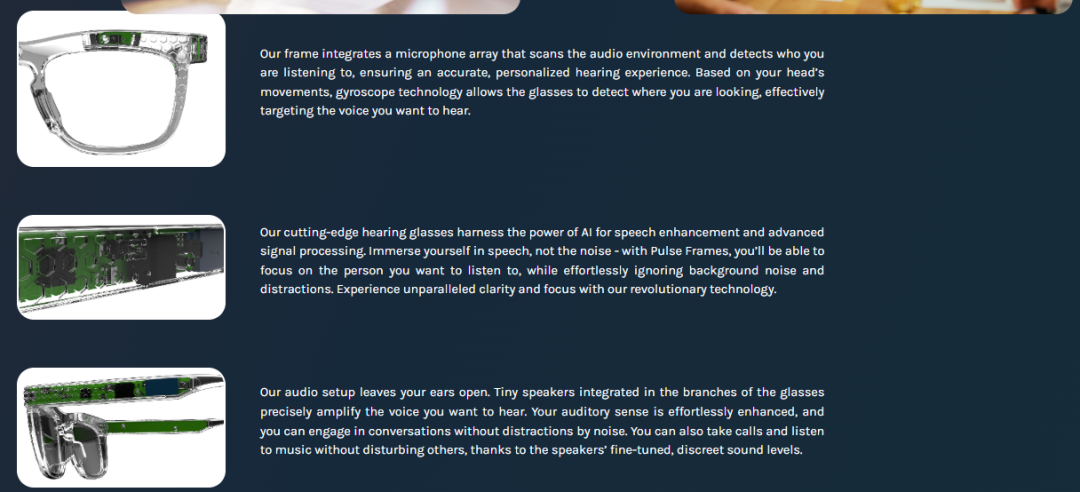
Similar to most hearing aid products, Nuance Audio glasses also require a hearing calibration before use, which can be completed independently through an application in just one minute. The frame is equipped with beamforming microphones to pick up the speaker’s voice, while the built-in head contour calibration algorithm enhances speech directionally without amplifying the overall ambient sound.
Moreover, the price of Nuance Audio glasses (including prescription lenses) is expected to be more competitive compared to hearing aids, which can cost up to $6,000 and are not covered by U.S. public insurance plans.
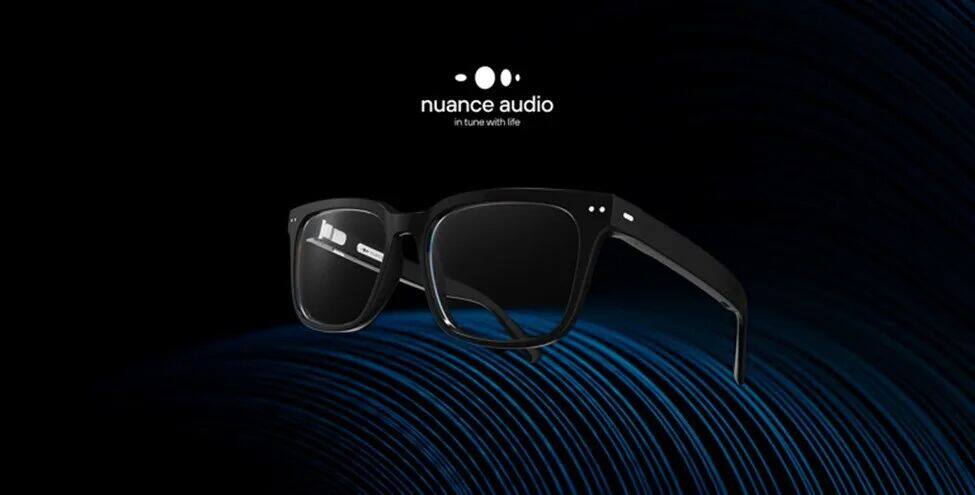
Nuance Audio Smart Glasses
The core technology of Pulse Audition mainly focuses onArtificial Intelligence Noise Reduction and Speech Enhancement AlgorithmsAbove, these technologies offer significant assistance to those with hearing impairments.
AI Noise Reduction Technology
Pulse Audition Using Deep Learning Models to Identify and Suppress Environmental NoiseThese models, through learning from large amounts of noisy data, are able to accurately identify various types of background noise and effectively separate them from audio signals.- Real-time Dynamic Adjustment: This technology can adjust noise reduction parameters in real time based on the user's environment. For example, in a quiet indoor environment, the noise reduction intensity will automatically decrease to maintain natural sound; whereas in a noisy outdoor environment, the noise reduction strength will increase to ensure voice clarity.
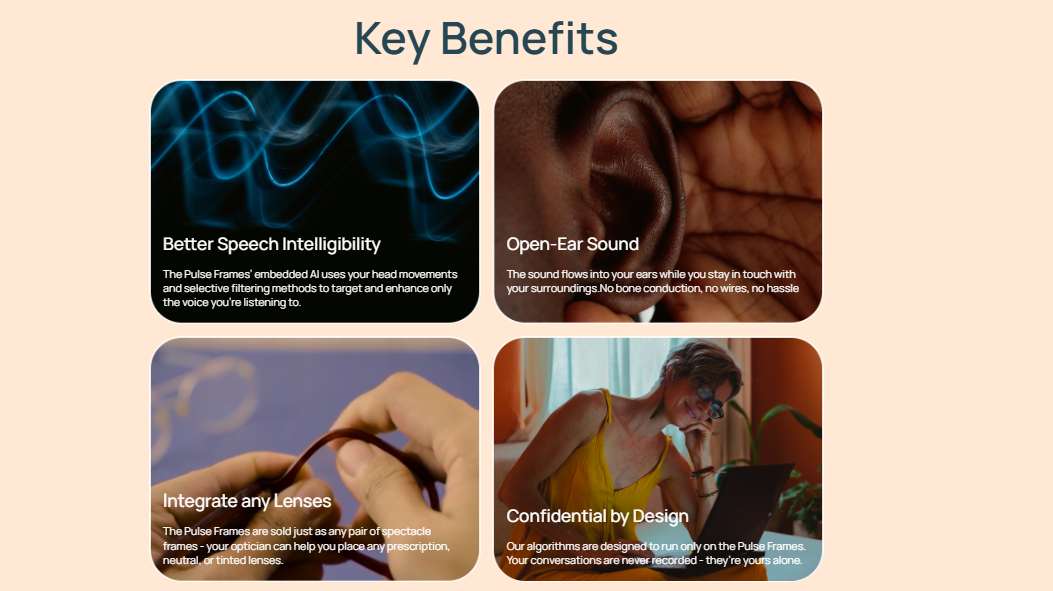
Signal Enhancement: After noise reduction, the AI model will further enhance the speech signal using techniques such as equalization and dynamic range compression to improve speech clarity and intelligibility.
Embedded AI and Audio Signal Processing: Combining embedded AI with audio signal processing technology enables hearing devices toAutomatically optimize audio output in different environments to ensure users can clearly hear the desired sound.
For those with hearing impairment, Pulse Audition's technology can provide assistance in various everyday environments.For assistance, whether conversing with others or in noisy public spaces, it ensures the clarity of speech.Smart Glasses Become New FocusIn July 2024, there were reports thatMeta Plans to Acquire Approximately 5% of EssilorLuxottica's Shares, according to the latter's current market value of 101.5 billion euros (approximately 760.1 billion RMB), this potential deal could amount to billions of euros. Negotiations are currently underway.Almost at the same time period,Google is also rumored to be in contact with EssilorLuxottica.The two parties plan to cooperate in producing smart glasses equipped with Google's large AI model, Gemini. Further acquisition of shares will also help Google enhance its say in the cooperation.Whether it's Meta or Google,The purpose of extending the olive branch is to point towards smart glasses., to collaborate on producing more and upgraded versions of smart glasses, accelerate the application of generative artificial intelligence, and seize the opportunity in the upcoming competition for AI hardware.- Large Models Are Changing the Game Rules for Smart Glasses
In the hardware field, there has always been a "triangle of impossibility" theory: under certain technical conditions, it is very difficult to balance performance, size, and price. If you want to maximize any two of these factors, the third one will inevitably fall short. However, Ray-Ban Meta has preliminarily achieved a balance among these three aspects.
October 2023,Meta Collaborates with EssilorLuxottica to Launch New Smart Glasses Ray-Ban Meta, Priced at $299Ray-Ban Meta not only features significant upgrades in functions such as photography, videography, audio, power consumption, and storage, but it is also the first smart glasses with built-in Meta AI. Relying on the capabilities of the Llama large model, users can activate the voice assistant through voice commands for conversational operations.According to Counterpoint Research, the product resulting from Meta's collaboration with EssilorLuxottica has become a best-seller in most Ray-Ban stores across Europe, the Middle East, and Africa, with total sales exceeding one million units as of May 2024. CICC estimated that Meta’s eyewear shipments could reach two million units in 2024. Moreover, considering that AI functionalities are currently limited to users in the U.S. and Canada, if regional and language support expands globally in the future, corresponding sales might surpass six million units.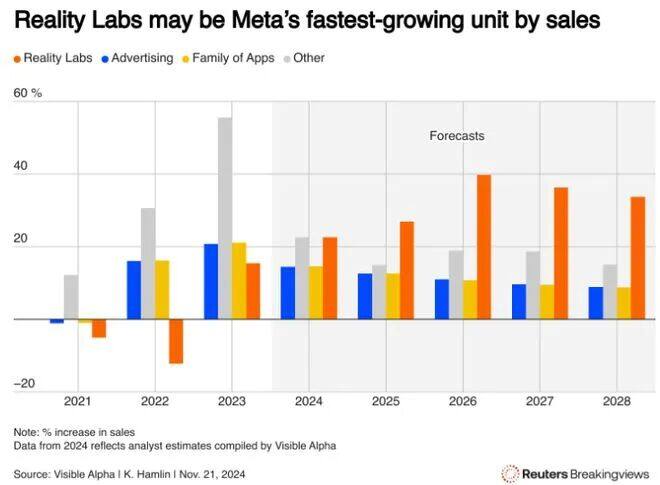 Unlike bulky virtual reality or augmented reality headsets that failed to win public favor, Meta's device looks just like ordinary glasses, weighs less than 50 grams, and offers practical everyday functions such as real-time translation, hands-free photo taking, and video capture based on built-in storage and processing capabilities. It can also seamlessly connect to smartphones, similar to wireless earbuds. Additionally, Meta's Ray-Ban glasses claim a battery life of four hours, while competitor Snap's battery lasts less than an hour.Counterpoint analysts estimate that the cost for Meta and EssilorLuxottica to manufacture a pair of smart Ray-Bans glasses is close to $135, implying a gross margin of 45%. According to analysts at Itaú BBA, this percentage is higher than the approximately 30% gross margin of the Apple Watch and approaches the 50% gross margin of AirPods. Reducing the costs of processor chips and batteries without compromising functionality and features will be a challenge, but not an impossible one.Of course, the Ray-Ban Meta still has its drawbacks, such as a limited user base, linear output, a learning curve for wake words and commands, and battery life anxiety, which prevent it from being suitable for heavy use. However, the multimodal interaction capabilities provided by the latest technology, along with its comfortable wearability, still significantly enhance its potential in the AI direction.Thus, it is not difficult to understand Google's intervention mentioned at the beginning. After all, the concept of smart glasses was initially proposed by Google, and it can be considered as Google’s unresolved aspiration (In 2014, Google's smart glasses, Google Project Glass, failed in the general consumer market, offering nothing more than a fleeting moment of excitement, which was quite regrettable).
- Potential smart glasses teams enter the market
In fact, it’s not just tech giants like Meta and Google. The hot sales of the second-generation Ray-Ban Meta have spurred a new wave of potential smart glasses teams to enter the market, creating a buzz reminiscent of the VR boom in 2016. However, whether startups are capable of competing with big companies remains a question worth debating.Among the many product forms and tracks in AI hardware, smart glasses remain a very important branch. The maturity of technology has once again made them a potential winner in the field of AI hardware.Because of this, manufacturers both in China and internationally are taking action. In November 2024, Baidu launched a pair of glasses powered by the AI robot Ernie; Amazon is also developing smart glasses for delivery personnel; Apple, Samsung Electronics, Xiaomi, and Alphabet are all working on new products; OPPO, vivo, Huawei, Tencent, and ByteDance have recently been evaluating AI glasses projects. It has also been reported that Apple is assembling a team to research the AI glasses market.Despite numerous manufacturers entering the market, a problem that cannot be ignored is the homogenization of products.First, from the artificial intelligence (AI) glasses that have been launched so far, current AI glasses can mainly be divided into two categories: one type is glasses products developed from the perspective of AI technology, focusing on the practical application of AI technology; the other type integrates AI technology from the perspective of augmented reality (AR) technology, expanding the functions of the glasses.Looking at the specific functions, in fact, most manufacturers' AI glasses are benchmarked against Meta's products or innovate based on Meta's foundation. Manufacturers mostly focus on integrating functions around the three core elements of "audio," "camera," and "AR display." As a result, voice broadcast reading and large model question-and-answer interactions have become standard configurations, while advanced functions such as real-time AI translation, voice calls, and AR navigation have also become common, meaning "if you have it, I have it too."The war of smart glasses may have just begun.EssilorLuxottica was established in October 2018, formed by the merger of Italy's Luxottica and France's Essilor. It currently owns 150 brands, covering all categories from eyewear to lens technology.EssilorLuxottica has five major R&D centers worldwide, with over 500 researchers, and to date, holds more than 9,500 patents (including those in the application process). The group (including joint venture partners) has more than 69,000 employees across 70 countries and regions globally, providing products and services to over 100 countries and regions, and serving approximately 350,000 customers with lenses and lens manufacturing equipment.In the first nine months of the 2024 fiscal year, the group's revenue increased by 4.9% year-on-year to 19.727 billion euros, with a cumulative 35.16% increase in share price over the past 12 months.