

GeneThera's AAV Gene Therapy GC310 for Wilson Disease Receives IND Approval in China

Genecradle
Gene Therapy Drug Developer
On February 6, 2025, Beijing Genecradle Therapeutics Co., Ltd. (hereinafter referred to as "Genecradle") independently developed a gene therapy drug.GC310 Adeno-Associated Virus Injection("GC310 Injection"),Granted Implied Permission for Clinical Trial Registration by the National Medical Products Administration(Application Nos.: CXSL2400774, CXSL2400775), with the indication for Wilson's disease.GC310 Adeno-Associated Virus Injection is the fourth Class 1 new gene therapy product developed by Genecradle to have received IND approval.。
The clinical trial application for GC310 Injection was submitted on November 14, 2024, and after a rigorous review process, it was approved on February 6, 2025. This efficient approval process not only reflects the support of the National Medical Products Administration for innovative drugs but also highlights the R&D strength of Genecradle in the field of gene therapy.
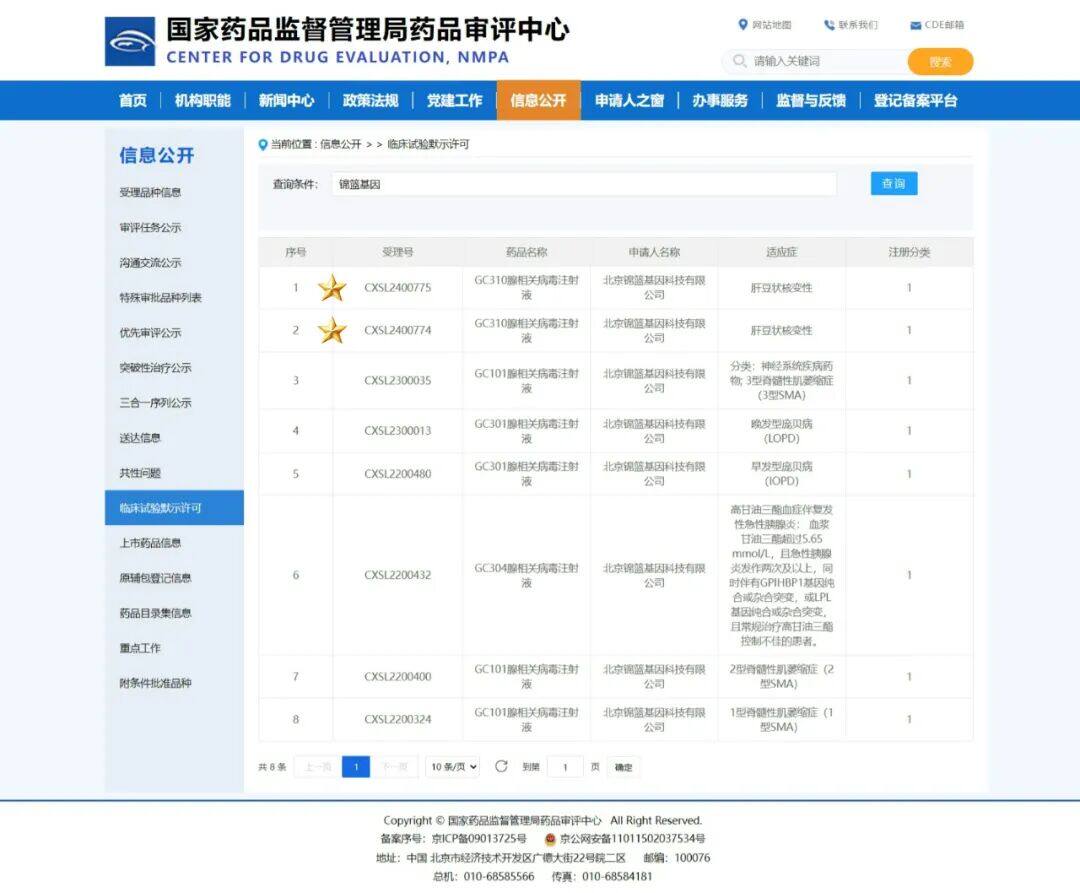
Genecradle's Overview of Granted Clinical Trial Implied Permits (IND)
Source of the image: CDE official website
Screenshot
Hepatolenticular Degeneration, also known as Wilson Disease (WD), is an autosomal recessive genetic disorder caused by mutations in the ATP7B gene.Functional defects in the ATP7B gene lead to copper metabolism disorders, causing toxic free copper ions to accumulate abnormally in the body, mainly depositing in the liver, central nervous system, kidneys, and cornea, etc., triggering a series of progressively worsening pathological changes, including cirrhosis, neuropsychiatric disorders, renal dysfunction, and the characteristic formation of corneal K-F rings.Globally, the prevalence of WD is approximately 1 in 30,000 to 100,000 people, while the carrier rate of the disease-causing gene is about 1/90.The age of onset for this disease varies widely, but it mainly concentrates in children and adolescents, with the peak incidence occurring between the ages of 5 and 35.Notably, epidemiological studies suggest that the incidence and carrier rate of WD may be higher in Asian regions such as China compared to Western countries, with some data indicating that the incidence in China may approach one in ten thousand.In terms of treatment, hepatolenticular degeneration faces significant clinical challenges and unmet needs.The current standard treatment regimen requires patients to undergo frequent drug interventions for a long term or even lifelong after diagnosis, yet these treatments cannot fully restore the normal metabolic balance of copper ions within tissue cells.As the disease continues to progress, if not effectively controlled, it will inevitably worsen to the middle and late stages, posing a serious threat to the patient's life.Therefore, it is particularly urgent to explore more efficient treatment strategies that can fundamentally improve copper metabolism abnormalities.
GC310 AAV Injection is an AAV gene therapy drug independently developed by Genecradle for the treatment of Wilson's disease. Non-clinical studies have demonstrated good drug safety and significant efficacy. A single treatment enables the target tissue to express the miniATP7B copper transporter with biological function, restoring copper metabolism capacity and increasing ceruloplasmin levels, which is expected to improve the condition of the Wilson's disease community in the long term.
About Genecradle
E.N.D

Previous article recommendations:
A Foreign Enterprise to Build Industrial Base for Cell Therapy Products in China
Gene Therapy Company Huayi Lejian Founded by Rao Yi Appoints New President
CDE of NMPA Releases Technical Guidelines for Non-Clinical Studies of Preventive mRNA Vaccines
China's Leading Culture Medium Company Acquires a CRO Company
$810 Million! Two AAV Gene Therapy Out-Licensing Collaborations Achieved
Chinese Scientists Achieve Significant Breakthrough, Induce Human iPS Cells in as Fast as 10 Days
NMPA Inspection Center Releases "Guidelines for the Production Inspection of Cell Therapy Products"
World's First! Chengdu Usino Umbilical Cord Blood-Derived Universal CAR-T Product Approved for Clinical Trials in the U.S.
China's First Stem Cell Therapy Approved for Marketing