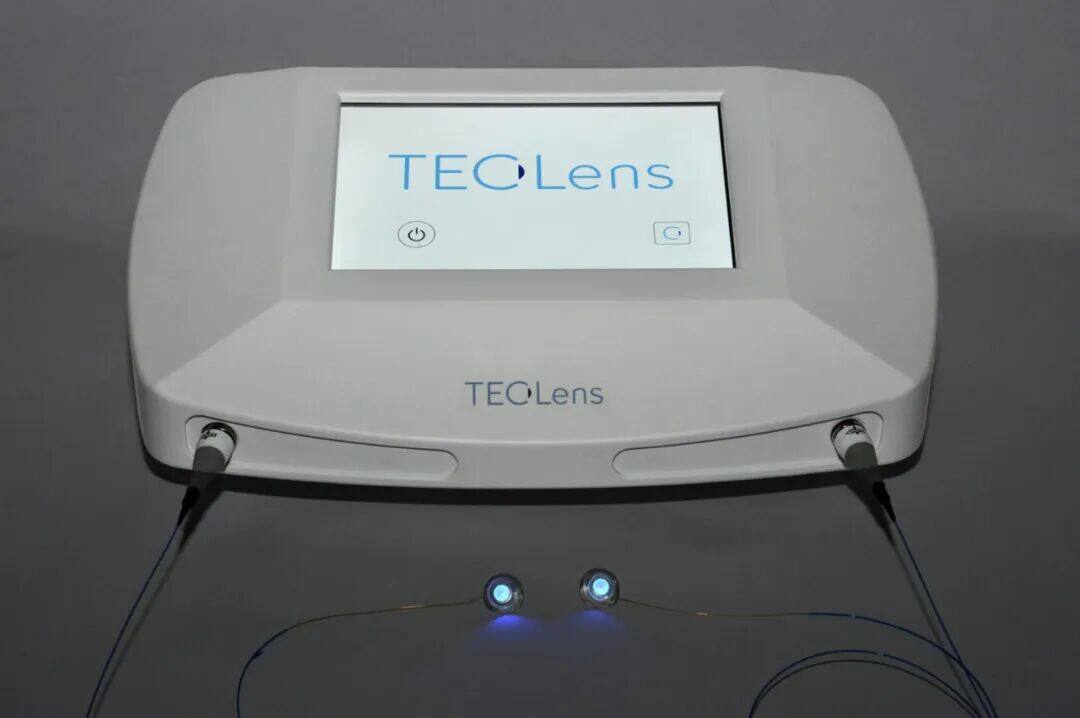
Source: Eye Future; Editor: SophiaReprint Requirements: Can be reprinted 24 hours after the first publication, source must be credited.Recently, a startup medical technology company dedicated to disrupting the refractive surgery marketTECLens Announcement Completed$9.3 million (approximately 67.89 million RMB)Series A Financing, to support the clinical development of the company's non-incisional refractive correction surgery. The surgeryReshaping the Cornea Using Corneal Cross-Linking (CXL) Technology. This round of financing was led byJohnson & JohnsonThe innovative investment departments JJDC Inc. and Yonjin Capital jointly led the investment, with other investors including Rimonci Capital and Sunmed Capital.
The core technology of the company is a product namedInnovative Incision-Free Technology of Quantitative Corneal Cross-Linking (qCXL™), which can reshape the cornea without the need for laser ablation or invasive surgery. This investment also aligns with Johnson & Johnson's commitment to advancing smarter, minimally invasive, and personalized medical solutions.TECLens initially targeted presbyopia but plans to expand its clinical research to cover keratoconus, mild myopia, hyperopia, and astigmatism. The company envisions itsNon-invasive, clinic-based treatmentIs expected to become the first choice for patients seeking refractive correction.TECLens is currently planning its first refractive correction clinical study for a single-use vision correction treatment.
# Clinical Pain Points
Traditional corneal cross-linking (CXL) technology uses riboflavin and ultraviolet light to enhance corneal strength.ThroughThe combination of riboflavin (a type of vitamin B2) and ultraviolet (UV) light enables the cross-linking of collagen fibers in the cornea., thereby enhancing the hardness of the cornea.and stability, this method is mainly used to treat corneal diseases such as keratoconus.
Corneal Cross-LinkingIt is an important surgical method for treating corneal diseases such as keratoconus, mainly divided into epithelium-off and epithelium-on approaches. Its therapeutic effect is influenced by factors such as riboflavin concentration, irradiation energy, and exposure time.Therefore,How to make riboflavin penetrate quickly into the corneal stroma tissue has also been a hot topic of discussion in recent years.Mainstream technology usedCrosslinking instruments are relatively large in size., using overhead ultraviolet light to irradiate the cornea, with the ultraviolet lamp mounted on a movable arm support,Not only do they take up a large amount of space, but they also require doctors to constantly control the light to ensure proper targeting.。The patient needs to lie completely still on the operating table for about half an hour with the help of an eyelid speculum., patient compliance is also a key challenge.# qCXL——Refractive Technology RevolutionTECLens's Quantitative Corneal Cross-Linking (qCXL™) innovative incision-free technology reshapes the cornea without laser ablation or invasive surgery.Not only can it treat keratoconus, but also correct vision problems in healthy eyes., such as the restoration of reading vision for presbyopia patients, the control of progressive myopia in children, and the correction of adult vision errors like hyperopia and low-degree myopia.qCXL™ TechnologyA scleral contact lens connected by optical fiber delivers UV light directly to the eye., combined with a customized dose of riboflavin (vitamin B2), the treatment process is carried out under real-time ultrasound monitoring until the onboard sensors and algorithms determine that certain biomechanical properties of the corneal stroma have been adjusted to pre-planned values.
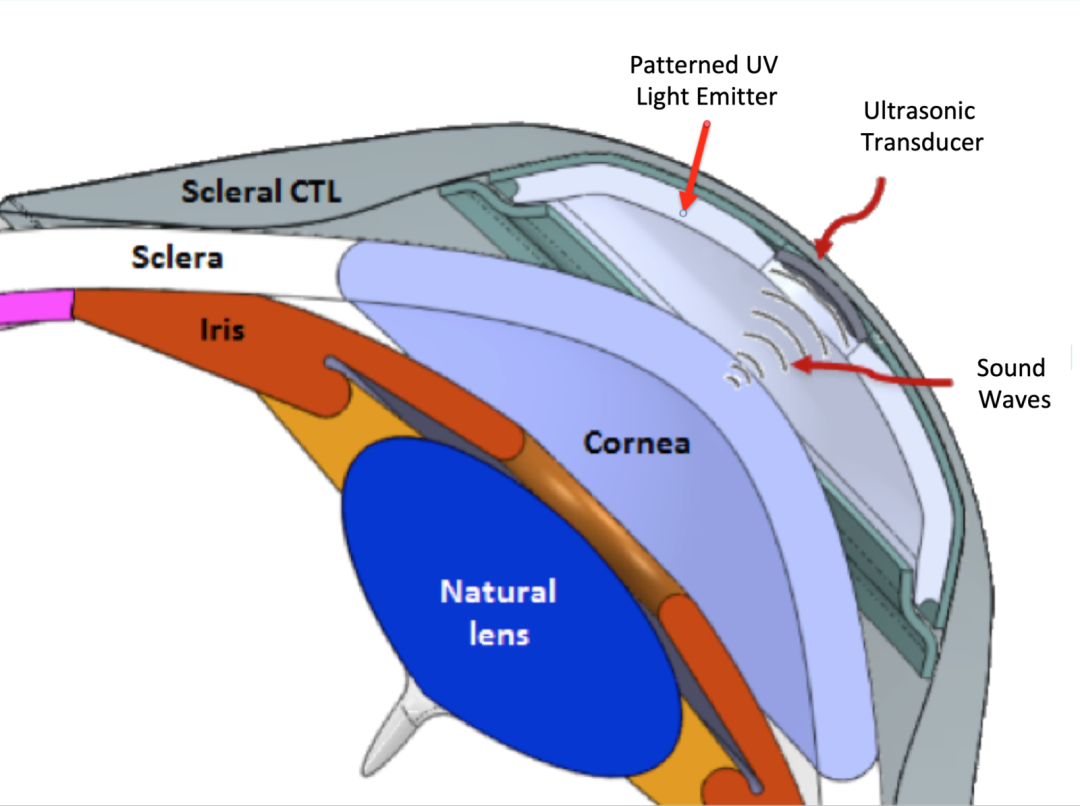
The patient does not need an eyelid speculum., allowing the wearer to open and close their eyes while using contact lenses. This technology is equipped with hardware and algorithms for tracking complex eye movements.Eye and head movements do not affect the treatment outcome., eliminating motion artifacts in patients.In addition, this technology is equipped withSpecialized Riboflavin Storage System, which can automatically enter the arch-shaped space formed between the contact lens and the corneal surface.After administration of vitamin B2 (riboflavin),CXLens acts directly on the scleral surface of the eye.(Above the cornea), the process of emitting specific ultraviolet light for corneal cross-linking;
Ultraviolet irradiation continues, and ultrasound is transmitted through the ultraviolet beam.Built-in ultrasound transducer provides real-time elastography feedback during the cross-linking process., to measure real-time quantitative cross-linking parameters, including increased corneal stiffness, collagen fiber tightening, and changes in corneal thickness;
CXLens Lens Cross-Section- CXLens Through thisClosed-loop drug deliveryModel, achieved control over permanent corneal shape changes (refractive correction).
- Special cross-linking solution for accelerated cross-linkingProviding a comfortable high-oxygen environment. Supplemental oxygen can accelerate reactions, stored in the reservoir of the scleral lens, providing an ultrasonic conduction pathway and carrying up to 60% of its weight in oxygen. Both ultraviolet light and ultrasound can penetrate.
TECLens, Inc., established in 2013, is developing a cross-linking technology capable of precisely correcting vision problems in healthy eyes as well as treating keratoconus. This innovation allows presbyopic patients to regain the ability to read at a distance, controls progressive myopia in children, and corrects vision issues such as adult hyperopia and mild myopia.The main members of the company's management team are as follows:Tom Dunlap serves as the CEO of TECLens, Inc., and has previously led global healthcare startups and divisions worth billions of dollars.He has held senior executive positions at HOYA Surgical Optics, Centricity Vision, Allergan Medical Optics, Bausch + Lomb, Coherent Medical, and Surgilase.He has also served on the boards of several ophthalmic companies.
David Acker is a co-founder of TECLens. He has founded multiple medical device companies, including "Biosense" (now "Biosense Webster, Inc."), which was acquired by Johnson & Johnson. Additionally, he holds 33 U.S. patents for medical devices in the field of minimally invasive surgery.Pat Lopath is a co-founder of TECLens, with over 20 years of experience in the medical device and pharmaceutical development fields. He has a background in management consulting and operational leadership in both medical device and pharmaceutical companies, and holds 17 U.S. medical technology patents.
IfBooth/White Paper/Speech SharingIf you are interested in the above content, please feel free to contact us.Contact information is as follows:You can also contact the editor-in-chief Zhao Qing, Alice, Jacky, Ziana and other staff members of the Siyu team directly.Ophthalmology Solutions Case
Ophthalmic Instruments Industry Research