

Chaomo Tech Completes Series B Funding Round; Class III Active Implantable Ocular Muscle Nerve Stimulator Submitted for Regulatory Approval
Super Vision
Ophthalmic Disease Treatment Product Developer

Fosun Health Capital
New Drug Innovation Fund
Text|Hu Xiangyun
Editor|Hai Ruo Jing
Imagine a life where one cannot steadily look straight ahead: the eyeballs are always uncontrollably swaying left and right. Although it does not lead to blindness, it severely affects vision. Clinically, this condition is known as Congenital Nystagmus (CN), considered an "incurable disease" in the field of ophthalmology. Relevant statistical data indicates that there are already 7 million CN patients globally; in China, the number of CN patients has reached the million level.
The cause of this type of disease remains unclear. In past clinical practice, since patients could not voluntarily control nystagmus, the goal of treatment has not been to "eliminate" the eye tremors but rather to reduce the severity of nystagmus through various methods to improve visual quality. Currently, while some ophthalmic surgeries can achieve this, they often have limited effectiveness or may lead to complications.

Symptom of Nystagmus (Illustration: https://makeagif.com/gif/animation-of-right-upbeating-torsional-nystagmus-seen-in-bppv-yXwH0C)
To completely solve this global medical challenge, Super Vision Technology, Inc. was officially founded in 2018, focusing on the precise development of high-end ophthalmic medical devices and medical chip research. Super Vision was initiated by Professor Wang Lejin, Chief Ophthalmologist at Peking University People's Hospital, and Professor Wang Wensi from Beijing University of Technology, among others. The co-founder and CEO, Wang Tianfang, has led and participated in multiple investments in medical device and pharmaceutical projects, possessing extensive experience in startup incubation and post-investment management.
36Kr learned that Super Vision has now completed its Series B financing. Since its establishment, the company has accumulated financing of several hundred million yuan, with investors including Suzhou Aibo Qingshi Biomedical Venture Capital Partnership (Limited Partnership), Fosun Health Capital, Longpan Investment, Chang Development Group, Yuanpei Investment, and Shuimu Ventures.
Recently, at the Global Healthcare Industry Innovation Conference jointly hosted by Tsinghua Industrial Development Research Institute and Global Healthcare Industry Innovation Center (GHIC), Wang Tianfang shared with 36Kr the latest progress in the development of medical device products for CN treatment by Super Vision.
Currently, the company's core product is a Class III active i-NYS implantable ocular muscle neurostimulator, which is primarily implanted through subcutaneous surgery behind the ear. The product contains a chip system that delivers electrical stimulation to the extraocular muscle nerve interface, helping patients suppress abnormal nerve impulses and thereby resolving nystagmus issues.
Compared with traditional surgical treatment, the advantage of the i-NYS treatment lies in "not damaging the patient's ocular nerves and muscles, with stable efficacy and good long-term prognosis." At the 2024 annual meeting of the American Association for Pediatric Ophthalmology and Strabismus, Super Vision disclosed relevant data: 71 clinical trials verified that after i-NYS treatment, nystagmus frequency and amplitude could be reduced by about 80%, fixation time could be increased approximately fourfold, and patients' visual quality and quality of life could be significantly improved.
Based on the results of existing clinical trials, i-NYS was approved to enter the National Medical Products Administration's special review process for innovative medical devices in January 2024.By the end of 2024, i-NYS officially submitted a registration application to the National Medical Products Administration (NMPA) and was accepted.
In the development of traditional neuromodulation medical devices (such as pacemakers, cochlear implants, vagus nerve stimulators, etc.), large size and heavy trauma are common issues, often leading to clinical challenges such as large surgical wounds, poor prognosis, and in-body rejection. Therefore, the current mainstream R&D trend internationally is to develop more miniaturized medical chip solutions.
"We have developed an ultra-small medical neuro-modulation chip measuring 3mm x 3mm. In addition to our product, this chip can theoretically be applied to the miniaturization research and development of all medical devices. In January this year, the chip completed its second round of tape-out. One of our future goals is to create a research and development platform based on neuro-modulation medical chips, applying this technology to the development of more neuro-modulation products within the industry," said Wang Tianfang.
It is reported that, apart from the i-NYS implantable ocular muscle neurostimulator, Super Vision has also developed a range of product pipelines in the ophthalmic medical device sector, covering indications such as myopia prevention and correction, strabismus diagnosis, glaucoma, and presbyopia. Among these, the product for myopia treatment will enter clinical trials within this year and is expected to be launched in the market in the next 2-3 years.
As the core product research and development work is basically completed, Super Vision is also advancing the market promotion of the i-NYS Implantable Ocular Muscle Neurostimulator. Currently, the company primarily adopts methods such as attracting traffic through online new media platforms, building private patient communities, and collaborating with medical institutions offline to establish innovative diagnosis and treatment centers, expanding the market influence of this product.
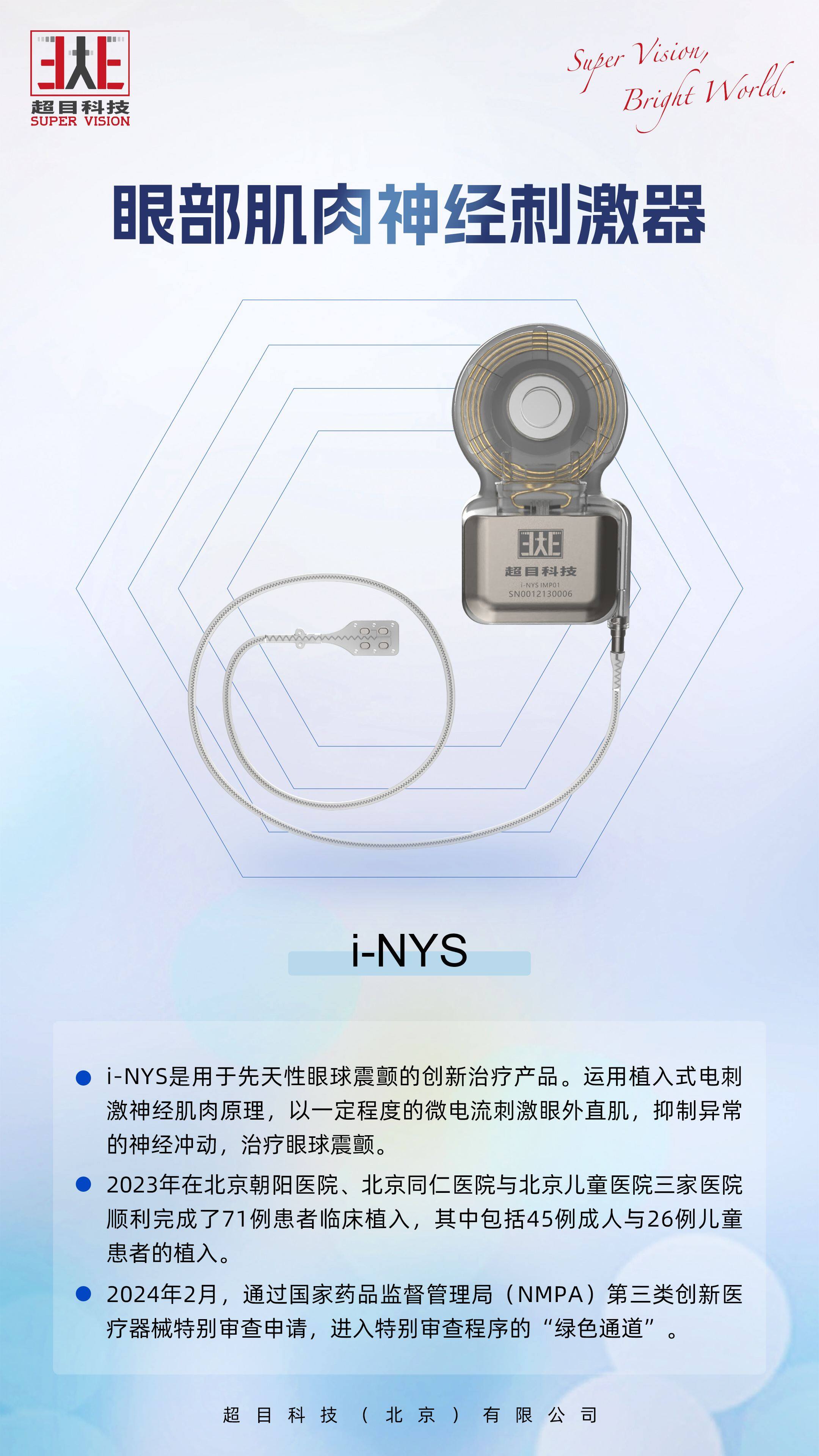
i-NYS Implantable Ocular Muscle Neurostimulator (Source: Super Vision)
Moreover, when discussing the surge in overseas expansion by medical device companies over the past two years, Wang Tianfang stated that as a global innovator in medical device R&D, going global has always been one of Super Vision's core strategic directions. In 2022, Super Vision established a subsidiary in the United States. By continuously participating in professional ophthalmology conferences in the U.S. and expanding business resources over the years, the company has gathered a group of overseas experts and partners to jointly support the registration and application process for its products in the North American market. "In the future,Super Vision Subsidiary to Further Develop Independently Through Capitalization"Allowing the 'China chip' to go global and serve more patients worldwide."
According to Wang Tianfang's observation, the entrepreneurial, investment, and operational logic of American medical device companies is clear, with diverse exit channels. "In the United States, the valuation for early-stage financing in the medical device industry is generally transparent. Overall, both the exit cycle and the level of exit prices are relatively high. Given the high financial cost of clinical trials and market approval in the U.S. for domestically produced innovative medical devices, if they can develop independently overseas, the probability of success is higher. This also represents an early exploration of value in the North American and even global markets."