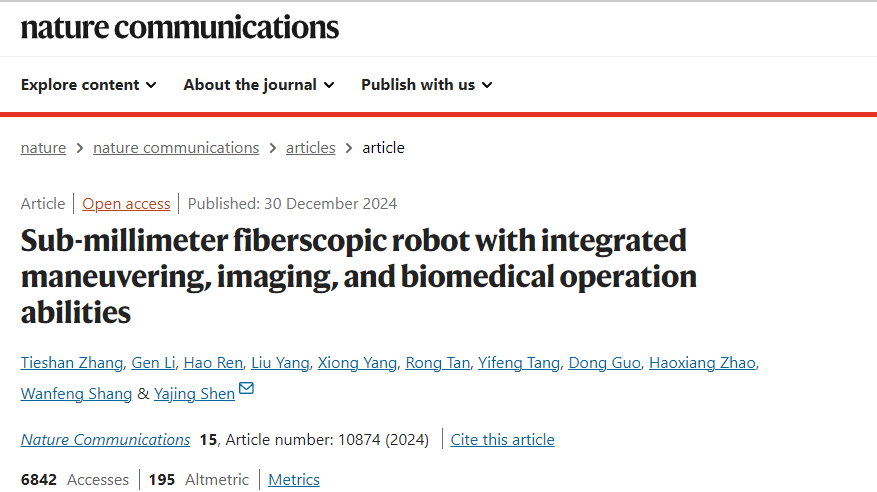
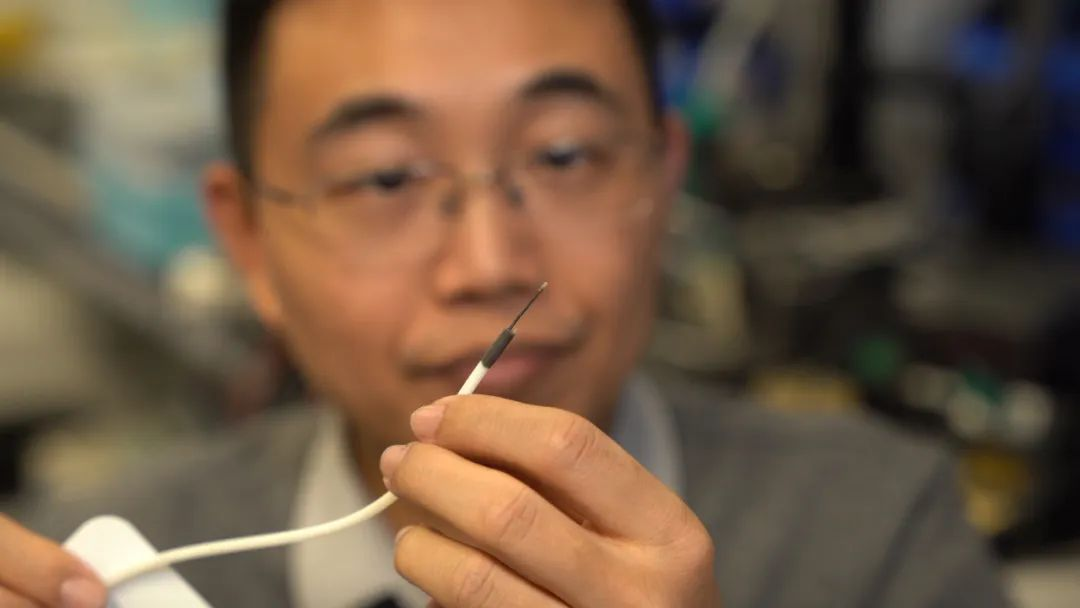
In the medical field,Micro-robotWith its minimally invasive and precise characteristics, it brings more possibilities to scenarios such as drug delivery, diagnosis, and surgery, becoming an emerging research direction. However, existing medical microrobots often struggle to balance the three key requirements of compact size, precise manipulation, and visualization.Facing Size, Precision, and Function Constraints, known as "Impossible Triangle”。 Recently, fromThe Hong Kong University of Science and Technology, City University of Hong Kong, Shenzhen Institutes of Advanced Technology, Chinese Academy of SciencesResearchers from institutions such as [institution names] published an article titled in Nature CommunicationsSub-millimeter fiberscopic robot with integrated maneuvering, imaging, and biomedical operation abilitiesResearch paper. Among them, a fiber optic robot was proposed, achieving an ultra-thin profile of 0.95 mm.Becoming the world's smallest multifunctional biomedical robot, with a volume 60% smaller than existing robots. Not only that, but the miniature robot also boasts powerful performance,Capable of clear imaging and precise manipulation, such as detecting obstacles at a distance ten times beyond the theoretical limit and expanding the inherent field of view by approximately 25 times, etc.。 Furthermore, the researchers verified through in vitro pig model experiments that the robot was able to enter.Restricted channel environments such as pulmonary bronchi, and perform functions like sampling, drug delivery, and laser ablation.。 Yajing Shen, associate professor in the Department of Electronic and Computer Engineering at the Hong Kong University of Science and Technology, said that this groundbreaking robot has great potential for clinical applications, with the prospect of enabling early diagnosis and treatment of hard-to-reach parts of the body. Zhang Tieshan, a postdoctoral researcher at the Hong Kong University of Science and Technology, stated that he will further optimize the design and control of fiber optic robots, prioritizing the safety and reliability of interventional surgeries.Looking forward to conducting in vivo tests to demonstrate its performance in clinical scenarios. Data shows that the global micro-robot market size reached$30.2 billion(approximately 219.5 billion RMB), and is expected to grow to$104.5 billion(Approximately RMB 759.7 billion), with a compound annual growth rate of 16.79%. Among them, healthcare will become one of the largest application scenarios for microrobots, driven primarily by the surge in demand for minimally invasive surgery, targeted drug delivery, and precision diagnostics., leading to the development of three major application scenarios: interventional surgery, in-vivo diagnostics, and drug delivery. Currently, related companies in China includeKouTech(Microsurgical Robot),Qiaojie Li(Endoscopic surgical robot),Dessight Biomedical(Ophthalmic surgical robot), etc.