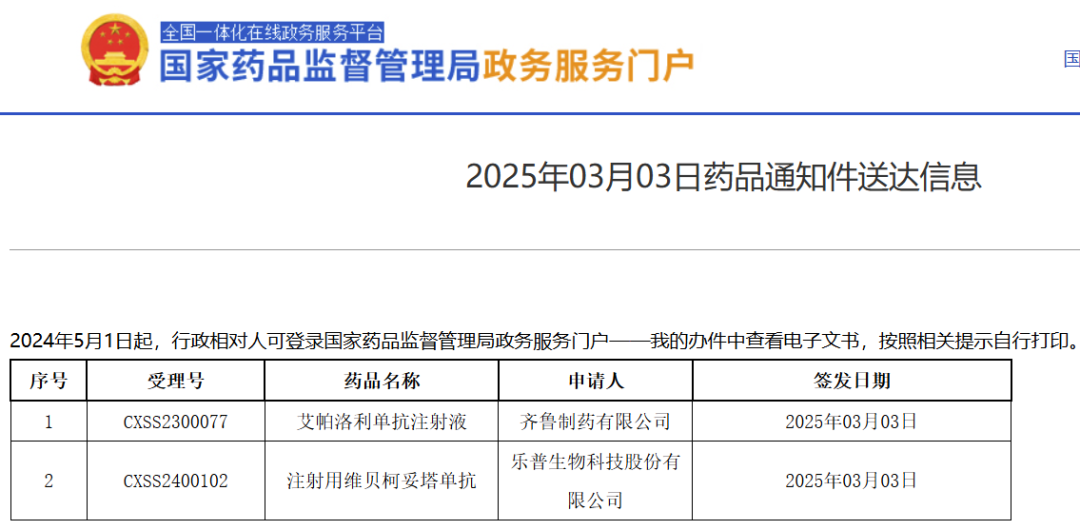
According to the latest drug notification delivery information from the National Medical Products Administration (NMPA), Qilu PharmaceuticalEpalumab Injection(Application No.: CXSS2300077, Registration Category: Class 1) andLEPU BIOPHARMA's Injectable Vericetuzumab (Application No.: CXSS2400102, Registration Category: Category 1, Indication:Recurrent/Metastatic Nasopharyngeal Carcinoma That Has Failed at Least Two Lines of Systemic Chemotherapy and PD-1/PD-L1 Inhibitor Treatment) in the list.Generally speaking, appearing in the notification letter usually implies two possibilities: one is that the drug's marketing application may not be approved, and the other is that the company may have voluntarily withdrawn the application. However, it is currently impossible to determine which specific case it is. Regardless of the reason, it indicates that the two pharmaceutical companies' respective new drugs cannot be launched as scheduled.1. Qilu PD-1 Monoclonal AntibodyPublic information shows,Epalumab Injection (R&D Code: QL1604)For Qilu PharmaceuticalThe world's first PD-1/CTLA-4 dual-function combination antibody developed. This drug consists of Aipalolizumab, which targets PD-1, and Tuvonralizumab, which targets CTLA-4, and has a synergistic mechanism of action that simultaneously blocks the two immune checkpoint pathways of PD-1 and CTLA-4.In December 2023, Qilu Pharmaceutical announced the Phase II clinical study results of its monotherapy for treating DNA mismatch repair deficiency (dMMR) or high microsatellite instability (MSI-H) solid tumors at the 2023 ESMO Congress.From June 2020 to January 2023, a total of 120 patients with dMMR/MSI-H solid tumors were enrolled, including 80 cases (66.7%) of colorectal cancer, 18 cases (15.0%) of gastric cancer, and 22 cases (18.3%) of other solid tumors; 97.5% of the patients were at stage IV at enrollment, with a median treatment line of 2.0 (range: 0–6).In terms of effectiveness, as of July 20, 2023,With a median follow-up time of 13.6 months, 11 patients achieved complete response (CR), and 44 patients achieved partial response (PR). The overall response rate (ORR) was 45.8% (95% CI: 36.7%–55.2%), and the disease control rate (DCR) was 77.5% (95% CI: 69.0%–84.6%). In colorectal cancer patients, the ORR and DCR were 42.5% (95% CI: 31.5%–54.1%) and 77.5% (95% CI: 31.5%–54.1%), respectively. The median duration of response (DoR) has not yet been reached, with 6-month and 12-month DoR rates of 100% and 97.4%, respectively. The median progression-free survival (PFS) and median overall survival (OS) have not been reached.。In terms of safety, the incidence of treatment-emergent adverse events (TEAEs) during the treatment period was 97.5%. The incidence of the most common treatment-related adverse events was 25.8%, and the incidence of grade 3 or higher treatment-related adverse events (TRAEs) was 5.0%; no treatment-related deaths occurred.On September 30, 2024, Eparlolibotuovirelimab Injection was conditionally approved by the NMPA for marketing to treat patients with recurrent or metastatic cervical cancer who have failed previous platinum-based chemotherapy.The appearance of the Eparalib monoclonal antibody injection in the NMPA's notification for pending collection may be related to subsequent supplementary applications or the approval of other indications. However, it is currently uncertain whether the specific reason is related to the drug's approval status; this still requires waiting for the official response from Qilu Pharmaceutical.
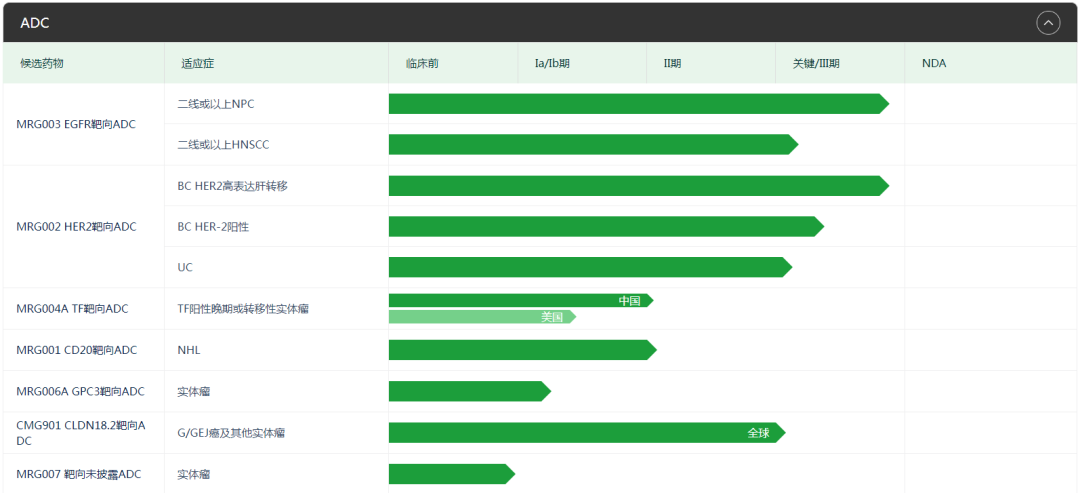
2. LEPU BIOPHARMA EGFR ADCVebecotamab for Injection (Research Code: MRG003)) is LEPU BIOPHARMA's ADC targeting the epidermal growth factor receptor (EGFR). It consists of an EGFR-targeting monoclonal antibody conjugated with the potent microtubule inhibitor monomethyl auristatin E (MMAE) via a valine-citrulline linker. It specifically binds to EGFR on the surface of tumor cells with high affinity, and after internalization and cleavage by lysosomal proteases, releases the potent payload, leading to tumor cell death.The indications under research areSecond-line or above NPC (nasopharyngeal carcinoma) or HNSCC (head and neck squamous cell carcinoma). Its nasopharyngeal carcinoma indication submitted an application for marketing authorization to the CDE in 2024 (Acceptance No.: CXSS2400102) and received priority review status.For receiptDrug Notification Delivery InformationToday, LEPU BIOPHARMA issued the latest announcement in response, stating that the reason for the notification was the CDE's request to supplement relevant materials. Therefore, the company withdrew the application and resubmitted the listing application today.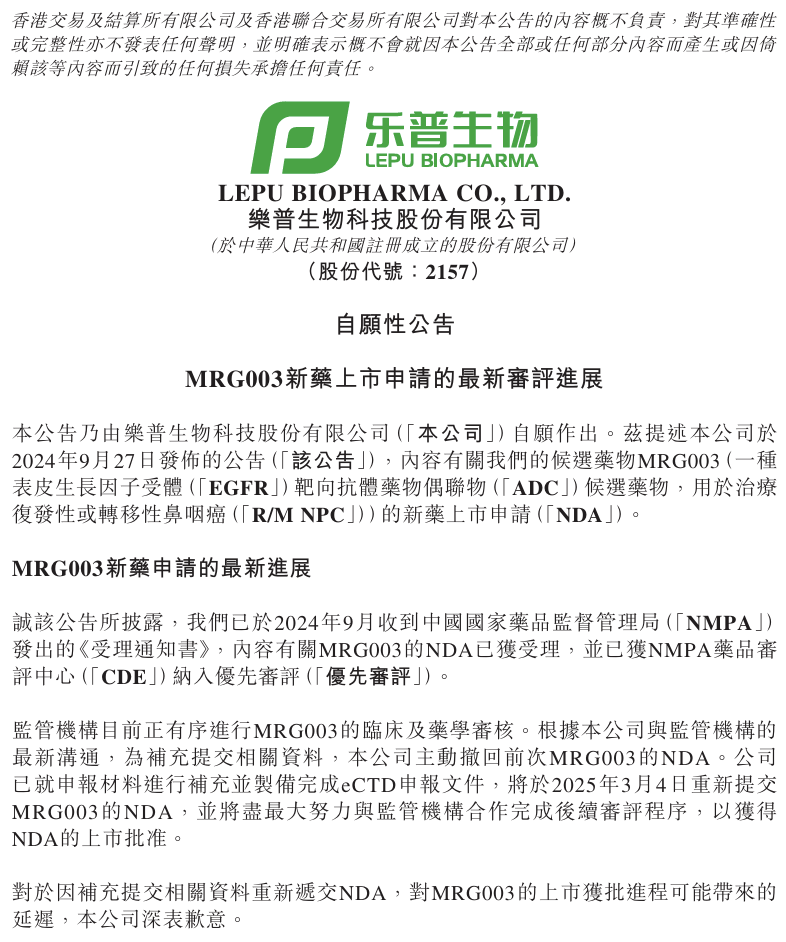
Regarding the concerns previously raised by investors, such as whether the lack of approval for listing was due to poor clinical data, CMC issues, etc., LEPU BIOPHARMA also proactively held a communication meeting on the morning of March 4, 2025, to address the public's concerns and provide detailed explanations. Based on the content discussed during the meeting, it was stated that...MRG003The relevant content, as well as LEPU BIOPHARMA's subsequent new drug plans and recent achievements, can be roughly summarized in the following points:
MRG003's recent disapproval was not due to issues with clinical trial data and does not impact its market launch. The main reason was errors in the submitted materials this time, and internal disciplinary actions have been taken against the team.
The resubmission of MRG003's marketing application this time will impact the overall product timeline by approximately 1-3 months (from the end of 2025 to early 2026), but it will not affect the 2026 National Reimbursement Drug List (NRDL) negotiations.
In the second half of 2025, there will be an initial clinical data readout for therapies related to MRG003 in combination with PD-1. The multi-antibody platform has currently screened out a novel antibody, which is expected to submit an IND in the first half of 2025.
LEPU BIOPHARMA Sees Positive Growth, 2025 to Be a Year of Significant Gains.
In summary, the submission of the MRG003 marketing application has little impact on the overall product launch and progress, and minimal influence on critical timeline milestones (such as National Reimbursement Drug List negotiations). Additionally, due to the use of the eCTD format for submitting registration documents, there may be potential acceleration in the review process. More importantly, this will positively influence the regulatory approval processes for the company’s subsequent new drug products.
This article is compiled fromDrug News Commentary,Boya Express,Yidu Medicine, etc.。
Scan the WeChat QR code, add the editor of the Antibody Circle, and those who meet the requirements can join the Antibody Circle WeChat group!Please indicate: Name + Research Direction!
All reproduced articles in this official account are intended to convey more information, with the source and author clearly indicated. Media or individuals who do not wish to be reproduced can contact us (cbplib@163.com), and we will immediately proceed with deletion. All articles represent the views of the author and do not represent the position of this website.