

BVI Medical Secures $1 Billion Funding, Reshaping the Global Cataract Treatment Landscape

BVI Medical
Ophthalmic Instrument R&D Manufacturer
Major Financing in the Ophthalmology Industry is Coming!
Recently, a financing announcement of up to 1 billion US dollars (equivalent to approximately 7.2 billion RMB) has set a new historical record for the largest publicly disclosed financing in the global ophthalmology primary market.
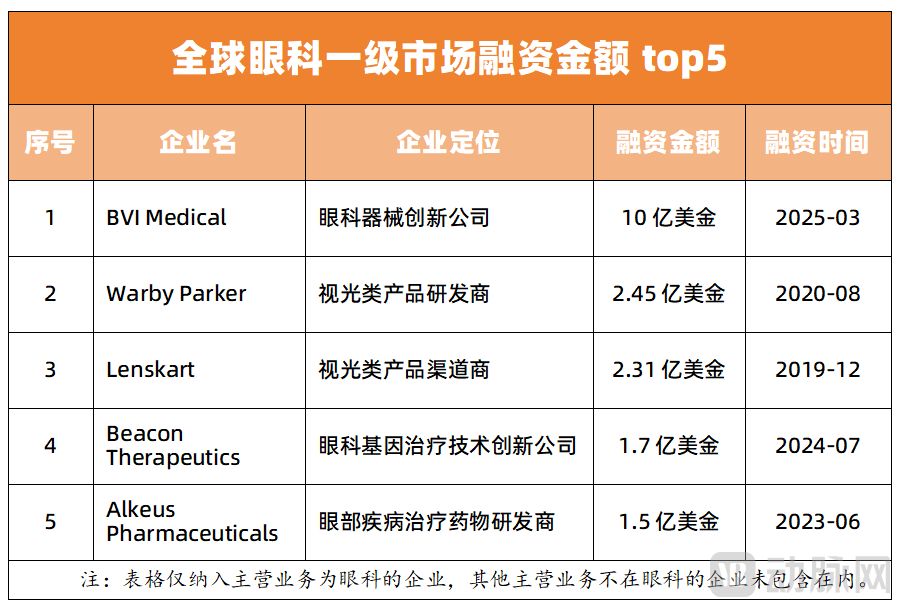 ▲Data source: VCBeat Database VCBeat Chart
The company behind the financing is BVI Medical, headquartered in the United States. Its core business mainly involves providing a series of high-quality ophthalmic equipment and consumables for ophthalmic surgical teams, such as cataract surgery systems, intraocular lenses, retinal surgical instruments, and other products.
According to the company's official website, this round of financing was invested by TPG, a private equity giant with over $246 billion in assets under management, and other institutions. The funds will be used to further expand BVI Medical's global business footprint and accelerate innovation in its ophthalmic products.
Interestingly, most of BVI Medical's products (such as cataract surgery systems, intraocular lenses, iris expanders, etc.) focus on the surgical treatment scenarios of cataracts—VCBeat’s observation found that innovations in the field of cataract treatment have recently attracted intensive attention from both the industry and capital, whether in China or abroad.
For example, in October 2024, the overseas innovative company Horizon Surgical Systems successfully completed a $30 million (approximately RMB 210 million) Series A round of financing. Its core business is the development of cataract surgery robots. In China, as an important piece of equipment for cataract surgery treatment, the localization of phacoemulsification and vitrectomy integrated machines has entered a critical stage. The phacoemulsification and vitrectomy integrated machine under Tupa Medical, which has just secured 500 million yuan in E-round financing, has entered the late stage of research and development, with prototype development expected to be completed within this year. Another innovative company, Xiran Medical, expects its phacoemulsification and vitrectomy integrated machine to obtain product registration certification this year. Additionally, in September 2024, the disposable vitrectomy cutter developed by Jiashinuode received NMPA marketing approval, marking it as the first domestically produced vitrectomy cutter independently developed in China.
There is no doubt that, with the layout of more innovative companies and the investment of capital, the field of cataract treatment is about to enter a phase of rapid growth in products and solutions.
In the ophthalmology industry, BVI Medical is not a newcomer. Its story began in 1932 when the company's founder, Rudolph Beaver, developed the first Beaver-brand blade and handle for surgical use, quickly gaining recognition.
In its early entrepreneurial stage, BVI Medical has always focused on the research and development and production of basic ophthalmic surgical instruments, building core brands such as Beaver® (surgical blades) and Visitec® (cannulas), and gradually accumulating technical and product experience in fundamental areas including cataract treatment.
Entering the 21st century,Especially in the past decade, BVI Medical's development has started to accelerate, continuously expanding its sales channels and broadening its product pipeline through acquisitions.
For example, in 2017, BVI Medical acquired Malosa Ltd, a UK-based company, enhancing its portfolio of disposable surgical instruments and completing its supply of cataract and retinal surgery consumables. In 2023, BVI Medical acquired Medical Mix, an innovative company focused on the sales channels of ophthalmic surgical instruments in Western Europe. In 2024, BVI Medical completed the acquisition of the ophthalmology division of Surgical Specialties Corporation, adding high-precision microscopes and suture materials to its line of disposable surgical devices. The amounts of these two acquisitions both ranked among the top ten global ophthalmology M&A deals of their respective years.
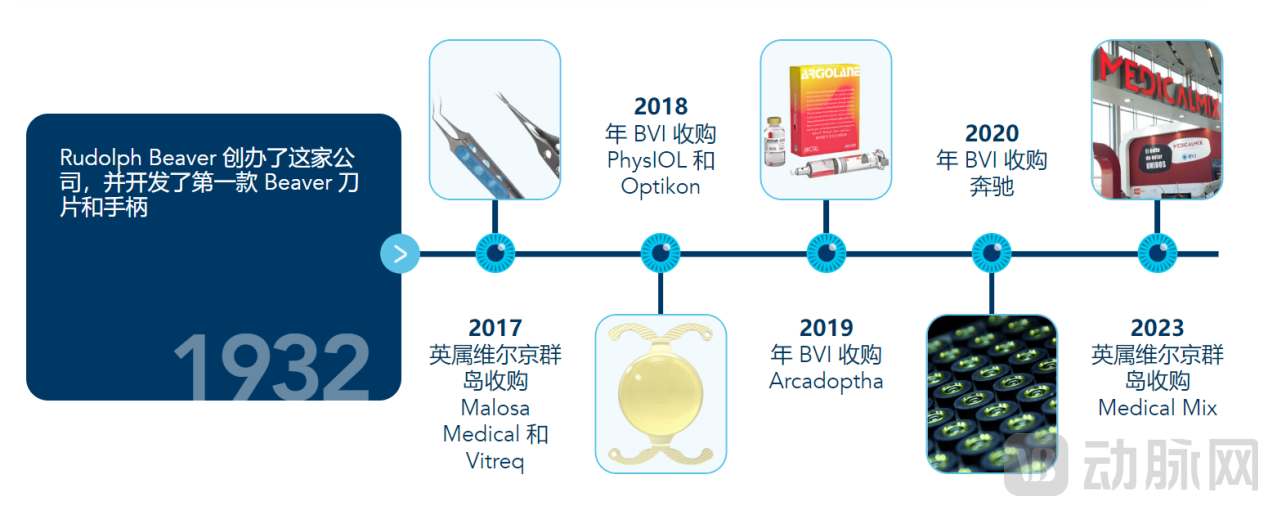 ▲Key milestones of BVI Medical Image source: official website of the company
It is through continuous mergers and acquisitions that BVI Medical has become one of the most diversified ophthalmic enterprises globally.The brand portfolio includes Beaver® (knives and blades), Visitec® (cannulas), Malosa® (disposable instruments), Vitreq® (vitreoretinal surgical products), and PhysIOL® (advanced intraocular lenses).
Taking the star product of BVI Medical's PhysIOL® series of intraocular lenses as an example, it includes high-end product lines such as the premium monofocal intraocular lens (SERENITY Toric), hydrophobic trifocal intraocular lens (FINEVISION HP), and hydrophobic enhanced monofocal intraocular lens (ISOPURE). These products provide an effective option for patients with significant myopia or hyperopia and astigmatism deviation after cataract surgery.
It is worth mentioning that,Centered around the scenario of cataract treatment, BVI Medical has built a complete set of solutions., including the Visitec and Vitreq series of catheters, eye surgery covers, various fluid control products, disposable instrument kits, ophthalmic viscosurgical devices (OVD), intraocular lenses, preloaded iris expanders, etc. The construction of system solutions can address various complex issues that doctors face in specific scenarios.
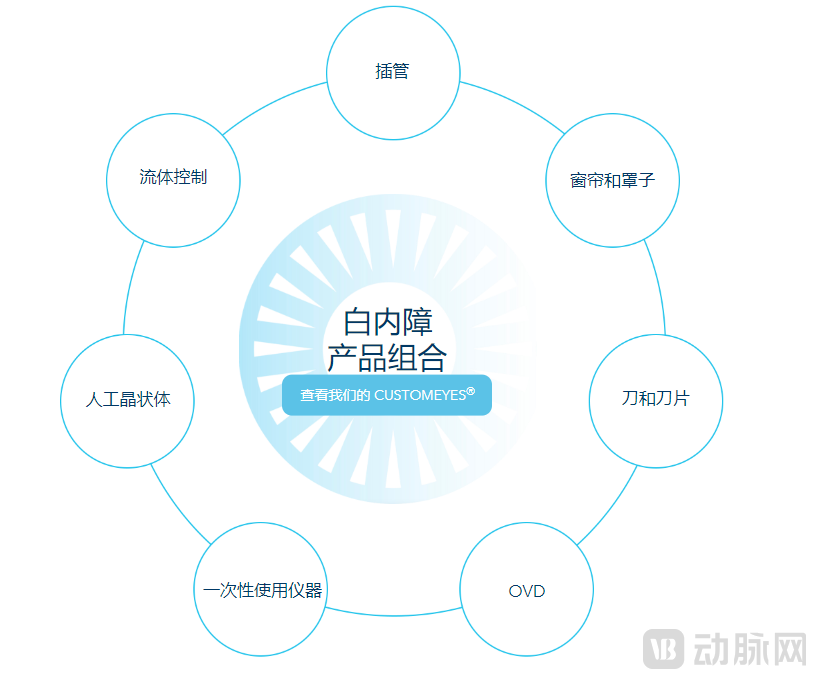 ▲Image Source: BVI Medical Official Website
For example, in cataract phacoemulsification surgery, sufficient preoperative pupil dilation is an important condition to ensure the smooth progress of the surgery and reduce surgical complications. This is because only when the pupil is dilated enough can the surgical operation be safer, and the incidence of surgical complications such as posterior capsule rupture will be reduced. However, since some patients suffer from diabetes, uveitis, etc., the risk factors for small pupils increase significantly, so doctors will perform some surgical procedures to enlarge the patient's pupil.
Academician of the International Academy of Ophthalmology and Professor Ke Yao from the Second Affiliated Hospital of Zhejiang University School of Medicine previously stated in a media interview that iris dilators are best used in small pupil cases — the advantage of this product is that after being implanted into the eye, it directly and evenly expands the entire pupil, and due to minimal damage to the iris, the pupil can easily contract back after the removal of the iris dilator. In this context, BVI Medical has introduced the I-Ring preloaded iris dilator, which is now widely used in clinical practice.
Beyond products and solutions, how to expand sales channels and capture doctors' mindshare is a mandatory question for every innovative enterprise.At this point, BVI Medical has adopted a "self-built sales network + cooperation with global distributors" dual-channel sales strategy, allowing its products to reach more than 90 countries and regions. Meanwhile, BVI Medical launched the EyeXchange Solutions platform in 2024 to enhance surgeons' decision-making capabilities through comprehensive educational resources and clinical support programs, optimizing professional patient care for ophthalmic conditions such as cataracts.
Based on the aforementioned layout, BVI Medical has gradually become a globally influential ophthalmic innovation enterprise (it should be noted that, as BVI Medical has not publicly disclosed its financial data from last year, the revenue situation of the company's various product lines remains unclear for now), thereby gaining the favor of investors.
"This investment is a pivotal moment for BVI Medical, and we will seize this opportunity to expand our capabilities to meet the urgent global demand for advanced ophthalmic solutions. By promoting the widespread adoption of breakthrough technologies among surgeons worldwide, we aim to reshape the future of ophthalmic surgery and transform the competitive landscape of the industry," said Shervin Korangy, CEO of BVI Medical.
As the world's leading cause of blindness, cataracts are closely related to aging, with an incidence rate as high as 80% in people over 60. According to data from the World Health Organization (WHO), about 18 million people worldwide are blind due to cataracts.
Currently, there are still limited options for the treatment of cataracts. The only effective treatment is the restoration of vision through phacoemulsification combined with intraocular lens implantation surgery.
Therefore, from the perspective of the entire industry, the research and development of phacoemulsification-related equipment and the iteration of intraocular lenses are the main lines of innovation at present.
First, in the phacoemulsification field, the major global manufacturers currently include Alcon, Bausch + Lomb, Carl Zeiss Meditec, Geuder, and Oertli. The market share of leading companies exceeds 90%. For instance, in China, ophthalmic ultrasound surgical equipment (such as phacoemulsifiers and combined phaco-vitrectomy systems) mainly relies on imported devices.
In principle, a phacoemulsification instrument is a surgical device based on ultrasonic energy. It utilizes high-frequency mechanical vibrations (ultrasound) to act on ocular tissues, achieving tissue fragmentation, cutting, and emulsification. Through a suction device with negative pressure, the fragments are removed. After residual tissues are thoroughly cleared, the doctor can implant an artificial lens for the patient.
According to VCBeat's observation,Leading companies are continuously optimizing phacoemulsification devices in terms of intraoperative stability, balance, high doctor controllability, and minimal patient injury.In China, three domestically produced phacoemulsification devices have already been approved for marketing.
The R&D barriers for the phaco-vitrectomy machine, which integrates the two major functions of phacoemulsification and vitrectomy, are higher. The advantage of this device lies in its "two-in-one" design, which reduces the cumbersome process of changing equipment during surgery, making it especially suitable for complex cases requiring combined treatment. On a global scale, various R&D enterprises are accelerating the technological upgrade of their products. For instance, the SMART phaco-vitrectomy machine recently approved for marketing in China by Keelin Instruments adopts a dual-pump design of "peristaltic pump + Venturi pump," thereby enhancing surgical stability and efficiency.
Although there are currently no domestically produced phacoemulsification and vitrectomy integrated machines approved for marketing in China, the field has already attracted numerous innovative companies. For instance, the Genesis phaco-vitrectomy machine developed by Xiran Medical may obtain product registration in 2025; the "Venus" phaco-vitrectomy machine under research by Tupai Medical has entered the late stage of development; Si'erran Medical's products under development mainly include a phaco-vitrectomy integrated machine and its supporting consumables; Jiasinuode’s product line planning also includes vitrectomy machines, phacoemulsification machines, and more... Overall, domestic brands are making rapid progress.
Looking at the direction of intraocular lenses, continuous research and iterative development by innovative companies worldwide have led to advancements from single-focus lenses to bifocal lenses, and then to trifocal lenses and extended depth-of-field intraocular lenses (EDOF) technologies., bringing increasingly clearer all-around vision to cataract patients. Among these, trifocal and EDOF are popular research and development directions. The advantage of such products is that they not only treat cataracts but also provide more continuous and higher-quality distance, near, and intermediate vision, thereby reducing patients' reliance on glasses after cataract surgery.
Before 2024, trifocal and EDOF technologies were mainly monopolized by Alcon, Zeiss, and Johnson & Johnson, with BVI Medical, which recently secured a billion-dollar financing, also capturing a certain market share. Now, domestic companies are changing this situation. For instance, last year, the domestically produced brand Raymon Biotech received approval for the first Chinese-made trifocal intraocular lens (IOL), while Aibono's extended depth-of-focus IOL, Century Kangtai's extended depth-of-focus IOL, and SML's trifocal IOL successively entered the "green channel" for innovative medical device approval. From this perspective, as innovative companies continue to invest heavily in research and development, the mid-to-high-end intraocular lens sector will also enter a critical phase of domestic substitution.
Beyond the catch-up efforts of domestically produced intraocular lenses, how to further advance their development is a core issue that companies entering the market need to consider. In this regard, VCBeat previously mentioned in the article "In This Ophthalmic Track Dominated by Imports, Domestically Produced Products Break Through!" that future directions for intraocular lens products could include: first, addressing issues such as halos, glare, longer patient adaptation periods post-surgery, and blurred vision caused by uneven light distribution associated with trifocal intraocular lenses; second, for toric intraocular lenses, which demand higher requirements for both technological platforms and materials, it is necessary to solve challenges like providing excellent rotational stability, ensuring the astigmatism axis remains unchanged, and delivering stable and reliable astigmatism correction.
In addition to the technical iteration of the two key devices around cataract surgery treatment — phacoemulsification equipment and intraocular lenses,The industry is also currently developing surgical robots to address challenges in traditional ophthalmic surgeries, such as hand tremors, limited feedback mechanisms, and more.
Take Horizon Surgical Systems, which secured a new round of financing in October last year, as an example. The company is developing the Polaris cataract surgery robot. According to information on the company’s official website, the Polaris surgical robot system integrates several innovative technologies: its high-precision robotic arm offers excellent flexibility, ensuring accurate positioning during surgical operations. In the field of medical imaging, the system is equipped with an advanced digital microscope and intelligent image processing system, enabling real-time acquisition of high-resolution images of the surgical area and providing clear visual feedback. Additionally, the system uses deep learning algorithms to intelligently analyze surgical data, allowing for surgical risk prediction and offering scientific decision-making support to doctors.
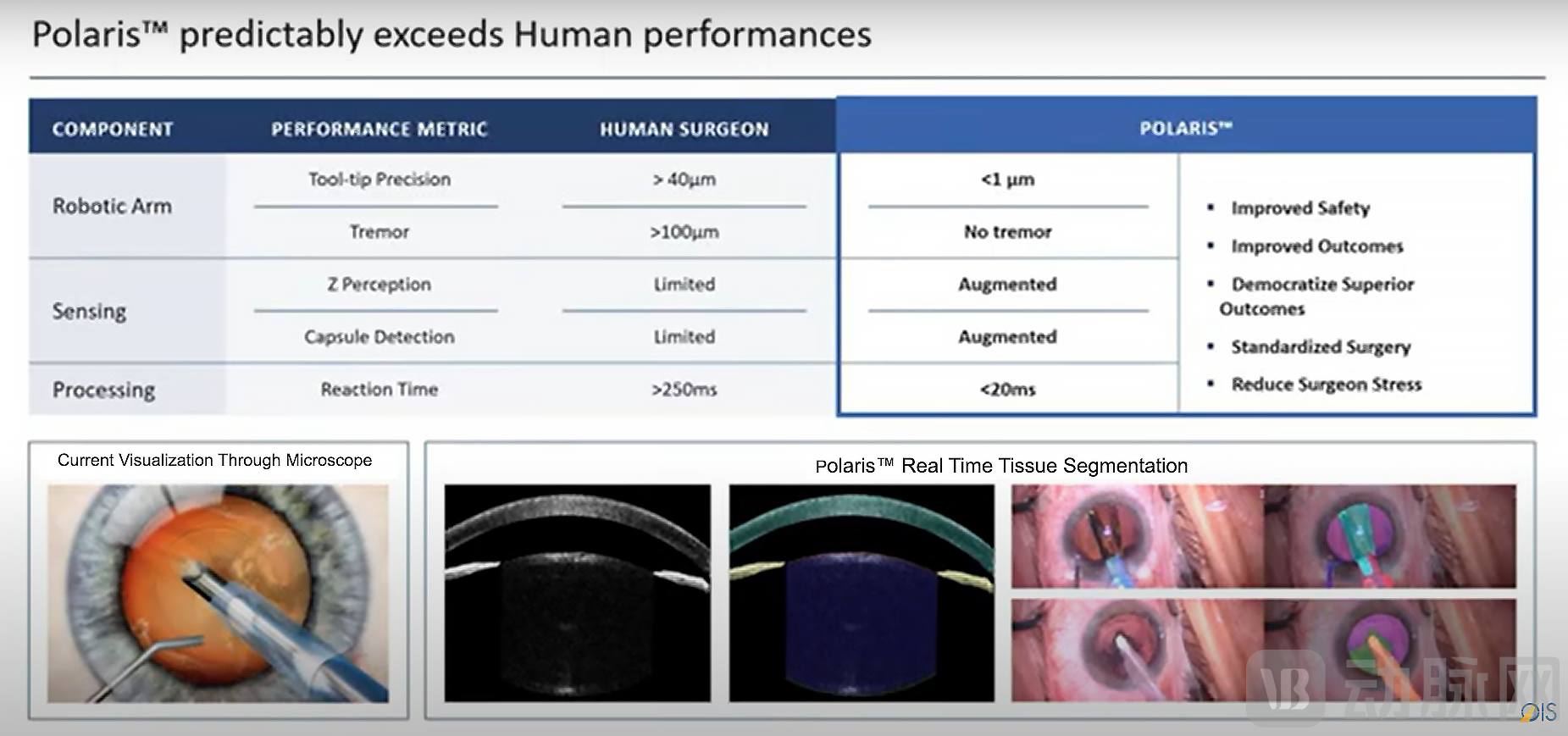 ▲Image Source: ois.net
According to official experimental data, the Polaris surgical robot system demonstrates outstanding performance: its tool tip accuracy is less than 1 micron, combined with a tremor-free robotic arm design, significantly enhancing the stability and safety of surgeries. Additionally, the system features an ultra-fast response time of less than 20 milliseconds, along with high-precision visual presentation under the microscope and real-time tissue sectioning capabilities, providing strong technical support for surgical operations.
It is not difficult to find that in the field of surgical treatment for cataracts, global innovative companies have made significant progress, and China-produced enterprises are narrowing the gap with global giants. This, against the backdrop of global aging, will undoubtedly benefit more cataract patients.
For the treatment of cataracts, surgery is the preferred option but is only suitable for patients in the middle to late stages of the condition. Patients in the early stages of cataracts cannot undergo surgery due to the lack of surgical indications. Additionally, although cataract-related surgeries are already highly advanced both in China and internationally, there are still some potential risks, such as postoperative complications like infections, secondary cataracts, and the loss of accommodative ability.
Faced with the above situation, can taking medicine solve the clinical pain points? Unfortunately,Currently, all clinical drugs for cataracts available in the industry are auxiliary medications, with no therapeutic drugs.
Specifically, they can be roughly divided into anti-quinone drugs, antioxidant damage drugs, aldose reductase inhibitors, auxiliary nutritional drugs, and traditional Chinese medicine, such as Pirenoxine Eye Drops, Amiodapeptide Eye Drops, Phacolin Eye Drops, and oral Vitamin C tablets, Vitamin B2 tablets, Vitamin E tablets, etc. Some patients in the early stage may experience a slowdown in the progression of the condition after taking the medication, or even feel a slight improvement in vision, but overall, it is not possible to achieve definitive efficacy.
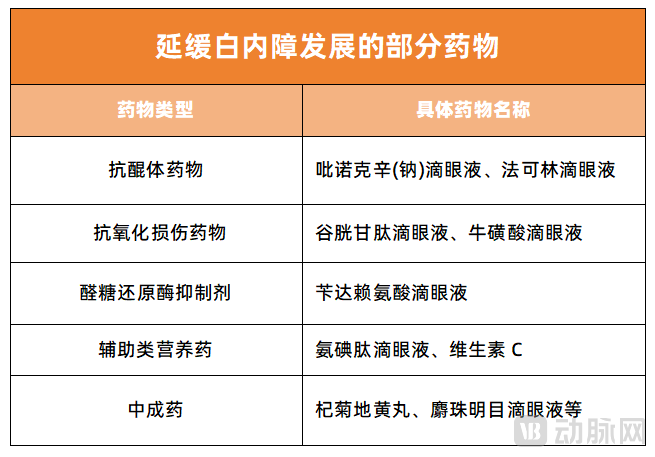 ▲VCBeat Mapping
It is precisely based on this,The early treatment of cataracts represents an unmet clinical need, making it a vast blue ocean market. However, behind this highly imaginative space lie significant challenges.——The formation of cataracts involves multiple mechanisms such as lens protein denaturation, oxidative stress, and epithelial cell apoptosis. There are significant differences in the pathogenic factors among different subtypes (e.g., the molecular mechanisms of congenital cataracts differ from those of age-related cataracts). Although existing research has proposed hypotheses like aldose reductase activation, quinone theory, and nutritional metabolic imbalance, which provide directions for drug development, a unified therapeutic target has yet to be established. This has led to relatively slow innovative progress in this field.
From the perspective of the entire industry, cutting-edge innovations are still mainly concentrated in the university and laboratory stages.For example, in 2024, a collaboration between the Eye Center of the Second Affiliated Hospital of Zhejiang University School of Medicine and the National Eye Institute (NEI) of the U.S. National Institutes of Health (NIH) discovered that in ground squirrel lens cells, the expression of a protein called RNF114 gradually increases in cold environments, which helps to clear protein aggregates. In human lens cells, the expression of RNF114 can also promote the degradation of protein aggregates, providing potential insights for developing new treatments for cataracts.
In addition, treating cataracts through gene therapy (such as promoting the breakdown and clearance of abnormal proteins in the lens by introducing specific genes) and stem cell therapy (using stem cells to repair damaged lenses or restore their transparency) has become a research focus for many institutions.
In this process, the above-mentioned innovative therapies still require more research to determine their efficacy, safety, and optimal treatment protocols. Therefore, it is essential to give industry innovators sufficient time and patience.
And once a disruptive drug for cataracts emerges, "aging without blindness" will truly become possible as people's lifespans continue to increase.
References:
1: "BVI Medical Secures Strategic Capital Raise to Fuel Global Growth and Innovation" —— BVI Medical Official Website
2: "The 'Magic Weapon' of Cataract Doctors, the 'Nemesis' of Small Pupils —— BVI Beifeng I-Ring Preloaded Iris Dilator, the Leader in Small Pupil Surgery" —— BVI Beifeng
3: "Drug Treatment Mechanisms, Market, Competition, and Return on Investment for Early/Mid-Stage Senile Cataracts" —— Good Vision Imagination