

Servier Inks $780M Deal for RAF Inhibitor BDTX-4933 Targeting RAF/RAS-Mutant Solid Tumors

Servier
International Pharmaceutical Manufacturers

Black Diamond Therapeutics
Cancer Treatment Drug Developer
On March 19, Servier announced a global strategic licensing agreement with Black Diamond Therapeutics, a developer of precision oncology drugs.
Under this agreement, Servier will lead the development and global commercialization of the RAF inhibitor BDTX-4933 across multiple indications, including non-small cell lung cancer, to address unmet medical needs in RAF/RAS mutant solid tumors. Black Diamond Therapeutics will receive a $70 million upfront payment and is eligible for up to $710 million in development and commercial sales milestone payments, as well as tiered royalties based on global net sales.
Currently, BDTX-4933 is undergoing a Phase 1 dose-escalation trial and is a potential optimal targeted therapy for solid tumors.
Effectively crossing the blood-brain barrier and inhibiting KRAS, NRAS, and BRAF mutations
RAF/RAS mutations are relatively common in various solid tumors, such as non-small cell lung cancer, colorectal cancer, and melanoma. Patients with these tumors have a high demand for targeted therapy drugs. According to predictions by the World Health Organization, the global incidence of cancer will continue to increase, reaching 24 million cases by 2035.
As a brain-penetrant oral inhibitor, BDTX-4933 can inhibit oncogenic mutations in KRAS, NRAS, and BRAF with a unique mechanism of action. After entering the human body, BDTX-4933 is rapidly absorbed in the gastrointestinal tract and enters the bloodstream. Due to its special chemical structure, it can effectively cross the blood-brain barrier, target KRAS, NRAS, and BRAF mutant cancer cells in the brain, and bind to the mutant proteins, disrupting their normal protein interactions.
In normal cells, the RAS-RAF-MEK-ERK signaling pathway regulates cell growth, among other functions. However, after mutations occur in cancer cells, this pathway becomes overly active, continuously driving cell division. BDTX-4933 binds to the mutant RAF protein, blocking MEK activation and interrupting pro-growth signal transmission, thereby preventing cancer cells from continuous proliferation. At the same time, BDTX-4933 activates apoptotic pathways in cancer cells, disrupting their survival signals, interfering with DNA repair, and weakening their viability. Within the tumor microenvironment, it also inhibits the production of cytokines and growth factors by cancer cells that recruit immune cells and promote angiogenesis, reducing blood vessel formation and cutting off the tumor’s nutrient supply. This multi-faceted targeting approach makes BDTX-4933 a promising treatment for tumors with relevant mutations.
The ongoing Phase I dose-escalation trial aims to evaluate the safety and tolerability, preliminary recommended Phase 2 dose, and anti-tumor activity of BDTX-4933 in adults with recurrent advanced/metastatic cancers carrying BRAF, CRAF, or NRAS mutations. In October 2024, Black Diamond Therapeutics announced the suspension of the clinical development plan for BDTX-4933 and declared its intention to seek a partner for this pipeline.
Pioneer in the Field of Precision Oncology, First to Develop Novel MasterKey Therapy
Black Diamond Therapeutics, Inc. was co-founded by Dr. David M. Epstein and Dr. Elizabeth Buck in 2015 and went public in January 2020. Black Diamond Therapeutics has made significant contributions to the field of precision oncology and is a pioneer in the development of MasterKey therapies—aiming to create drugs targeting families of cancer-causing mutations in patients with cancer, addressing a wide range of hereditary tumors. Overcoming drug resistance is one of its key objectives. Meanwhile, Black Diamond Therapeutics is also a low-profile AI-driven drug discovery company.
Since 2017, Black Diamond Therapeutics and Versant Ventures have jointly built a platform known as MAP (Mutation-Allostery-Pharmacology). The MAP platform integrates tools such as artificial intelligence/machine learning to comprehensively analyze human genome sequencing data, enabling the rapid identification of potential cancer-related allosteric gene mutations for the development of drugs that inhibit these mutations.
First, regarding mutations, the MAP platform integrates various forms of genomic-level data and has an in-depth understanding of mechanisms, structures, and dynamics to explore mutations in allosteric sites that may generate potential oncogenes. Next, mutated oncogenes are mapped to regulatory domains and regions involving protein-protein interfaces to gain insights into the mechanisms by which mutations drive oncogene activation. Finally, through screening in cancer-specific models, allosteric oncogenes are validated, and drugs that are effective and selective for allosteric mutant oncogenes are designed.
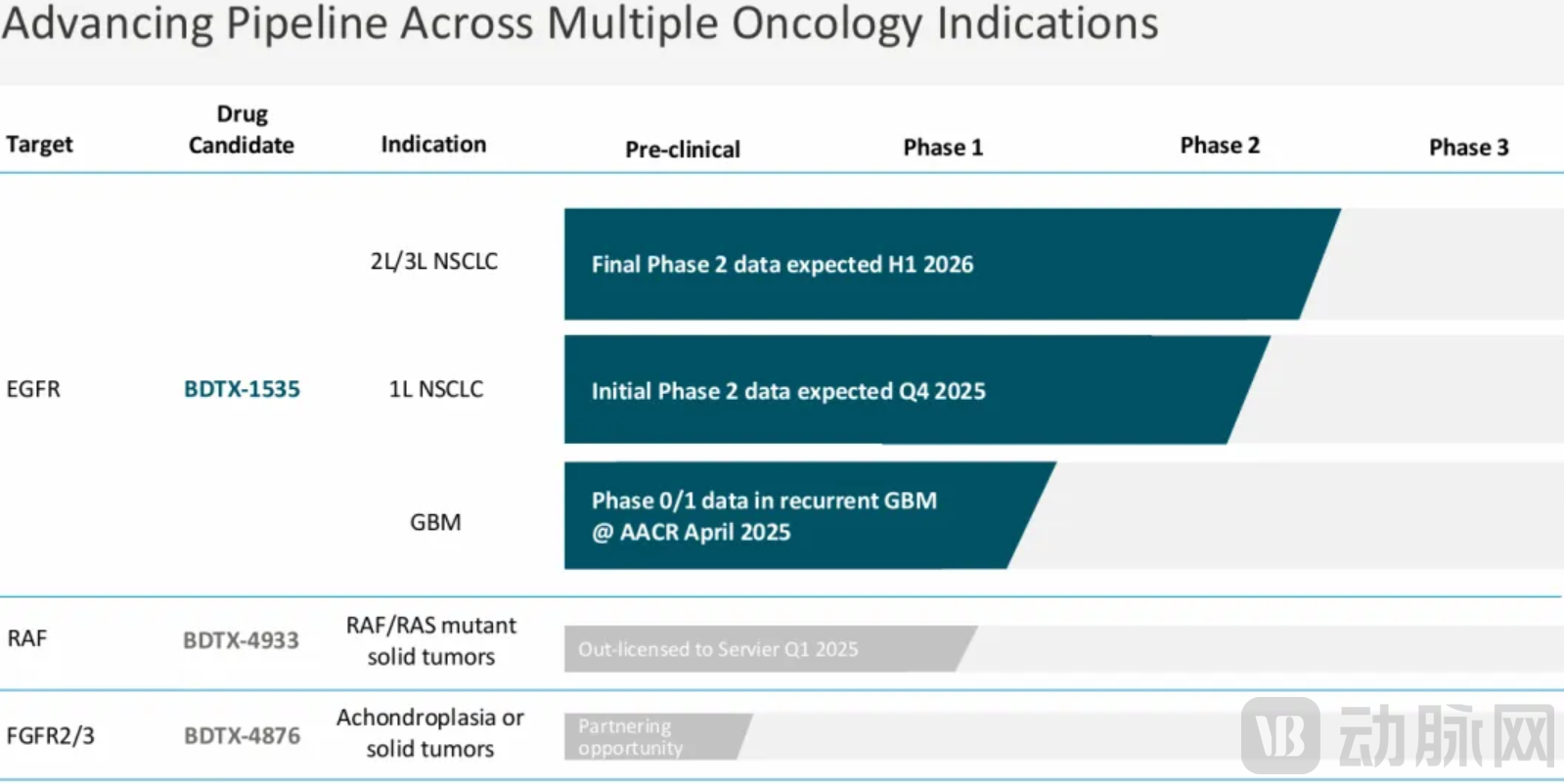 Black Diamond Therapeutics R&D Pipeline
Currently, Black Diamond Therapeutics is simultaneously developing multiple pipelines, with a key focus on the BDTX-1535 pipeline—an oral, brain-penetrant MasterKey inhibitor. It belongs to the fourth generation of EGFR inhibitors, designed to address the challenge of oncogenic EGFR mutations in NSCLC, covering various types including classical driver mutations, non-classical driver mutations, and the acquired resistance C797S mutation.
In September 2024, Black Diamond Therapeutics announced preliminary efficacy data from the Phase II trial of BDTX-1535 in patients with relapsed/refractory EGFR-mutant NSCLC. Among 22 evaluable patients, the preliminary objective response rate was 36%. Notably, among 19 patients with known osimertinib-resistant mutations, the objective response rate reached 42%, with 5 patients achieving confirmed partial responses and 1 patient transitioning from partial response to unconfirmed complete response at 8 months, pending confirmation scans.
Currently, BDTX-1535 is undergoing Phase II clinical trials as a first-line and second/third-line treatment for NSCLC patients. In the fourth quarter of 2023, after receiving feedback from the U.S. Food and Drug Administration (FDA) regarding the Phase I trial, Black Diamond Therapeutics initiated a Phase II first-line cohort study (NCT05256290) in the first quarter of 2024 for non-classical epidermal growth factor receptor mutation-positive (EGFRm) non-small cell lung cancer (NSCLC) patients.
French pharmaceutical giant Servier allocates 70% of R&D budget to oncology field
As early as 2022, Servier, the French pharmaceutical giant, allocated over 50% of its R&D budget to the oncology field, focusing on two major directions: immunotherapy and targeted therapy. In terms of R&D progress, Servier has been actively deploying resources, and its oncology pipeline now encompasses 30 R&D projects, 11 of which have the potential to become "first-in-class therapies." These projects cover a wide range of common and difficult-to-treat cancer types, including breast cancer, colorectal cancer, lung cancer, and gastric cancer, as well as highly malignant and challenging cancers such as pancreatic cancer and acute leukemia.
At the same time, Servier continues to strengthen its oncology portfolio through strategic acquisitions. In 2018, Servier spent a staggering $2.4 billion to acquire Shire's oncology portfolio. This strategic move injected new vitality and innovative elements into Servier’s presence in the field of cancer treatment, greatly enriching its R&D pipeline.
In December 2020, Servier announced the acquisition of Agios Pharmaceuticals' clinical and research-stage oncology business for $2 billion, including an upfront payment of $1.8 billion, a $200 million registration milestone payment, and additional royalties.
In December 2023, CStone Pharmaceuticals announced the transfer of exclusive rights for the development, manufacturing, and commercialization of TIBSOVO (ivosidenib tablets) in Greater China (including mainland China, Hong Kong, Macau, and Taiwan) and Singapore to Servier. According to the agreement terms, CStone Pharmaceuticals will receive a total payment of 50 million US dollars. This transaction will help Servier expand the indications of TIBSOVO in Greater China and Singapore and improve patient access to the drug.
Financial reports show that in the fiscal year 2024, Servier's consolidated revenue reached 5.902 billion euros, increasing by 10.8% year-on-year. Revenue from the oncology sector was 1.43 billion euros, accounting for 24.2% of the group’s consolidated revenue, up from 20.2% in fiscal year 2023. Meanwhile, Olivier Laureau, President of Servier Group, stated that the company will increase its investment in the oncology field, which will account for 70% of the R&D budget.