Cargo Therapeutics Halts All Pipeline Programs, Cuts Workforce by 90%, and Pursues Reverse Merger

Cargo Therapeutics
CAR-T Cell Therapy Developer

On March 18, 2025, biotech company Cargo Therapeutics announced a series of significant adjustment measures: abandoning its investigational candidate drug CRG-023 for the treatment of B-cell diseases, suspending the development of its allogeneic platform, and cutting approximately 90% of its workforce. Just a few months ago, the company had already given up its leading asset and laid off 50% of its staff, and now it is undergoing another large-scale "downsizing."
 Management Changes
In this change, the company's board of directors has appointed Chief Operating Officer and Chief Financial Officer Anup Radhakrishnan as the interim Chief Executive Officer. He will lead the company in seeking reverse merger or other business consolidation opportunities, while the original Chief Executive Officer Gina Chapman and other undisclosed members of the management team will step down.
 Pipeline Reset
Cargo Therapeutics had originally planned to initiate a Phase 1 dose-escalation study for CRG-023 in the coming months and select a lead vector candidate for its allogeneic platform. However, following the suspension of its lead asset fricabtagene autoleucel (firi-cel) in January 2024, the company has now also terminated the CRG-023 program and its allogeneic platform, leaving its pipeline entirely empty.
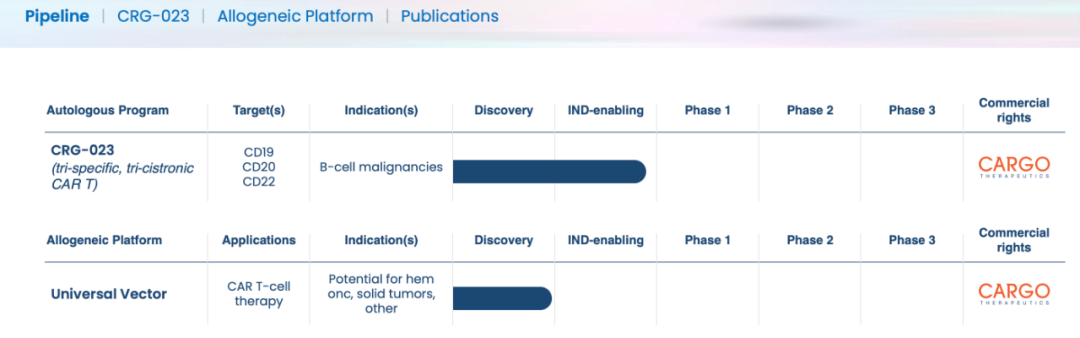
Screenshot from the Cargo official website
Firi-cel is an autologous CD22 CAR-T cell therapy designed to treat patients with large B-cell lymphoma. However, in the Phase 2 trial, patients experienced severe side effects, with 18% of patients developing Grade 3 or higher Immune Effector Cell-associated Hemophagocytic Lymphohistiocytosis-like Syndrome (IEC-HS). Some patients also died from this syndrome, forcing the company to shelve the project and cut its workforce by 50%. At the time, the company stated that the cost savings from the layoffs would extend its cash reserves until mid-2028.
 Whither and Whence
Cargo Therapeutics was founded in March 2022 with initial funding of $200 million. In 2023, the company raised approximately $291 million through its Initial Public Offering (IPO), using the proceeds to support clinical trials of firi-cel, which unfortunately did not succeed. As of the end of 2024, the company still has $368.1 million in funds. Currently, the company is looking toward reverse mergers or business combinations as a path for new growth.
 Written at Last
The story of Cargo Therapeutics is a microcosm of the biopharmaceutical industry. In this field full of hope and challenges, companies need to constantly seek balance among research and development, funding, and the market. Although the decisions made by Cargo Therapeutics were difficult, they also reflected the helplessness and courage of companies when facing difficulties. In the future, whether or not Cargo Therapeutics can find new development opportunities through a reverse merger, its experience is worth deep reflection by every participant in the industry.
Source: Fierce Biotech