

Guangzhou Dabio Biopharmaceutical Receives NMPA's Implicit Approval for Umbilical Cord Mesenchymal Stem Cell Injection (E101) in Type 2 Diabetes

Double Bioproduct
Developer of Anti-Tumor Gene Therapy Drugs

March 29, 2025
eMedClub News
Recently, the National Medical Products Administration (NMPA) of China inspected Guangzhou Dabo Biological Products Co., Ltd.("Dabo Bio")Application for "Human Umbilical Cord Mesenchymal Stem Cell Injection"(E101)" New Drug Clinical Trial Application(IND)Granted implied permission for the treatment of type 2 diabetes.
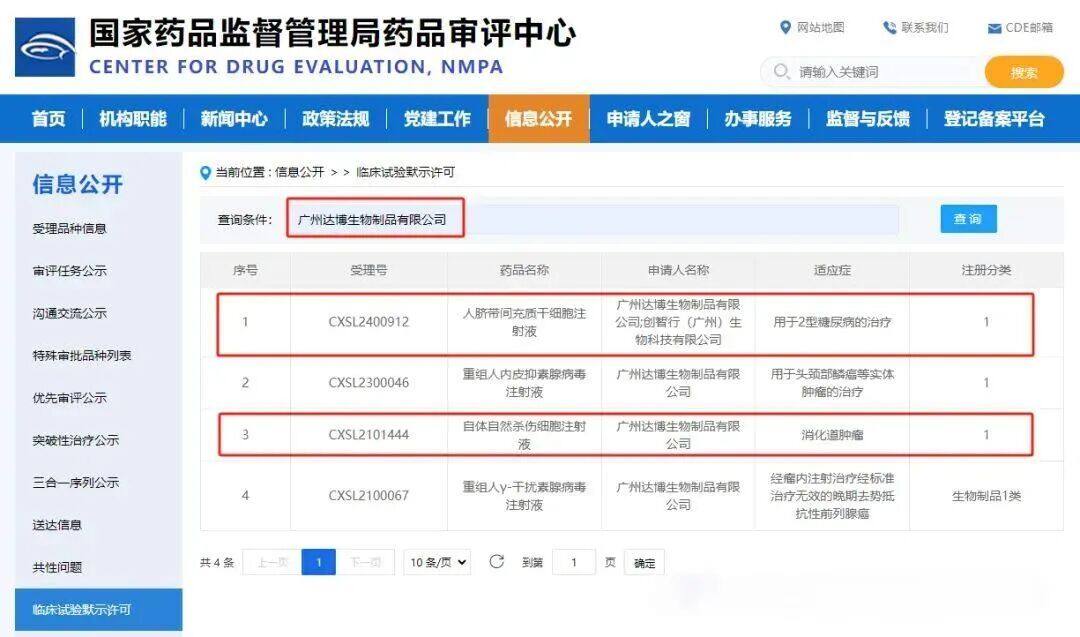
Image Source: Screenshot from the CDE official website
According to publicly disclosed information, the cryopreserved stem cell preparation independently developed by Guangzhou Dabo Biological Products Co., Ltd.Human Umbilical Cord Mesenchymal Stem Cell Injection(E10I)" has been accepted. This preparation is manufactured using umbilical cord tissue through in vitro separation, screening, and large-scale three-dimensional expansion processes. It is the first umbilical cord mesenchymal stem cell product in China to achieve three-dimensional culture and fully automated large-scale production. While making breakthroughs in the stem cell field, Dabo Bio continues to maintain its technological leadership in the field of immune cell therapy.

Notably, Dabo Bio is the only innovative pharmaceutical company in China that has obtained clinical approval in both stem cell and NK cell therapy fields. As early as February 2022, the autologous natural killer cell injection developed by Guangzhou Dabo Biological Products Co., Ltd.(E10 H)Has already received the National Medical Products Administration's tacit approval for clinical trials.(Approval No.: 2022LP00160), becoming the first autologous NK cell therapy project approved for clinical trials in China. This dual breakthrough highlights Guangzhou Dabo Biological Products Co., Ltd.'s technical integration capabilities and innovation strength across the entire cell therapy industry chain.
Diabetes is a common chronic endocrine metabolic disease, which has now become the third non-communicable disease threatening people's health after cardiovascular diseases and cancer.
Diabetes is mainly divided into type 1 diabetes, type 2 diabetes, other specific types of diabetes, and gestational diabetes, etc.
The prevalence of diabetes in the global population aged 20-79 years was approximately 10.5% in 2023.(536.6 million people), which will increase to 12.2% by 2045.(783.2 million people)。
Treatment strategies for type 2 diabetes include dietary adjustments, medication, islet transplantation, and pancreas transplantation, among others. The therapeutic drugs include insulin, insulin sensitizers, insulin secretagogues, biguanides, glucosidase inhibitors, glucagon-like peptide-1 receptor agonists, incretin enhancers, sodium-glucose co-transporter 2 inhibitors, and amylin analogs, among others.
Despite the continuous emergence of new hypoglycemic drugs and treatment strategies, which have provided new options for the treatment of type 2 diabetes, they still cannot effectively halt the progression of the disease. Therefore, there is an urgent need for new and more effective strategies to treat type 2 diabetes.
Mesenchymal stem cells are adult stem cells with self-replication capabilities and multi-directional differentiation potential, widely present in tissues such as umbilical cord, bone marrow, adipose tissue, dental pulp, and placenta. Among these, umbilical cord mesenchymal stem cells(UC-MSCs)Characterized by wide availability, low immunogenicity, non-invasiveness, no ethical issues, and low tumorigenicity. Compared with bone marrow mesenchymal stem cells, UC-MSCs can maintain a stable doubling time during the first 10 passages.
In recent years, studies on the treatment of type 2 diabetes based on UC-MSCs have been increasingly reported. UC-MSCs can improve the immune microenvironment and alleviate insulin resistance by blocking inflammasome activation, reducing the release of inflammatory factors, and lowering systemic inflammation levels.
In the diabetic inflammatory microenvironment, UC-MSCs can promote macrophage polarization into anti-inflammatory M2 macrophages, reduce inflammatory activity, and improve insulin sensitivity in insulin-target tissues. Due to the strong immunomodulatory capacity of UC-MSCs, it is considered an ideal candidate cell therapy platform for treating type 2 diabetes.
Exciting Live Broadcast Preview
Press and hold to scan the QR code to participate immediately ↓
Swipe up and down to view more
Recommendation 1
Monday, March 31st, 19:00-20:00
Breaking and Reconstructing | Industry Changes and Opportunities Under Hainan's New Policy on Cell Therapy Charges


In Collaboration with 医麦客 IBI EXPO 2026


Daboo "Share”、“Like"and"In View",Give me a little recharge~