

Editor's Note
The 2025 Annual Meeting of the European Association for the Study of the Liver (EASL2025) was held in Amsterdam, Netherlands, from May 7 to May 10. During the conference, several research advances on new hepatitis B drugs were disclosed. Ganlin Jun has selected some important progress to share with everyone.
Imdusiran (IDR, AB-729) is an siRNA drug jointly developed by Arbutus Biopharma and Qilu Pharmaceutical, and VTP-300 is a therapeutic vaccine developed by Vaccitech. Both drugs are currently in Phase II clinical trials.
Previous studies on Imdusiran followed by VTP-300 or placebo (Group A and B of a Phase IIa study) showed that the VTP-300 or placebo groups had a similar inhibitory effect on HBsAg during treatment and in the early post-treatment period, while sequential VTP-300 helped maintain lower HBsAg levels for 24 weeks after the end of treatment.
The abstract of EASL2025 conference revealed the latest data on the longer follow-up period after the sequential treatment of Imdusiran followed by VTP-300/placebo, as well as the data from Group C of the Phase IIa study involving Imdusiran followed by VTP-300 and low-dose Nivolumab. No statistically significant difference was observed in HBsAg reduction at 36 weeks post-treatment between NA-experienced chronic hepatitis B patients treated with Imdusiran + VTP-300 + Nivolumab versus those treated with Imdusiran + VTP-300. In the groups treated with Imdusiran + VTP-300 + Nivolumab, Imdusiran + VTP-300, and Imdusiran monotherapy, 13%, 11%, and 40% of patients respectively restarted NA treatment. Notably, only in the Imdusiran + VTP-300 + Nivolumab group, two patients with low baseline HBsAg levels achieved clinical cure.

Research Methods
A randomized, double-blind Phase IIa study enrolled chronic hepatitis B patients who had been treated with nucleos(t)ide analogues (NA) for > 12 months and had HBsAg levels of 100–5000 IU/mL. Patients first received Imdusiran 60 mg for 24 weeks, followed by sequential treatment with VTP-300 (Group A), placebo (Group B), or VTP-300 ± low-dose Nivolumab (Group C, abbreviated as LDT) until week 48, at which point discontinuation of NA was evaluated. The criteria for NA discontinuation were ALT < 2 × ULN, HBV DNA < LLOQ, HBeAg negative, and HBsAg < 100 IU/mL. Patients who achieved NA discontinuation were followed up for an additional 48 weeks to monitor for relapse.
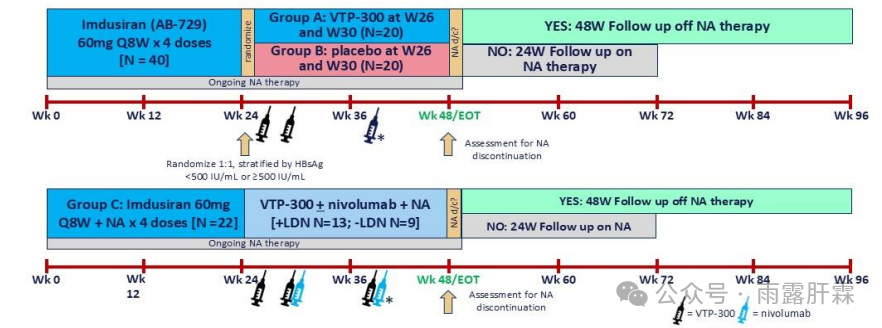
Experimental Design
Research Results
The baseline characteristics were similar across groups, with mean baseline HBsAg levels of 1123, 1135, 1105, and 1296 IU/mL in Groups A, B, C1 (IDR + VTP-300 + LDN), and C2 (IDR + VTP-300), respectively. Additionally, 55%, 50%, 62%, and 67% of patients in each group had HBsAg < 1000 IU/mL.
In all groups, the mean HBsAg decline from baseline was 1.86 log at Week 26 after 24 weeks of Imdusiran treatment. At Week 84, the mean HBsAg reduction in Group C1 (IDR + VTP-300 + LDN) and other groups showed no statistically significant difference compared to Imdusiran monotherapy (Group B).
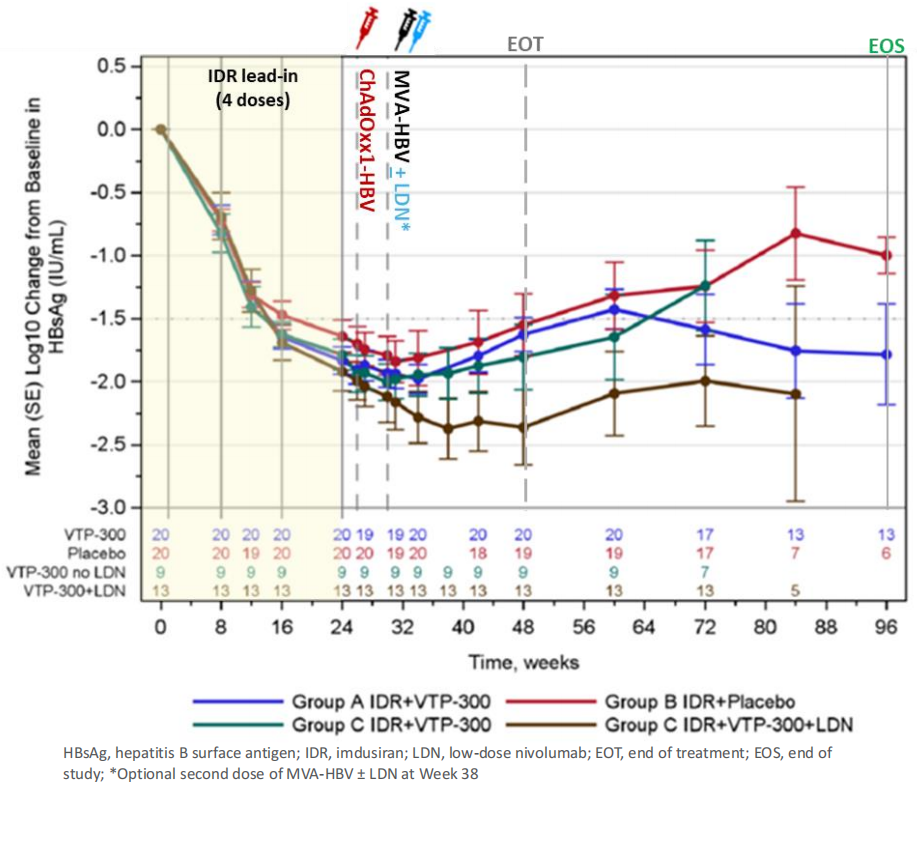
Average HBsAg Change Over Time in Each Group
In Group A, one patient achieved HBsAg < 0.05 IU/mL at week 96; in Group B, one patient achieved HBsAg < 0.05 IU/mL at week 48 but did not meet the NA discontinuation criteria; in Group C1 (IDR + VTP-300 + LDN), three patients (3/13) achieved HBsAg < 0.05 IU/mL at week 48, all three discontinued NAs, among them, one patient experienced HBsAg rebound at week 60, and two patients achieved clinical cure. The baseline HBsAg levels of the two patients who achieved clinical cure were 480 and 98 IU/mL, respectively. No other patients achieved HBsAg clearance or clinical cure.
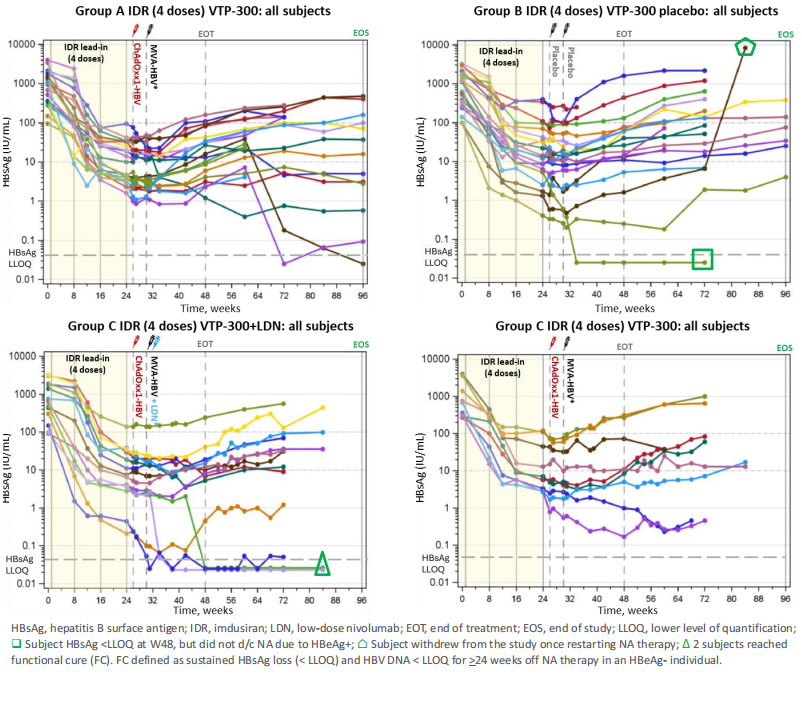
Decrease in HBsAg Levels Among Individuals in Different Groups
Group A, B, C1 (IDR + VTP-300 + LDN) and C2 (IDR + VTP-300) had 80%, 53%, 69%, and 67% of patients achieve NA cessation at week 48, respectively, while 13%, 40%, 11%, and 17% of patients restarted NA treatment due to HBV DNA levels increasing to > 20,000 IU/mL.
Treatment Management and NA Discontinuation
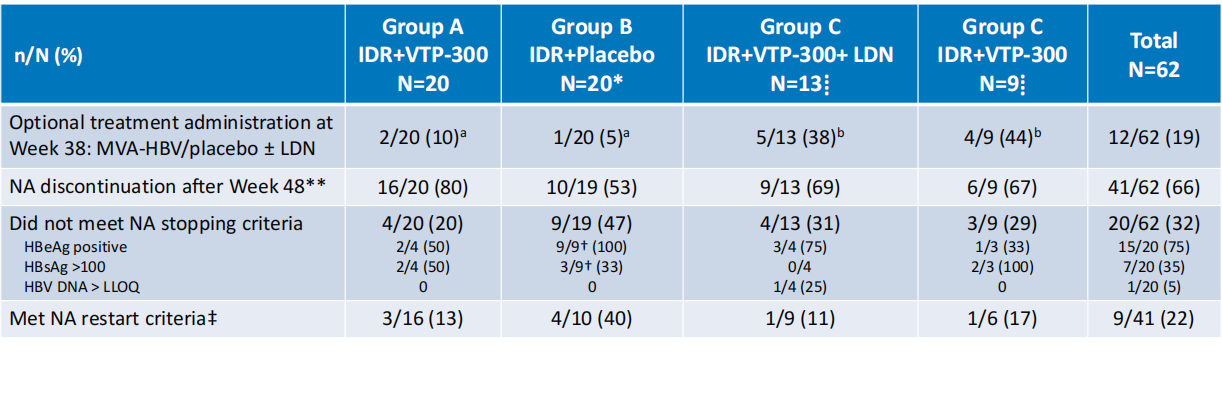
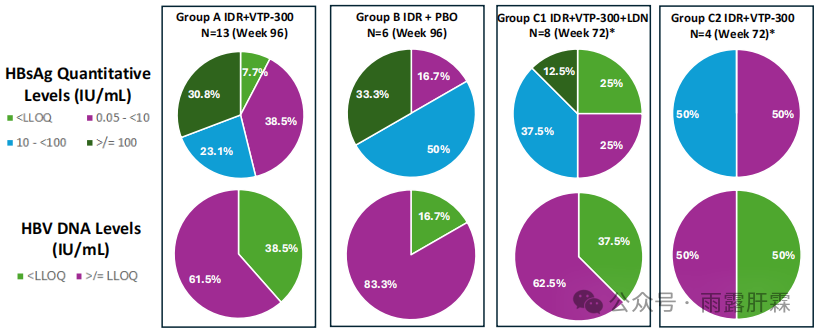
Distribution of HBsAg and HBV DNA Levels in NA-Discontinued Patients
During the study period, there were no serious adverse events, deaths, or early discontinuations. The most common treatment-related adverse events (all grade 1-2) included: Imdusiran: 3 cases of elevated ALT, 2 cases of injection site pain; VTP-300: 5 cases of injection site pain, 2 cases each of fatigue and pruritus; Nivolumab: only 2 cases of treatment-related adverse events (1 case of post-vaccination symptoms, injection site pain, pruritus, and headache, and 1 case of rhinorrhea).
Research Conclusion
Imdusiran + VTP-300 + Low-dose Nivolumab Treatment Well Tolerated; Two Subjects with Low Baseline HBsAg Levels Achieved Clinical Cure. Most Imdusiran-treated Subjects Maintained Quantitative HBsAg Levels Below Pre-treatment During Follow-up. Compared with Imdusiran + Placebo (Group B), Imdusiran + VTP-300 (Group A) Treatment Did Not Achieve Clinical Cure but Allowed More Patients to Sustain NA Cessation. Patients in Group C Are Under Continuous Follow-up.
Gan Lin Jun Has Something to Say
As can be seen from the results of this study, sequential treatment with Imdusiran followed by VTP-300 helps reduce HBsAg rebound after discontinuation of Imdusiran. Sequential treatment with Imdusiran followed by VTP-300 and Nivolumab further reduces early HBsAg rebound after the end of treatment compared to sequential treatment with VTP-300 alone, but there is no statistically significant difference between the two during long-term follow-up.
Imdusiran Sequential VTP-300 and/or Nivolumab Enabled 67%-80% of Patients to Discontinue NA, but 11%-17% Restarted NA Treatment Due to HBV DNA Levels Rising Above > 20,000 IU/mL; Over 50% of Patients Maintaining NA Cessation Experienced HBV DNA Rebound, and Approximately 10%-30% Showed HBsAg Increase to > 100 IU/mL. Safe Discontinuation Remains a Significant Challenge. Therefore, Achieving True Functional Cure—Sustained HBsAg Clearance and Undetectable HBV DNA After Stopping All Medications—Remains a Major Challenge for Current Novel Drugs.
References:
Wong GL, Yuen MF, Kennedy P, et al. Off-treatment antiviral efficacy and safety of repeat dosing of imdusiran followed by VTP-300 with or without nivolumab in virally-suppressed, non-cirrhotic subjects with chronic hepatitis B (CHB). EASL2025, Late-breaker Poster (LBP-020).