Home First-in-Class Off-the-Shelf Allogeneic DNT Cell Therapy Demonstrates Promising Safety and Efficacy in Phase 1/2 Trial for Preventing AML Relapse Post Allo-HSCT, Highlighted at ASCO 2025

First-in-Class Off-the-Shelf Allogeneic DNT Cell Therapy Demonstrates Promising Safety and Efficacy in Phase 1/2 Trial for Preventing AML Relapse Post Allo-HSCT, Highlighted at ASCO 2025

Jun 05, 2025 07:20 CST Updated 07:20
Wyze Biotech

Innovative Immune Cell Therapy Developer

Image

June 5, 2025

eMedClub News

Acute Myeloid Leukemia(Acute Myeloid Leukemia,AML)It is a type of malignant clonal disease originating from bone marrow hematopoietic stem cells, accounting for approximately 60% of adult acute leukemia cases, posing a serious threat to human health.Allogeneic Hematopoietic Stem Cell Transplantation(allo-HSCT)It is currently the main curative method for patients with relapsed and refractory AML after chemotherapy, and its efficacy is mainly attributed to donor-derived T cell-mediated graft-versus-leukemia effects.(GVL)Effect.

However, even if the patient successfully completes the transplantation, the recurrence rate after Allo-HSCT remains as high as 20%-60%.The median survival period for recurrence does not exceed six months., especially for those patients with relapsed acute AML after transplantation, the treatment options are extremely limited. Therefore, it is crucial to find new safe and effective treatments that can avoid causing graft-versus-host disease.(GvHD)At the same time, reducing the risk of recurrence in this group of patients has become an unmet clinical need that urgently needs to be addressed in AML patients after allo-HSCT.

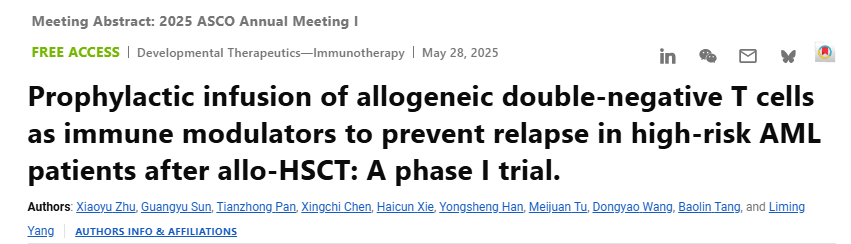
Recently,Ruishun BiotechAndProfessor Xiaoyu Zhu, Department of Hematology, First Affiliated Hospital of USTCTeam Collaboration on "Allogeneic Double-Negative T Cells(DNTs)"Phase 1/2 Clinical Trial of Preventive Infusion for Relapse in High-Risk AML Patients After Allo-HSCT" Successfully Selected for Poster Presentation at the 2025 ASCO Annual Meeting.

Image

Clinical trial results indicate that "off-the-shelf universal" allogeneic DNTs cells demonstrate significant safety and efficacy advantages in preventing relapse in AML patients after allo-HSCT.DNT cells can suppress GvHD while preserving the GVL effect, along with their "off-the-shelf" characteristic.,which is expected to provide a transformative treatment option for post-transplant therapy/prevention in patients with relapsed/refractory AML.


Research Background


DNTs cells are a special subset of T cells present in human peripheral blood, accounting for 1%-10% of total T cells. They express CD3 but do not express CD4, CD8, or CD56 molecules. Existing studies have shown,When the level of DNT is higher in allo-HSCT patients, the risk of disease recurrence decreases, and the incidence and severity of GvHD are also lower.Early clinical trial data initiated by researchers showed that allogeneic DNTs derived from healthy donors have good safety and GvL therapeutic potential in preventing relapse in high-risk AML patients after allo-HSCT.(IIT, ChiCTR1900023499). The phase 1/2 clinical study showcased in this presentation(IND,CTR20231592)Aims to further evaluate the safety and efficacy of "off-the-shelf" allogeneic DNTs in preventing relapse in high-risk AML patients after allo-HSCT.


Research Methods


The study enrolled a total of 6 high-risk AML patients undergoing allo-HSCT, divided into two dose groups: 1×10^8 DNTs/kg and 1.5×10^8 DNTs/kg. GMP-grade DNT cells were expanded in vitro from healthy donor PBMCs and cryopreserved for use.

Each patient received three DNT infusions without lymphodepleting preconditioning, with each infusion spaced one month apart. The median time to the first infusion was 3.1 months post-transplant. The primary endpoints were the incidence of adverse events and dose-limiting toxicity, while the secondary endpoint was the cumulative incidence of relapse.(CIR)


Research Results


The published results showed that as of February 1, 2025, with a median follow-up of 17.95 months, 4 out of the 6 enrolled patients...(66.7%)Achieve and Maintain Minimal Residual Disease(MRD)Negative CR status,The longest recurrence-free survival period exceeds 21 months.Among them, both patients who relapsed carried high-risk TP53 gene mutations and were MRD positive before transplantation, passing away at 11.4 and 14.2 months post-transplant, respectively.The 1-year OS for the entire cohort was 83.3%.

Image
▲ Six patients received three DNT infusions

Image
▲ 1-Year Overall Survival (OS) and Progression-Free Survival (PFS)

In 2 MRD-negative CR patients, the infused DNTs persisted in vivo for up to 360 days. The levels of IFN-γ, IL-6, and IL-10 increased in most patients after infusion, indicating activation of the immune system. Importantly, safety assessments showed no dose-limiting toxicity, neurotoxicity, or cytokine release syndrome above grade 2.None of the patients experienced adverse events greater than Grade 2.

Image

Compared with relapsed patients, the levels of CD4+, CD8+, and DNT cells were elevated in 4 MRD-negative CR patients, particularly in the effector memory T cell phenotype. These cells highly expressed granzyme A and K. Co-culture experiments confirmed that the secretion of granzyme B and IFN-γ significantly increased in CD8+ T cells after 3–4 days of co-culture with DNT cells. Transcriptome sequencing and multi-factor cytokine analysis showed,DNTs Enhance GVL Effect by Activating Patients' CD8+ T Cells While Reducing GvHD Risk, Demonstrating Dual Immune Modulatory Functions. These clinical results are consistent with the data published by Professor Zhang Li's team from the University of Toronto Faculty of Medicine in Canada in their preclinical studies.(Lee et al. J Exp Clin Cancer Res (2025) 44:28)


Conclusion


Overall, this study reveals allogeneic DNT(Allo-DNT)The Potential Clinical Value of Cells in Preventing Relapse in High-Risk AML Patients After Allo-HSCT. As an "off-the-shelf" cell product, Allo-DNT Cell TherapyWith Anti-Tumor Properties(GvL)And Anti-GvHD Function, providing a disruptive and entirely new treatment option, is one of the best-known cellular products for preventing relapse after acute leukemia transplantation.Donor lymphocyte infusion holds promise to replace the current Class I recommendation in the guidelines for preventing relapse after transplantation.(DLI)Therapy, allowing more AML patients to benefit in the long term after allo-HSTC. In addition, since there is no need for pre-treatment with lymphocyte-depleting conditioning, treatment-related toxicity can be minimized.


Editor-in-Chief | Luca

Proofread by Luca


References:

1.https://ascopubs.org/doi/10.1200/JCO.2025.43.16_suppl.2532

2.Lee, J., Kang, H., Chen, B. et al. Allogeneic DNT cell therapy synergizes with T cells to promote anti-leukemic activities while suppressing GvHD. J Exp Clin Cancer Res 44, 28 (2025). 


Image


Exciting Live Broadcast Preview

Press and hold to scan the QR code to participate immediately ↓

Swipe up to view

Recommendation 1

June 5th, 19:00-20:30

Focus on the Biosafety and Quality Control Innovation of AAV Gene Therapy Products

Image


Statement and Copyright Notice

Disclaimer: This article aims to convey industry development information and explore the frontier progress of biomedicine. The content of the article represents the author's viewpoint, and does not represent the position of Yi Mai Ke, nor does it constitute any value judgment, investment advice, or medical guidance. If necessary, please consult a professional for investment or visit a regular hospital for medical advice.


Copyright Statement:Welcome to share the article on your personal Moments. Unauthorized media or institutions are prohibited from reprinting the article in any form to other platforms. If you need to reprint, please leave a message below the article to obtain authorization.

Image

DianDian "Share”、“Like"and"In View", charge me up a bit~"