

Breakthrough in AAV Gene Therapy for nAMD by USTC and StarryGene: Engineered RPE-Tropic Vector Expressing VEGF-A/ANG-2 Bispecific Antibody
StarryGene
Gene Therapy Drug Developer
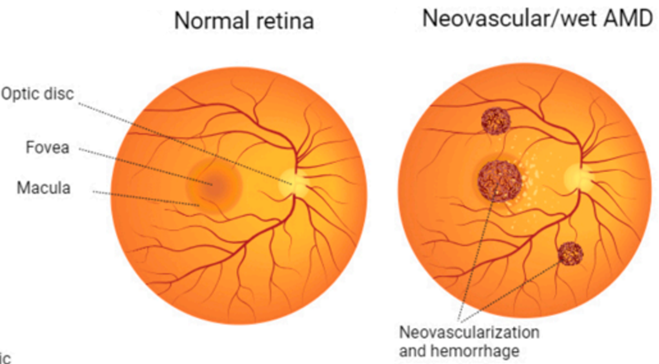
Image Source: https://doi.org/10.1016/j.ijpharm.2024.124258
Neovascular age-related macular degeneration (nAMD) is a retinal degenerative disease that causes vision loss, characterized by the formation of choroidal neovascularization (CNV), leading to subretinal hemorrhage and exudation, and ultimately resulting in vision loss. As one of the leading causes of blindness worldwide, nAMD constitutes a significant public health burden due to the irreversible nature of its associated vision impairment.
VEGF and ANG-2 are key regulatory molecules in angiogenesis and play a central role in the pathogenesis of nAMD. Current standard treatments mainly rely on anti-VEGF drugs, but these treatments require frequent intravitreal injections, placing significant psychological and financial pressure on patients.
Recently, the University of Science and Technology of China (hereinafter referred to as "USTC"), the First Affiliated Hospital of USTC, and StarryGene teams published a breakthrough research achievement in the authoritative journal 'Research'. They developed an adeno-associated virus (AAV) vector that specifically targets retinal pigment epithelial cells (RPE). Through intravitreal injection, it can express a bispecific antibody that simultaneously targets VEGF-A and angiopoietin-2 (ANG-2), successfully treating nAMD in animal models and patients.
1. Design of RPE Cell-Targeting AAV Vectors Beyond AAV2.7m8
The research team successfully developed a novel AAV-RPE vector through in vivo directed evolution technology. After intravitreal injection, it can penetrate the retinal barrier and efficiently infect RPE cells adjacent to the lesion area. Compared with the internationally leading intravitreal injection capsid AAV2.7m8, AAV-RPE demonstrates higher efficiency and specificity in infecting RPE cells, while the AAV2.7m8 capsid primarily infects retinal ganglion cells.
2. Dual-target treatment strategy, single dosing, long-lasting effectiveness
The bispecific antibody expressed by XMVA09 vector can simultaneously inhibit two key angiogenesis regulators, VEGF-A and ANG-2. Compared with single-target anti-VEGF therapy, the dual-target strategy shows stronger therapeutic effects in suppressing vascular leakage and reducing fibrosis.
A single injection of XMVA09 can achieve sustained bispecific antibody expression, avoiding the need for frequent injections associated with traditional anti-VEGF treatments, offering patients a more convenient treatment option.
1. Animal Model Validation
In the laser-induced CNV mouse model, XMVA09 significantly reduced fluorescein leakage through a single intravitreal injection and demonstrated a dose-dependent inhibitory effect on CNV (Figure 1)。
In the rhesus macaque model, XMVA09 treatment significantly reduced the number of Grade IV CNV lesions and leakage area while improving retinal thickness. The high-dose group (5×10^11 vg/eye) showed therapeutic effects as early as 19 days after laser induction.
'%20fill='%23FFFFFF'%3E%3Crect%20x='249'%20y='126'%20width='1'%20height='1'%3E%3C/rect%3E%3C/g%3E%3C/g%3E%3C/svg%3E)
Figure 1 Efficacy of XMVA09 on laser-induced choroidal neovascularization (CNV) lesions in mice
2. Safety Assessment
3. Preliminary Results of Clinical Trials
Based on promising preclinical data, the research team conducted a single-center, single-arm, investigator-initiated clinical trial (ChiCTR2400085329) to evaluate the safety and efficacy of XMVA09 in patients with nAMD.
Six patients received XMVA09 treatment, divided into two groups, receiving doses of 8×10^10 vg/eye and 2.5×10^11 vg/eye, respectively. The results showed that XMVA09 treatment was well-tolerated in patients, with no dose-limiting or drug-related adverse events observed. After treatment, best-corrected visual acuity (BCVA) was maintained, and central retinal thickness (CRT) decreased in the low-dose group.
XMVA09, as an innovative gene therapy candidate, achieves precise treatment of nAMD through an engineered AAV-RPE vector. Its unique dual-target strategy, along with favorable safety and efficacy, brings new hope to patients with nAMD.
The success of this study not only validates the tremendous potential of AAV gene therapy in ophthalmic diseases but also provides valuable experience for the treatment of other retinal diseases. With continuous technological optimization and the advancement of clinical research, AAV-based gene therapy is expected to become an important approach in the treatment of ophthalmic diseases.
Information on the AAV virus used in this study
Serotype: AAV-RPE (Directed Evolution Novel Capsid)
Promoter: CAG
Expression Cassette: VEGF-A-P2A-ANG-2 Bispecific Antibody (scFv-Fc)
Administration Route: Intravitreal injection, 5 × 10¹¹ vg/eye (highest dose)
PackGene is honored to have provided AAV packaging and production services for this research, ranging from research-grade to clinical-grade.。
Click at the end of the articleRead the original text, UnderstandMore experimental details.
References:
1. Cai Y, Gu Y, Zhang J, Zhu Y,Ma Z, He Q, Sun Y, Yuan M, Li X, Zhu K,et al. An Engineered Intravitreal Injection Retinal-Pigment-Epithelium Tropic Adeno-Associated Virus Vector Expressing a Bispecifc Antibody Binding VEGF-A and ANG-2 Rescues Neovascular Age-Related Macular Degeneration in Animal Models and Patients. Research 2025;8: Article0717. https://doi.org/10.34133/research.0717
2. https://mp.weixin.qq.com/s/5fo_Qo7mmuVyuY2dGf00Jw
About PackGene Biotech