

Next-Generation TCE with Third Signal IL-2: Asher Bio and Amgen Launch Combination Trial Featuring Selective CD8+ T Cell Activator AB248

Asher Bio
Precision Targeted Immunotherapy Developer
Signal 1: TCR binding to the MHC complex (specific recognition). T cells specifically recognize and bind to the MHC-antigen complex presented by APCs through their TCR.
Signal 2: Co-stimulatory Signal (Enhanced Response),Co-stimulatory receptors on T cells (such as CD28) with APCsCo-stimulatory molecules (such asCD80/CD86) binding provides the second signal, a process known as co-stimulation signaling.
Signal 3: Cytokine signaling (expansion and differentiation),The third signal is mediated by cytokines (such as IL-2) secreted by APC.IL-2 is a key pro-proliferative cytokine that binds to the IL-2 receptor on T cells, initiating T cell proliferation and forming clonal expansion. This process produces a large number of specific T cells capable of effectively clearing antigens.
'%20fill='%23FFFFFF'%3E%3Crect%20x='249'%20y='126'%20width='1'%20height='1'%3E%3C/rect%3E%3C/g%3E%3C/g%3E%3C/svg%3E)
Figure 2. Schematic diagram of the three signals for T cell activation
Currently, multiple TCEs that integrate both first and second signals are in clinical development (see detailsThe Choice of Co-Stimulatory Signals for the Next Generation of TCE: What Have We Learned from CAR-T?;The Balance of Co-stimulatory Signals in the Next Generation of TCE), but at the same time containsTCE with the first and third signals, or even three different signals, remains rare.
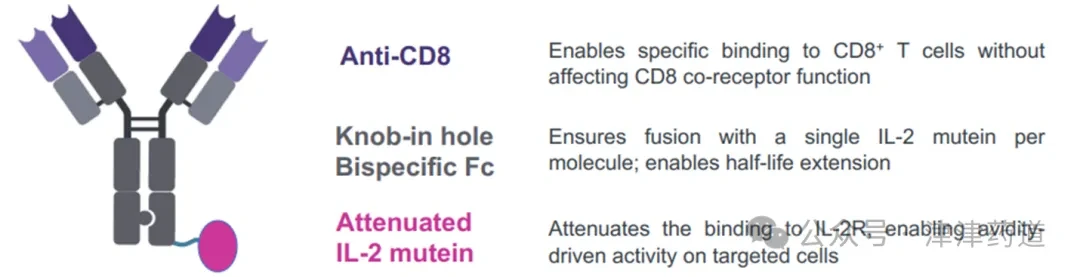
The combination of AMG757 and AB248 offers a new approach for the next generation of TCEs, utilizingCD8β Antibody and IL-2 Specifically Activate T Cell Subsets (seeNext-Generation TCE for Precise Activation of T Cell Subsets)Combining CD3/TAA。
IL-2 binds to the IL-2 receptor on the surface of T cells, activating the JAK/STAT pathway. The IL-2 receptor consists of three subunits: IL-2Rα (CD25), IL-2Rβ (CD122), and IL-2Rγ (CD132), regulatingProliferation, Differentiation, and Survival of T Cells.
When IL-2α, IL-2β, and IL-2γ are present simultaneously, the formed complex has the highest affinity for IL-2; the complex composed of IL-2β and IL-2γ has moderate affinity; whereasThe isolated IL-2α receptor has the lowest affinity (Figure 3).
Figure 3. Differences in Affinity of Different IL-2R Complexes
IL-2Rγ is expressed on all lymphocytes, while IL-2Rβ is constitutively expressed on NK and CD8 memory T cells and can be induced on naive T cells after antigen recognition. IL-2Rγ and IL-2Rβ are capable of intracellular signaling, whereas IL-2Rα does not participate in signaling.
This variable structure of the IL-2 receptor allows IL-2 to exhibit dual activity: in a high-dose environment, IL-2 can bind to the IL-2Rαβγ trimeric receptor, selectively activating Tregs to suppress immunity; whereas at low doses, it binds to the IL-2Rβγ dimeric receptor, selectively activating Teffs to promote immunity.
Therefore, for a considerable period of time, the industry has been inclined towards integration.IL-2Rβγ dimer receptor (or referred to as not-alpha) IL-2 has been extensively explored, includingNKTR-214、THOR-707、ALKS-4230, NL-201, ANV419, MDNA11, AU007 from Aulos, SHR-1916, 8MW2311, etc. However, theseNon-alpha IL-2 has experienced a series of clinical failures.
And the ensuing R&D hotspot is IL-2 targeted to immune cells through cis-targeting, includingRG6279(PD-1/IL-2Rβγ-biased IL-2)、REGN10597(PD-1/receptor-masked IL-2)、IBI363(PD-1/IL-2α-biased), AB248, etc.
Among them,AB248 demonstrated a preference for CD8+ T cells over NK cells in vitro experiments.Cell、TregCellMore than 1000-fold activation selectivity (Figure 4).
Figure 4.AB248 Selective ActivationCD8+ T Cells
In addition to being used in combination with AMG757, AB248 is currently also being used separately with Keytruda andRilvegostomig (PD-1/TIGIT Bispecific Antibody) Combination for Solid Tumor Clinical Development.
In terms of IL-2 modification, Innovent has adopted a completely different strategy from other companies. Its IBI363 is a PD-1/IL-2 bispecific fusion protein drug (Figure 5). The IL-2 arm reduces overall affinity through amino acid mutations, allowing it to preferentially bind to IL-2Rα while weakening its binding ability to IL-2Rβ and IL-2Rγ, thereby reducing toxicity. Meanwhile, the PD-1 binding arm can simultaneously achieve PD-1 blockade and selective delivery of IL-2.
Figure 5. IBI363 Structure and IL-2α-Biased Mutant TypeIn vivo activity
IBI363 can effectively bind to immune cell populations expressing CD25, particularly PD-1+/CD25+ T cells and Treg cells, significantly enhancing anti-tumor immune responses by increasing the Teff/Treg ratio, while effectively reducing toxicity associated with traditional IL-2 treatments (Figure 5).
According to the data released at the recently concluded ASCO annual meeting,IBI363 in 2L and above, and almost entirely in NSCLC patients post anti-PD-1/PD-L1 therapy, demonstrated superior survival data compared to existing standard treatments, especially in the 3mg/kg high-dose group, showing dose-related efficacy. However,The toxicity of IBI363 still poses a certain risk. In NSCLC, 43.9% of patients experienced Grade 3 or higher AEs, and four patients died, one of whom was treatment-related.
As more clinical data of T-cell-targeting IL-2 drugs are revealed, this concept will gradually achieve proof of concept (POC). It is believed that in the future, CD3/IL-2/TAA-type TCEs designed based on this concept will also continue to emerge.