

Over Two Years Relapse-Free Without Lymphodepletion: Phase I Data of Ruichuang Bio’s First-in-Class Allogeneic DNT Cell Therapy RC1012 Show Promise in Preventing AML Relapse Post-Allo-HSCT

July 5, 2025
eMedClub News
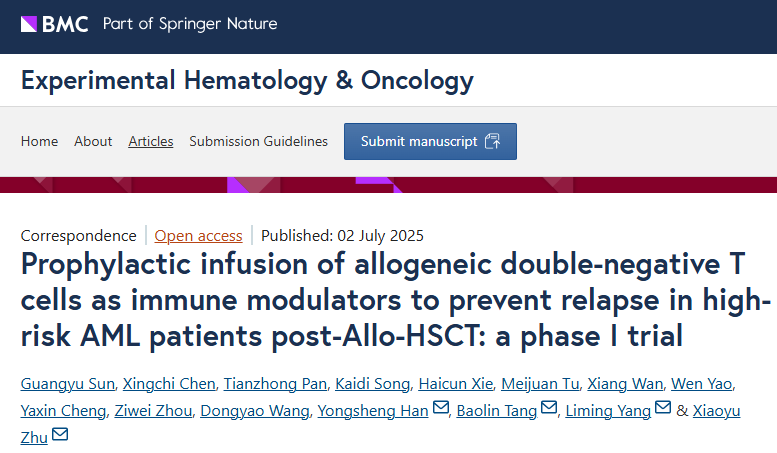
July 2,RuiShun BioResearch Team CollaborationProfessor Xiaoyu Zhu, Department of Hematology, First Affiliated Hospital of USTCThe team inExperimental Hematology & OncologyThe journal published a research article titled "Prophylactic infusion of allogeneic double-negative T cells as immune modulators to prevent relapse in high-risk AML patients post-Allo-HSCT: a phase I trial."
This study reports a phase 1 trial on "Prophylactic Infusion of RC1012 Injection for Relapse Prevention in High-Risk AML Patients After Allo-HSCT."(ChiCTR-1900022795)Positive data from clinical trials.
Data shows that RC1012(The main component is DNT cells.)Demonstrates significant safety and efficacy advantages in preventing relapse after allo-HSCT in AML patients.It can suppress GvHD while preserving the GVL effect, along with its "off-the-shelf" characteristic., which is expected to provide a transformative treatment option for post-transplant therapy/prevention in patients with relapsed/refractory AML.
DNTs cells are a special subset of T cells present in human peripheral blood, accounting for 1%-10% of total T cells. They express CD3 but do not express CD4, CD8, or CD56 molecules. Studies have shown that when the level of DNTs is higher in allo-HSCT patients, the risk of disease relapse decreases, and the incidence and severity of GvHD are also lower.
Early clinical trial data initiated by researchers indicate that allogeneic DNTs derived from healthy donors have demonstrated excellent safety and therapeutic potential for GvL in preventing relapse among high-risk AML patients post allo-HSCT.(IIT, ChiCTR1900023499)。
The Phase 1 clinical trial disclosed this time enrolled 6 high-risk patients who received allo-HSCT, divided into two dose groups: 1×10^8 DNTs/kg and 1.5×10^8 DNTs/kg. Each patient received 3 DNT infusions without lymphodepletion preconditioning, with each infusion spaced one month apart. The median time to the start of infusion was 3.1 months post-transplant. The primary endpoints were the occurrence of adverse events and dose-limiting toxicity, with secondary endpoints being the cumulative incidence of relapse.(CIR)。
The disclosed data shows that as of May 1, 2025, with a median follow-up of 20.9 months,Four out of six enrolled patients(66.7%)Achieve and Maintain Minimal Residual Disease(MRD)Negative CR status,The longest recurrence-free survival period exceeds 24 months.. The 1-year overall survival rate of the entire cohort(OS) and the progression-free survival rate were respectively 83.3%And 66.7%.
'%20fill='%23FFFFFF'%3E%3Crect%20x='249'%20y='126'%20width='1'%20height='1'%3E%3C/rect%3E%3C/g%3E%3C/g%3E%3C/svg%3E)
▲ Six patients received three DNT infusions.
▲ 1-Year Overall Survival (OS) and Progression-Free Survival (PFS)
In terms of safety, no dose-limiting toxicity, neurotoxicity, or cytokine release syndrome greater than grade 2 was observed. No adverse events greater than grade 2 occurred in any of the patients.
Immune ReconstitutionTest data show that donor-derived DNT cells can be detected in the peripheral blood 1-4 days after infusion and persist for up to 28 days.In 2 patients without recurrence, the infused DNTs persisted in vivo for up to 360 days.。
In addition, compared with relapsed patients, CR patients exhibited higher levels of cytokines and immune cells. Not only were the levels of CD4+, CD8+, and DNT cells significantly elevated in vivo, but also granzyme B.(GZMB)And Effector Memory T Cells(Tem)The proportion has also been significantly increased.
In vitro studies further confirmed that co-culture of patient-derived CD8+ T cells with allogeneic DNT cells upregulated the expression of granzyme B and IFN-γ, while immune activation-related cytokines and pathways were also activated, suggestingDNTs can not only directly exert anti-tumor functions but also indirectly enhance the GVL effect by activating patients' CD8+ T cells.`, reflects`Dual ImmunomodulationFunction.
It is worth mentioning that Ruichuang Bio's RC1012 is not the only exploratory therapy in this field. IN8Bio, a U.S.-based company, is also developing an off-the-shelf γδ T cell therapy. INB-100As a representative of similar products, it also demonstrated significant efficacy in early clinical trials.
Transplantation and Cell Therapy in 2025(TCT)At the meeting, the latest research results published by IN8Bio showed that no relapse was observed in any AML patients treated with INB-100, and all patients had a median follow-up time of 20.1 months.1-Year PFS was 90.9%, and 1-Year OS was 100%., all of which are superior to historical controls in the real world. Previously released Phase 1 efficacy data showed that AML patients in the initial cohort achieved a median complete remission of 23.3 months.(CR)Period, several patients have been in remission for more than 3 years.
Despite the excellent data, publicly available information reveals significant differences in the treatment design between INB-100 and RC1012.
INB-100 adopts fludarabine + cyclophosphamide + total body irradiation(TBI)of6-Day Clearing Pre-Treatment Regimen, followed by haploidentical HSCT transplantation, with the cell product infused 7 days later. This high-intensity lymphodepletion regimenAlthough it may enhance the immunosuppressive effect, it also brings a higher risk of treatment-related toxicity, such as bone marrow suppression, infection, and organ toxicity., which poses an application challenge in clinical practice, especially for frail patients.
In contrast,The core differentiation advantage of RC1012 lies in achieving long-term recurrence-free survival "without the need for lymphodepletion preconditioning.", which is of great significance in clinical practice. Especially in areas with uneven distribution of medical resources, avoiding complex preprocessing procedures can significantly lower the treatment threshold and improve patient accessibility.
FromClinical AcceptanceFrom the perspective of high-intensity lymphodepletion regimens, they may also face dual concerns from both doctors and patients. Studies have shown that lymphodepletion chemotherapy not only increases the risk of infection but may also lead to grade 3-4 adverse reactions such as lymphocytopenia and anemia. In contrast, no adverse events exceeding grade 2 were observed with RC1012 in phase 1 trials, and no hospitalization is required for pre-treatment, making it more aligned with current medical trends.Safety and ConvenienceThe demand. In addition, the treatment cycle of INB-100 is longer.(From clearing to cell infusion takes about 13 days), while the three intermittent infusion regimens of RC1012 offer more flexibility,Can better adapt to the individualized treatment needs of different patients.。
In general, despite the small sample size and limited follow-up time in this study of RC1012, it revealed allogeneic DNT.(Allo-DNT)The Unique Advantages of Cell Therapy Compared to Existing Interventions After Hematopoietic Stem Cell Transplantation.
As an "off-the-shelf" cell product, Allo-DNT cell therapyWith Anti-Tumor Properties(GvL) and anti-GvHD function, providing a clinically ready-to-use solution for preventing recurrence. In addition, due toNo need for pre-treatment with clear drenching., this product can significantly reduce treatment-related toxicity, providing a safer and more convenient clinical pathway, and under this pathway, it has demonstrated definitive potential in preventing recurrence.Expected to replace the Class I recommendation in current guidelines regarding donor lymphocyte infusion for preventing recurrence after transplantation.(DLI)Therapy, offering patients a disruptive and entirely new treatment option.
Editorial Responsibility | Luca
Proofread by Luca
References:
1.https://ehoonline.biomedcentral.com/articles/10.1186/s40164-025-00680-1
Exciting Live Broadcast Preview
Press and hold to scan the QR code and participate immediately ↓
Recommendation 1
July 24th, 15:00-16:00
Development of Exosome Drugs Under ATMP Regulation and In-Depth Analysis of the World's First Exosome Drug
Dian Dian "Share”、“Like"And"In View",Give me a little recharge~