Disclaimer: Due to limited proficiency, errors are inevitable, and some information may not be the most up-to-date. Feel free to point out in the comments. This article is only an introduction to medical and health-related drugs, not a recommendation of treatment plans (if involved); this article does not constitute any investment advice.
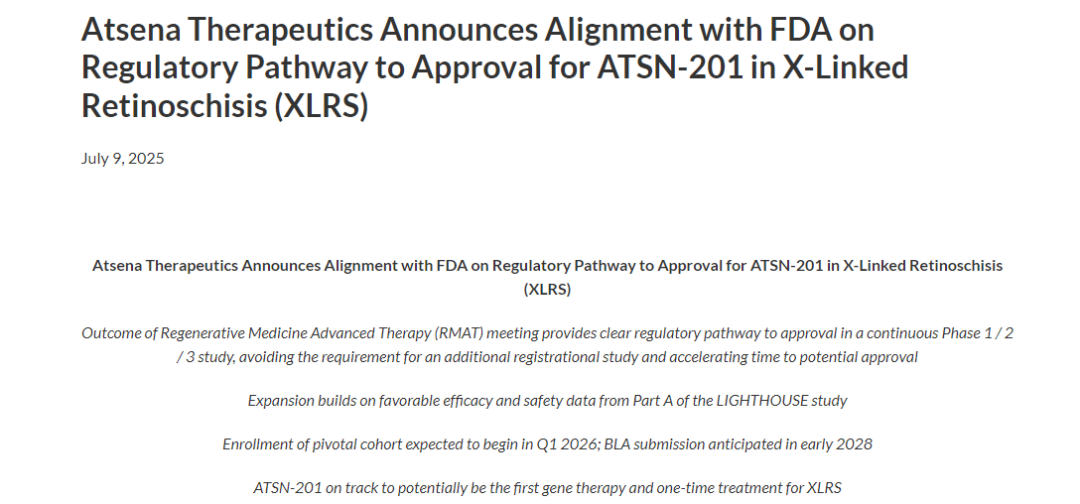
On July 9, 2025, Atsena Therapeutics, a clinical-stage gene therapy company focused on harnessing the power of genetic medicine to reverse or prevent blindness, announced that the U.S. Food and Drug Administration (FDA) has agreed to expand the company's ongoing Phase 1/2 LIGHTHOUSE study of ATSN-201 into a continuous Phase 1/2/3 trial, making it a pivotal trial to support its Biologics License Application (BLA) submission for the treatment of X-linked retinoschisis (XLRS).BLA is expected to be submitted in early 2028.The novel diffusion capsid AAV.SPR used in ATSN-201 can spread laterally beyond the subretinal injection site, enabling safe and effective gene delivery to the central retina (in patients with XLRS, the splitting cavities are mainly concentrated in the central retina). Previous studies have shown that AAV.SPR can effectively deliver payloads to cone cells on the fovea of the retina at clinical doses without surgical dissection and without causing inflammation.Patrick Ritschel, CEO of Atsena Therapeutics, stated: "This regulatory milestone marks another significant step forward in our efforts to provide XLRS patients with a potential first-in-class and best-in-class gene therapy. Compared to a standalone Phase 3 clinical trial, the FDA’s agreement will advance the clinical development timeline for ATSN-201 by at least 1.5 years. If approved,This will become the first drug available for the treatment of XLRS., bringing hope to patients and families affected by this hereditary retinal disease. We appreciate the FDA's ongoing guidance, and we will continue to advance this trial, preparing to submit a Biologics License Application (BLA) in early 2028.”This first-in-class and best-in-class gene therapy candidate has received the Regenerative Medicine Advanced Therapy (RMAT), Fast Track, Rare Pediatric Disease, and Orphan Drug designations from the U.S. FDA. This regulatory feedback was obtained following an RMAT meeting with the FDA. The FDA has reached an agreement on the proposed trial design, endpoints, and patient population to support potential registration. The ongoing multi-center trial will add a new cohort. In this additional cohort, approximately 30 adult and pediatric patients will be randomly assigned to the treatment group and the control group in a 1:1 ratio. Patients in the control group will have the opportunity to receive treatment after one year. The efficacy and safety of all patients will be assessed through indicators such as microperimetry, visual acuity, and macular structure.The pivotal cohort is expected to begin enrollment in the first quarter of 2026, with key data anticipated to be released in the second half of 2027.Kenji Fujita, M.D., Chief Medical Officer of Atsena Therapeutics, stated"The ongoing trial data show that, to date, subretinal injection of ATSN-201 has been well tolerated, including in patients with severe macular holes, with encouraging improvements in retinal structure and visual function. This program marks the first clinical application of our laterally spreading retinal download vehicle, providing important proof-of-principle for our ocular gene therapy platform. As the study expands, we are expected to obtain critical data needed, which is expected to advance the development of the first XLRS therapy."Reference: Company Announcement



'%20fill='%23FFFFFF'%3E%3Crect%20x='249'%20y='126'%20width='1'%20height='1'%3E%3C/rect%3E%3C/g%3E%3C/g%3E%3C/svg%3E)