Disclaimer: Due to limited expertise, errors are inevitable, and some information may not be the most up-to-date. Comments are welcome to point these out. This article is only an introduction to medical and health-related drugs and does not recommend any treatment plans (if involved). This article does not constitute any investment advice.
On July 10, NKGen Biotech announcedThe first dose was administered to a patient with mild Alzheimer's disease (AD) under the U.S. FDA-approved compassionate use authorization.Autologous NK Cell ProductTroculeucel, the patient's cognitive abilities continue to decline despite receiving Biogen/Eisai Leqembi (lecanemab) treatment.
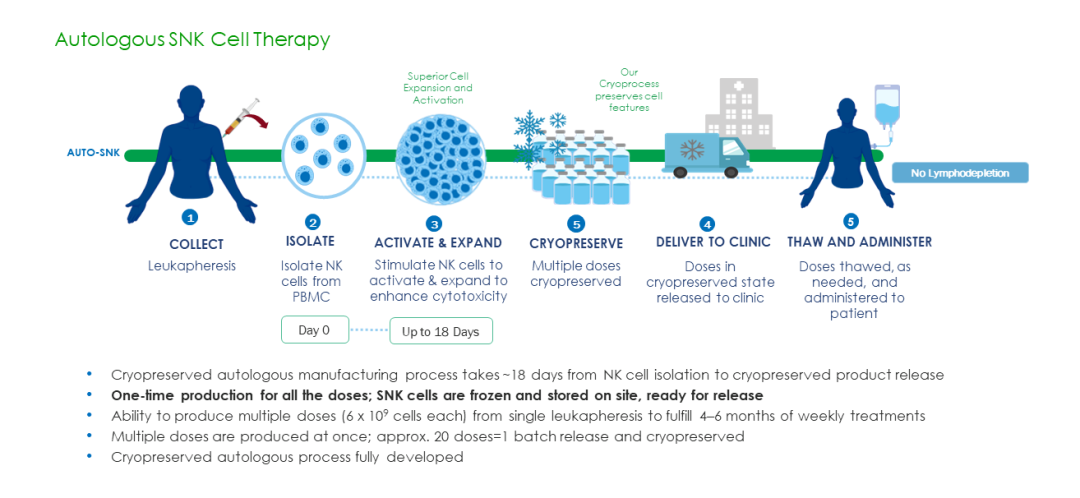
Troculeucel (Research Code: SNK01) is a novel cell-based, patient-specific immunotherapy drug developed from its Super NK (SNK) platform, involving the in vitro expansion of autologous NK cells.SNK injects self-activated NK cells (autologous SNK01) or donor NK cells (SNK02) into the body to enhance immune system function, eliminate diseased or abnormal cells, and prevent recurrence. Highly pure NK cells harvested from the patient’s or donor’s blood are activated and infused into the patient. Since these cells are derived from the patient's blood rather than being genetically modified, they have a lower likelihood of adverse reactions compared to other therapies, such as CAR-T.SNK has broad therapeutic potential in the fields of cancer, autoimmune diseases, and neurodegenerative diseases.
NKGen Biotech, Inc.'s ongoing double-blind randomized Phase 2a clinical trial (NCT06189963) focuses on mid-stage Alzheimer's disease, while this single IND represents the company’s first expansion into the treatment of mild Alzheimer's disease, specifically targeting patients who do not respond to existing first-line therapies.In February, NKGen Biotech announced the Phase 1 clinical study results of TroculeucelAD: 90% of patients achieved stable/improved outcomes, with no drug-related adverse events.'%20fill='%23FFFFFF'%3E%3Crect%20x='249'%20y='126'%20width='1'%20height='1'%3E%3C/rect%3E%3C/g%3E%3C/g%3E%3C/svg%3E) Paul Y. Song, M.D., Chairman and Chief Executive Officer of NKGen Biotech, Inc., stated: "Currently, there are two FDA-approved therapies targeting amyloid available for patients with mild cognitive impairment due to Alzheimer's disease. While both treatments have been shown to slow the rate of cognitive decline, they do not halt disease progression or improve cognitive function. Based on our clinical experience to date, troculeucel is well-tolerated, capable of crossing the blood-brain barrier, and increases levels of amyloid, alpha-synuclein, and tau in cerebrospinal fluid (CSF), while also reducing neuroinflammation, as evidenced by decreased levels of glial fibrillary acidic protein (GFAP). If we can demonstrate clinical improvement in Alzheimer’s patients whose disease continues to progress despite receiving standard amyloid-targeting therapies, this would provide significant insights into the underlying disease mechanisms and may support the rationale for combination therapy strategies."Reference: Company Announcement
Paul Y. Song, M.D., Chairman and Chief Executive Officer of NKGen Biotech, Inc., stated: "Currently, there are two FDA-approved therapies targeting amyloid available for patients with mild cognitive impairment due to Alzheimer's disease. While both treatments have been shown to slow the rate of cognitive decline, they do not halt disease progression or improve cognitive function. Based on our clinical experience to date, troculeucel is well-tolerated, capable of crossing the blood-brain barrier, and increases levels of amyloid, alpha-synuclein, and tau in cerebrospinal fluid (CSF), while also reducing neuroinflammation, as evidenced by decreased levels of glial fibrillary acidic protein (GFAP). If we can demonstrate clinical improvement in Alzheimer’s patients whose disease continues to progress despite receiving standard amyloid-targeting therapies, this would provide significant insights into the underlying disease mechanisms and may support the rationale for combination therapy strategies."Reference: Company Announcement