

B7-H3 (CD276): The Next Blockbuster ADC Target Heating Up with Multiple Global Phase III Candidates

Qilu Pharmaceutical
Specialty Formulations and Active Pharmaceutical Ingredients (API) Developer
Preface
Minghui Pharmaceutical Ltd. independently developedB7-H3-Targeted Antibody-Drug Conjugate MHB088C Recently Initiates Phase III Pivotal Clinical Trial in China for Refractory Small Cell Lung Cancer (SCLC)(Registration No.: CTR20250586), marking the project's entry into a critical clinical stage. Previously, on May 9, 2025, Minghui Pharmaceutical Ltd. and Qilu Pharmaceutical Co., Ltd. reached an exclusive licensing agreement for this project with a total value of 1.345 billion RMB, covering upfront payments, milestones, and sales royalties, setting a new record for BD transactions in China’s ADC field. The formal advancement to Phase III not only demonstrates the acceleration of its clinical progress but also reignites significant attention from the market and the industry towards the innovation capabilities of domestically produced ADCs.
Introduction to B7-H3 (CD276)
B7-H3 (also known as CD276) is a type I transmembrane glycoprotein and a member of the B7 family. It was first discovered in 2001 [1].
The B7H3 gene is located on chromosome 15 and encodes a protein composed of 316 amino acids with a relative molecular weight of 45-66 kDa. The entire B7H3 protein consists of four parts: a predicted signal peptide, extracellular V- and C-like Ig domains (IgV and IgC), a transmembrane domain, and an intracellular tail. There are two isoforms: 2Ig B7H3 and 4Ig B7H3, with the latter being the predominant form [2].
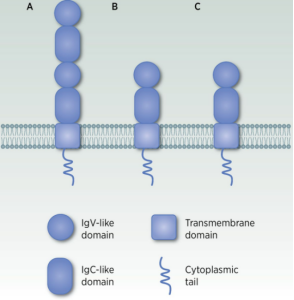
Figure 1 Structure of B7H3 [2]
Some studies have shown that B7H3 has both co-stimulatory and inhibitory effects on the immune system in non-malignant tissues [3]. On the one hand, B7H3 acts as a co-stimulator to co-stimulate T cells, inducing their activation, proliferation, and secretion of cytokines (such as IFN-γ and IL-2). On the other hand, B7H3 plays a co-inhibitory role in some adaptive immune responses, allowing tumors to evade immune responses and suppressing NK cell-mediated cytolysis.
'%20fill='%23FFFFFF'%3E%3Crect%20x='249'%20y='126'%20width='1'%20height='1'%3E%3C/rect%3E%3C/g%3E%3C/g%3E%3C/svg%3E)
Figure 2 B7H3 signaling pathway [3]
Studies have found that B7-H3 is overexpressed in various tumor tissues, including non-small cell lung cancer, pancreatic cancer, and primary liver cancer. Its excessive expression in tumor tissues is often associated with poor patient prognosis, shorter overall survival, and progression-free survival. In lung cancer, especially small cell lung cancer, about 65% of patients exhibit high B7-H3 expression in their tumors. This high expression correlates with a poor prognosis in lung cancer, making B7-H3 a promising therapeutic target.
Figure 3 Expression of B7H3 in cancer tissue [3]
Genmab Bio provides a series of cell lines, antibodies, and protein products targeting B7-H3 (CD276), offering significant support for drug screening and mechanistic studies related to B7-H3-associated diseases such as small cell lung cancer, prostate cancer, and nasopharyngeal carcinoma.
Gimane Bioscience has obtained commercial use authorization for cell lines such as HEK293, Jurkat E6.1, and CHO-K1, and provides comprehensive traceability documentation, enabling our partners to conduct compliant research from preclinical development through IND/BLA stages — helping to mitigate legal risks and accelerate commercialization.
B7H3(CD276)Research Landscape
CurrentlyNo B7-H3 ADC products have been approved for marketing globally.The R&D situation in the B7-H3 ADC field presents a different landscape compared to previous R&D scenarios in other fields. Despite encountering setbacks along the way, companies both in and outside of China continue to tirelessly work towards overcoming this "tough challenge."
According to incomplete data statistics from PharmaResearch, there are four B7-H3 ADC drugs in the global research pipeline that have entered Phase III clinical trials, with indications including small cell lung cancer, nasopharyngeal carcinoma, esophageal squamous cell carcinoma, and prostate cancer.
Table 1. Global B7H3 (CD276)Research Landscape
On the international stage, inatamab deruxtecan, co-developed by Daiichi Sankyo and Merck, has launched a global Phase III clinical trial for prostate cancer, becomingThe World's First B7-H3 ADC to Enter Phase III Clinical Trials. This drug, based on Daiichi Sankyo's proprietary DXd platform, marks the global competition for B7-H3 ADC entering uncharted waters.
Besides inatamab deruxtecan, the other three B7-H3 ADCs that have entered Phase III clinical trials are all from China: Minghui Pharmaceutical's MHB088C, Yilian Biotechnology's YL201, and Hansoh Pharma's HS-20093, showing a favorable competitive landscape.
Minghui Pharmaceutical MHB088C
MHB088C is an innovative B7-H3-targeted antibody-drug conjugate developed by Minghui Pharmaceutical Ltd. based on its proprietary SuperTopoi™ ADC technology platform, demonstrating enhanced tumor-killing efficacy and improved safety, significantly broadening the therapeutic window.
According to the results of a Phase I/II study presented at the 2024 ASCO conference, MHB088C demonstrated efficacy in 31 evaluable patients with small cell lung cancer (SCLC).ORR was 61.3%, DCR was 93.5%Among 10 patients treated with a dose of 1.6mg/kg Q2W, the ORR was 80%, and the DCR was 90%. Additionally, among 7 evaluable patients with esophageal squamous cell carcinoma, the ORR was 42.9%, and the DCR was 85.7%.
Notably, the subgroup analysis results of MHB088C in treating relapsed extensive-stage small cell lung cancer (ES-SCLC) and metastatic castration-resistant prostate cancer (mCRPC) were selected for oral and poster presentations at the 2025 ASCO Annual Meeting [4]. Dr. Guoqing Cao stated, "MHB088C demonstrates robust efficacy and excellent safety, with no major hematological toxicity or interstitial lung disease."
YL201 by Yilian Biotechnology
YL201 is an ADC drug targeting B7H3 developed based on the TMALIN® technology platform, which is independently innovated by Yilian Biopharmaceuticals. On June 23, Yilian Biopharma announced YL201.Granted Breakthrough Therapy Designation by the U.S. FDA(Breakthrough Therapy Designation), for the treatment of small cell lung cancer (SCLC). Currently, the YL201 project is conducting multiple clinical studies worldwide. Among them, the indications for small cell lung cancer and nasopharyngeal carcinoma have entered Phase III clinical research in China. At the same time, YL201 is also actively carrying out various monotherapy and combination trials to explore its therapeutic potential in a variety of solid tumors.
Hansoh Pharma HS-20093
HS-20093 is a B7-H3 ADC that utilizes a clinically validated topoisomerase inhibitor (TOPOi) payload.
On December 20, 2023, Hansoh Pharma announced that it had licensed the overseas rights of its H7H3 ADC drug HS-20093 to GSK for an upfront payment of $185 million and potential milestone payments of up to $1.525 billion. Two Phase III clinical trials for small cell lung cancer and osteosarcoma have been initiated.
On April 18, 2025, the Chinese Clinical Trial Registry and Information Disclosure Platform showed that Hansoh registered a Phase III clinical study (CTR20251474) comparing HS-20093 injection with gemcitabine combined with docetaxel for the treatment of osteosarcoma patients who failed second-line treatments. This is alsoThe First Phase III Clinical Trial of Osteosarcoma Initiated by This DrugRecently, the drug has entered a Phase I clinical trial for first-line maintenance treatment of small cell lung cancer in combination with a PD-L1 antibody. This combination strategy is expected to enhance response rates through immune synergy, offering a new approach for the treatment of "cold tumors."
Source of the image:China Drug Clinical Trial Registration and Information Disclosure Platform
Summary
As multiple B7-H3 ADC pipelines progressively enter the mid-to-late stages of clinical trials, a new wave of accelerated development targeting this antigen has swept across the globe. Whether through differentiated designs using Exatecan as a payload or synergistic strategies combining with PD-(L)1, the targeting potential of B7-H3 is transitioning from exploratory evidence to commercial validation. The next "blockbuster ADC" may well emerge from this particular target-focused track.
GimMax Biotech
Gimma Biotech provides B7-H3 (CD276) target-related cell lines, antibodies, and protein products, offering significant support for drug screening and mechanism research on B7-H3-related diseases (such as small cell lung cancer, prostate cancer, and nasopharyngeal carcinoma).
This year, we alsoSuccessObtained commercial use authorization for HEK293, Jurkat E6.1, CHO-K1 and other cell lines, providing comprehensive traceability documents.EmpowerPartners conduct compliance research from preclinical development to IND/BLA stages, assistingCustomer AvoidanceLegal risks and accelerate the commercialization process.
Product List
Cell ProductsData Display
GM-C09618 H_CD276(B7H3) CHO-K1 Cell Line
Validation Results Using Anti-CD276 (B7H3)
Validation Results of Anti-CD276 (B7H3) Stability
GM-C23914 Cynomolgus_CD276 CHO-K1 Cell Line
Validation Results Using Anti-CD276 (B7H3)
Protein Product ELISA Validation DataDisplay
GM-87617RP Human CD276(B7H3 2Ig) Protein; His Tag
GM-87618RP Biotinylated Human CD276(B7H3 2Ig) Protein; His-Avi Tag
GM-87619RP Human CD276(B7H3 4Ig) Protein; His Tag
GM-87620RP Biotinylated Human CD276(B7H3 4Ig) Protein; His-Avi Tag
Contact Us
Genomeditech, established in 2011, is a high-tech enterprise specializing in biotechnology services and cutting-edge technology research and development. Genomeditech focuses on empowering biopharmaceutical development and has independently created the well-known cell line brand in China—DDXCELL. It currently covers nearly 400 popular targeted drug targets and offers over 1,000 ready-to-use monoclonal cell lines, spanning multiple fields such as GPCR, cytokines, immune checkpoints, and TAA, achieving domestic substitution for imported cells. Additionally, Genomeditech provides a series of antibody and protein products during the drug research and development process, aiming to offer customers efficient R&D tools and solutions!
Scan to Consult
Scan to Find Stock
References:
[1]ChapovalAI, NiJ, LauJS, et al. B7-H3: a costimulatory molecule for T cell activation and IFN-gamma production[J]. Nat Immunol, 2001,2(3):269-274. DOI: 10.1038/85339.
[2]Kontos, Filippos, et al. B7H3: an attractive target for antibody-based immunotherapy[J].Clinical Cancer Research 27.5 (2021): 1227-1235.
[3]Koumprentziotis, Ioannis-Alexios, et al.New emerging targets in cancer immunotherapy: the role of B7H3[J]. Vaccines 12.1 (2024): 54.
[4]https://ascopubs.org/doi/10.1200/JCO.2025.43.16_suppl.8510
[5]https://mp.weixin.qq.com/s/VPyxlGF-AVRNAbY1RYAlCg