

Grit Biotechnology and Prof. Yang Yang’s Team at Shanghai Jiao Tong University School of Medicine Publish Breakthrough Research in Advanced Science on DNA Origami-Based TGFβ1 Sequestration for Enhanced Cancer Immunotherapy

Grit Biotherapeutics
Developer of Immunotherapy Drugs for Solid Tumors
Recently, a research team led by Yang Yang from the Institute of Molecular Medicine at Shanghai Jiao Tong University School of Medicine, in collaboration with Shanghai Grail Biotechnology Co., Ltd., published their research findings in *Advanced Science* (IF = 14.3) under the title "Engineering DNA Origami Captors for TGFβ1 Sequestration to Enhance Tumor Immune Modulation and Therapy." The study proposed and implemented the use of DNA nano-frameworks as blood scavengers to "capture and eliminate" the immunosuppressive factor TGFβ1, rapidly reversing the immunosuppressive state within the tumor microenvironment. This significantly enhances the anti-tumor activity of immune cells and improves the overall therapeutic efficacy of combined immunotherapy.
TGFβ1 is one of the key immunosuppressive factors in the tumor microenvironment. Its overexpression can suppress T-cell activity, induce regulatory T-cell differentiation, and promote tumor immune escape and progression. Traditional drugs that block TGFβ signaling (such as monoclonal antibodies or small-molecule inhibitors) often require high doses and have long circulation times, posing a risk of systemic toxicity, making it difficult to achieve rapid and precise intervention.
In response to the aforementioned challenges, the study constructed several DNA framework "captors" (DNA Framework Captors, DFCs) with varying calibers and internal spaces based on DNA origami technology. Among them, the tubular structure (DBC) demonstrated the highest TGFβ1 capture efficiency. The inner surface of this structure can be densely modified to recognize TG.DNA Aptamer of Fβ1 for Targeting TGFβ1 Spatial confinement enrichment and rapid "clearance". In vitro experiments show that the capturer can effectively reduce the activity of the TGFβ1 signaling pathway, significantly decrease the generation of immunosuppressive Treg cells, increase the proportion of effector T cells, and enhance the tumor-killing effects of PBMC and TCR-T cells. In a mouse MC38 tumor model, systemic injection of the DNA capturer at only picomole (pmol) doses rapidly reduced TGFβ1 levels in peripheral blood and, through a dynamic balance mechanism between circulation and tumor, significantly decreased TGFβ1 content in tumor tissues, remodeling the immune microenvironment and suppressing tumor growth. Combination with PD-L1 antibody therapy achieved stronger synergistic anti-tumor effects, and the renal clearance pathway of DFCs capturing TGFβ1 was confirmed using immunohistochemistry. This system also demonstrated good biocompatibility and safety.
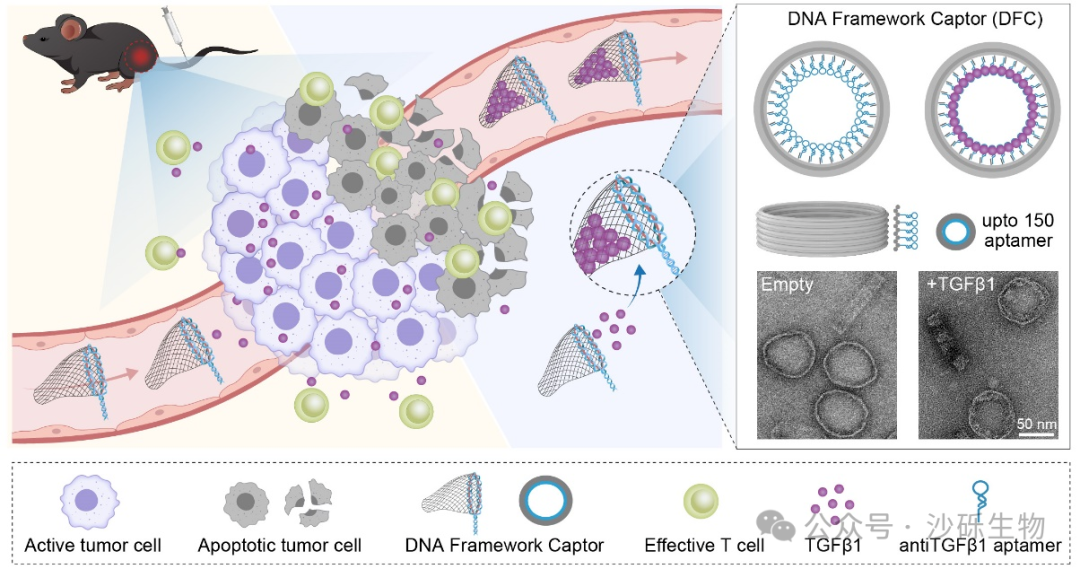
This study is the first to systematically propose and validate the immunomodulatory potential of the "high-capacity capture + rapid clearance" strategy in cancer treatment, offering a novel approach for cancer immunotherapy. The DNA framework capturer not only acts as a "spatial trap" to isolate immunosuppressive factors but also offers bioengineering advantages such as programmability and biodegradability, with the potential to further expand its application to more disease scenarios, including controlling cytokine storms and clearing metabolic waste.
Chen Xiao and Liu Dunfang, Ph.D. candidates from the Shanghai Jiao Tong University School of Medicine, are the co-first authors of this study. Researcher Yang Yang from Renji Hospital, Dr. Sun Jingwei, and Dr. Liu Yarong from Grail Biotechnology are the corresponding authors. This work was supported by the National Natural Science Foundation of China, the Innovation Team of High-Level Local Universities in Shanghai, and the National Center for Biomedicine of the Ministry of Science and Technology.
'%20fill='%23FFFFFF'%3E%3Crect%20x='249'%20y='126'%20width='1'%20height='1'%3E%3C/rect%3E%3C/g%3E%3C/g%3E%3C/svg%3E)