

Originator Exited, Qilu Ascends: Oxaliplatin Injection Gains Reference Status Amid Regulatory Shift

Qilu Pharmaceutical
Specialty Formulations and Active Pharmaceutical Ingredients (API) Developer
▲August 1-22025 Biomedical Innovation ExpoScan to register
Note:This article does not constitute any investment opinions or suggestions.,Subject to official/company announcements;This article only introduces drugs related to medical health, not a recommendation of treatment options (if involved), and does not representPlatform position.Any article reprinted needs to be authorized.
On July 15, the official version of the second batch of the "List of Reference Preparations for Removal" was released.
Injection with Oxaliplatin, which was included in the draft for comments as early as September 2023, has finally been settled and confirmed to be removed.
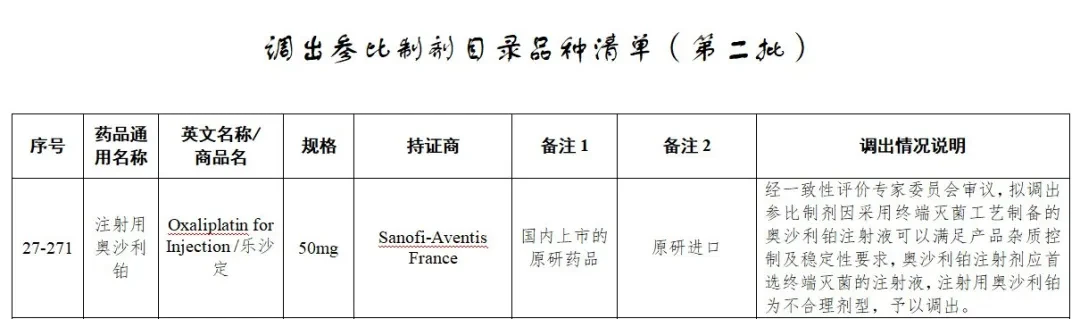
This means that there is currently no reference preparation for injectable oxaliplatin, and the generic pathway for lyophilized powder injections has been officially cut off.
As the third-generation platinum-based antineoplastic drug, oxaliplatin has two types of formulations in China: true solution and freeze-dried powder. Its reference status, however, has experienced several reversals —
From replacing lyophilized powder with true solutions, to the exclusion of the original research product from the reference list, while the generic products were included instead....
'%20fill='%23FFFFFF'%3E%3Crect%20x='249'%20y='126'%20width='1'%20height='1'%3E%3C/rect%3E%3C/g%3E%3C/g%3E%3C/svg%3E)
OxaliplatinThe earliest dosage form was lyophilized powder injection, developed by Sanofi in 19Launched in France in 1996, entered the Chinese market in 1999. In the early days, there were many domestically produced products available in China, including those from Aosaikang, Hengrui, and Yangzijiang.For many years thereafter, freeze-dried powder remained the mainstream dosage form in China.
In 2005,Sanofi has launched another solution formulation in the United States.Oxaliplatin Injection, but this dosage form has never entered the Chinese market.
In 2020, Sanofi's lyophilized powder was listed as a reference. Meanwhile, one month later,The true solution also announced the reference, but it was not Sanofi's original product, but Qilu Pharmaceutical's generic product launched in the United States in 2016.
The original drug didn't make it, but the generic did. The reason given was also clear: Sanofi's Oxaliplatin Injection sterilization method does not comply."Guiding Principles for Research and Validation of Sterilization and Aseptic Processes for Chemical Injectable Agents (Trial)", not eligible for reference.
The status of a reference preparation has never been solely about "original research," but rather whether it holds the position of a reference.For Oxaliplatin Injection, the original research drug was excluded, leaving domestically produced generics.
What about Qilu Pharmaceutical's products? How are they improved over the original research?
According to Qilu Pharmaceutical Co., Ltd.Disclosure, itsThe oxaliplatin injection is manufactured byTerminal high-temperature sterilization,The National Medical Products Administration (NMPA) has explicitly stated in both the "Basic Technical Requirements for Chemical Injectable Agents" and the "Guiding Principles for Sterilization/Aseptic Process Validation" that,Injectable preparations should primarily adopt high-temperature sterilization processes, which provide a higher level of sterility assurance; for those unable to withstand terminal sterilization processes, filtration sterilization or aseptic processing can be considered.
The core difference is speculated to be whether terminal sterilization is applied; Qilu Pharmaceutical has made improvements to the original research product rather than replicating it exactly.
In contrast, there are significantly more companies applying for injectable solutions, including leading enterprises like Hengrui and Huiyu. A relatively large number of these companies have successfully passed the evaluation, and the progress is much faster than that of freeze-dried powder.
Looking at the market side again,The market for injectable oxaliplatin is not small,Before 2021, it once broke through 3 billion yuan, with the original research Sanofi accounting for more than 90%.
Until 2021Oxaliplatin InjectionIncluded in the fifth batch of national procurement, the freeze-dried powder was exclusively awarded to Sanofi. This is also one of the few cases where an original research company has won a national procurement bid.
But the price compression brought by centralized procurement still makes the market decline inevitable.As the fifth batch of national procurement agreements expire in 2024, freeze-dried powder will not be renewed and will no longer be affected by centralized procurement, leaving the marketOnly 1.5 billion left, Sanofi still holds 90% of the market。
By contrast, both oxaliplatin injection and lyophilized powder participated in the fifth batch of centralized procurement. However, after the agreement period ended, they successfully completed the renewal process, retaining their eligibility, which means they will gain a solid foothold in the new round of market redistribution.
CurrentlyOxaliplatin Injection has been approved by eight companies, and the centralized procurement renewal is ongoing.FutureThe three major winning companies: Hengrui, Qilu,Huiyu Will Gradually Erode the Remaining 1.5 Billion Market for Lyophilized Powder。
A 1.5 billion market is being re-divided. The winner and loser have, in fact, long been decided.
All screenshots in this article are from: Mosentropy Medicine
August, pre-scan to register: Secure new learning opportunities and trading prospects.
◈ 09:00-09:25
Regulation Under the New FDA Policy
WangYaning
Reiningkang Biopharmaceutical, Founder & CEO
◈ 09:25-09:50
Trends and Responses in FDA AI Review
Li Changqing
Eglin Pharmaceuticals, Co-Founder & CMO
◈ 09:50-10:15
Considerations for Submitting Chinese Clinical Data to the U.S.
Yuwen Gao
Senior Vice President and Global CBO of Stem Pharmaceuticals
◈ 10:15-10:40
FDA Non-Clinical AI Review and Organoid Applications
Han Xiaomei
Kuoyue Biotech, Founder & CEO
◈ 10:40-11:05
FDA New Non-Clinical Regulations and Response Strategies
Zhang Yongbin
Joinn Laboratories, Vice President and Chief Technology Officer
◈ 11:05-12:00
Panel: New Trends in FDA Regulatory Oversight
[ Host ]
Du Xin Eglin Pharma, CEO
[ Guest ]
Li Changqing Eglin Medicine, Co-founder & CMO
Yuwen Gao StemMed Senior Vice President and Global CBO
Han Xiaomei Kuoyue Biotech, Founder & CEO
Zhang Yongbin Vice President and Chief Technology Officer of JOINN Laboratories
◈ 12:00-13:30
Lunch
◈ 13:30-13:55
New Trends in cGMP Compliance Regulation
Sun Zhigang
Senior Vice President of Luye Pharma Group
◈ 13:55-14:20
New Developments in FDA Regulation of Botanical Drugs
Dou Jinhui
Former Senior FDA Review Expert
◈ 14:20-14:45
Communication on Interdisciplinary Key Controversial Issues in EOP2 Conference
Yang Jing
Professor at the Center for Drug Metabolism Research, China Pharmaceutical University
◈ 14:45-15:10
Non-clinical Safety Evaluation Studies of Advanced Therapy Products and the Application of New Safety Evaluation Methods
Lu Jinhua
Stardust Bio, Co-Founder, CSO
◈ 15:10-15:35
Application of Real-World Data in New Drug Clinical Development
Shen Xiao
Libang Pharmaceuticals, Chief Scientific Officer
◈ 15:35-16:20
Panel: New Developments in FDA Regulation of Emerging Medical Products
[ Host ]
Du Xin Eglin Pharmaceuticals, CEO
[ Guest ]
Sun Zhigang Luye Pharma Group, Senior Vice President
Dou Jinhui Former Senior FDA Review Expert
Yang Jing Professor at the Drug Metabolism Research Center of China Pharmaceutical University
Lu Jinhua Stardust Bio, Co-Founder, CSO
Shao Shen Libang Pharmaceuticals, Chief Scientific Officer
Copyright Statement: This article is reproduced from PharmaComm. Media or individuals who do not wish to be reprinted can contact us, and we will delete it immediately.
Rooted in Shanghai and radiating globally, PharmaCircle serves as a strategic platform for the biopharmaceutical industry. With the mission of "enabling the boundaryless flow of intelligence and networks," it has established an empowering system that covers the entire pharmaceutical industry chain, including R&D, production, distribution, and commercialization. Through four core engines—intelligent cloud services, precise resource linking, industrial think tanks, and ecological communities—it builds the infrastructure for the flow of pharmaceutical value in China.
Under the dual waves of globalization and digitalization, PharmaCircle is redefining the circulation paradigm of pharmaceutical resources — it is not only a hub for information and networking but also a catalyst for industrial transformation. With China as the origin, we are weaving a global network of pharmaceutical intelligence, making every precise connection a catalyst for leapfrog growth of enterprises.