

Boehringer Ingelheim Inks $1B+ Deal for Re-Vana’s Long-Acting Ocular Drug Delivery Platform

Boehringer Ingelheim
Developer of Innovative Drugs and Therapies
Re-Vana Therapeutics
Ophthalmic drug and drug delivery technology and product developer
On July 28, 2025, local time, global biopharmaceutical giant Boehringer Ingelheim and innovative drug delivery company Re-Vana Therapeutics (hereinafter referred to as Re-Vana) officially announced the establishment of a strategic collaboration and licensing agreement, aiming to jointly develop the first-of-its-kind, long-acting treatment solutions for ophthalmic diseases.
According to the cooperation agreement, Boehringer Ingelheim aims to add up to three projects annually, covering various therapeutic modalities. Both companies will jointly oversee Re-Vana's feasibility and development activities in these long-acting projects, while Boehringer Ingelheim will assume full responsibility for subsequent clinical development, regulatory approval, and global commercialization. The agreement also grants Boehringer Ingelheim exclusive rights to the targeted projects.
The agreement grants Boehringer Ingelheim exclusive rights and stipulates that it will make upfront, development, regulatory, and commercial milestone payments to Re-Vana Therapeutics. In addition to royalties on net sales, the potential total value of the transaction for the first three projects will exceed $1 billion (approximately 7.178 billion RMB), making it the largest deal since Merck announced the $3 billion acquisition of ophthalmology biotech company EyeBio.
Let "One Needle a Year" Officially Enter Ophthalmic Clinical Practice
Re-Vana Therapeutics was founded in 2016 as an ophthalmic treatment and innovative ophthalmic drug delivery company spun off from Queen’s University Belfast, and is a wholly-owned subsidiary of Re-Vana Holding, Inc. based in Tampa, Florida.
The company has received investment support from leading ophthalmology investors in the United States (including Visionary Ventures, ExSight Ventures, InFocus Capital Partners) and investors from the United Kingdom (including QUBIS, TechStart Ventures, Invest Northern Ireland, and Clarendon Fund Managers).
The core of Re-Vana's patented technology can be understood as "one-step photopolymerization." At room temperature, the reaction is triggered by light, instantly forming the implant—while maintaining nearly unchanged internal pH levels, fully preserving protein activity. The crosslinked network acts as a "molecular gate" restricting water movement, which not only suppresses implant swelling but also locks the drug firmly within the matrix, enabling long-term stable release.
Meanwhile, by adjusting the light dose, drug load, and implant size, precise customization of the release rate and duration can be achieved. This implant is suitable for all biologics, including small molecules, peptides, and proteins; it biodegrades over time after being injected into the eye, enabling long-term, consistent drug delivery without the need for secondary surgery.
It is worth mentioning that Re-Vana's proprietary photo-crosslinked sustained-release technology is highly likely to contribute to the development of a wide range of novel sustained-release products applicable to various therapeutic fields.
Based on this, Re-Vana has developed two major technology platforms: EyeLief.®&EyeLief-SD™ and OcuLief®Platform.
EyeLief®&The EyeLief-SD™ platform utilizes ultraviolet light for photo-crosslinking through pre-formed IVT implants, administered clinically via a narrow-gauge needle, aiming to provide a range of therapeutic options. Re-Vana's implants can be customized for the release profiles of various drugs. The pre-formed implants enable sustained drug release and are suitable for biologics, peptides, large molecules, and small molecules.
These two technologies enable sustained drug release; each product is customized according to specific therapeutic requirements. Re-Vana implants can carry up to 50% by weight of active pharmaceutical ingredients (API) and are meticulously designed to provide stable release of potent drugs over a period of 3 to 12 months.
OcuLief®The platform is another patented technology platform of Re-Vana, supporting IVT implants synthesized in situ through photopolymerization using visible light. Clinically administered via a narrow needle (25G) and a customized applicator in liquid form, the drug subsequently solidifies into a solid implant for controlled, sustained release.
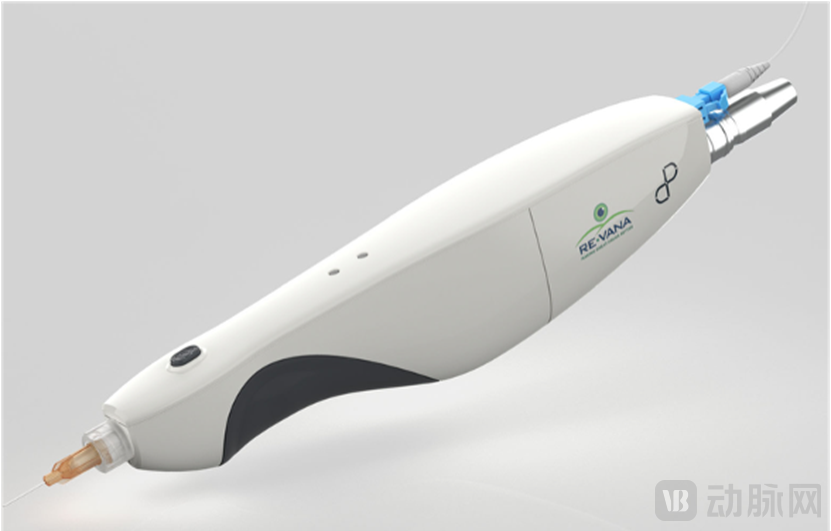 OcuLief®Applicator
Re-Vana Therapeutics is not only developing a long-acting drug delivery platform but also attempting to develop its own pipeline. The core pipeline is a long-acting anti-VEGF drug.
The introduction of anti-VEGF drugs has been a significant advancement in the treatment of patients with age-related macular degeneration (AMD). However, due to the need for frequent intravitreal injections, reducing the injection frequency remains a top priority for the entire industry, with the challenge lying in finding the optimal pharmacokinetic (PK) profile. Currently, no such products are available on the market.
In other words, this technological breakthrough by Re-Vana Therapeutics has the potential to revolutionize traditional ophthalmic drug delivery methods, offering new solutions for chronic eye conditions such as age-related macular degeneration (AMD) and diabetic macular edema (DME). AMD is the leading cause of severe vision loss in people over 50, indicating a vast market potential.
 Re-Vana Therapeutics' R&D Pipeline
Breaking the Deadlock in Ophthalmology: Seizing Long-Acting Drug Delivery
Boehringer Ingelheim's investment marks the official recognition of sustained-release technology as a "highly contested area" in the treatment of fundus diseases. For Boehringer Ingelheim, Re-Vana Therapeutics' unique advantages are evident: a micro-injection solution that does not require surgery, and its implantable polymer carrier has already received Class III medical device certification from the European Union.
"Repeated injections in the eye not only cause pain for patients but also increase the risk of infection and retinal detachment," noted the Chief Scientific Officer of Re-Vana Therapeutics in a statement. The company's platform, which precisely controls the drug release rate, reduces the injection frequency to 1-2 times per year while maintaining efficacy. This technology has demonstrated feasibility in preclinical studies. A long-acting version based on Regeneron's Eylea (aflibercept) is currently in Phase II/III trials, with preliminary data showing non-inferior efficacy for dosing every six months compared to monthly injections.
Re-Vana will also bring a technology premium. First, Re-Vana's core assets are not specific pipelines at present, but a long-acting platform that can be sustainably expanded for new indications. Its core patent "P3289992B1" is valid until 2037, further strengthening the patent barrier. In addition, Re-Vana has also built a production process barrier, with the molecular weight of the polymer precisely controlled at 20-40kDa.
Re-Vana's technology is not an isolated case, as long-acting drug delivery has become a research and development hotspot in the ophthalmology field. Novartis' ranibizumab sustained-release implant has been proven in Phase III trials to allow dosing every three months, and Roche is also developing an intravitreal implantable anti-VEGF formulation in an attempt to extend the injection interval to six months.
For Boehringer Ingelheim, this collaboration is a crucial step in its expansion into the ophthalmology field. Currently, Boehringer Ingelheim's ophthalmology pipeline includes only four drugs under research, such as the Phase II antibody BI 764524 for diabetic retinopathy and the Phase II antibody fragment BI 771716 for geographic atrophy, both of which are still in the early stages. Compared with giants like Novartis and Roche, the gap is evident.
On the other hand, ophthalmic treatment has long been limited by drug delivery methods: the bioavailability of eye drops is less than 5%, and while intravitreal injections are direct, they result in a poor patient experience, leading to low compliance. In this context, breakthroughs in long-acting formulations could become the key to reshaping the competitive landscape.
As a latecomer in the ophthalmic drug track, whether Boehringer Ingelheim can break the deadlock depends on whether it can achieve "overtaking on a curve" through a long-acting platform. Currently, the company's traditional advantages in fields such as respiratory and cardiovascular are facing a patent cliff, urgently requiring new growth points. The choice of Re-Vana Therapeutics' technology is precisely due to its ability to quickly address the company’s shortcomings in drug delivery technology while building its own differentiated advantages. In the era of "target homogenization," whoever can shorten the drug delivery cycle from "months" to "years" will gain a strong voice among both payers and patients.