

ViaLase Files for IPO: Pioneering Non-Invasive Femtosecond Laser Therapy for Glaucoma

ViaLase
Glaucoma Treatment Developer

Glaucoma is a serious eye disease characterized by optic nerve damage and visual field defects, primarily associated with elevated intraocular pressure. It is the leading cause of irreversible blindness globally and the second leading cause of blindness (with cataracts being the first). Primary Open-Angle Glaucoma (POAG) accounts for over 70% of cases. The number of people affected by POAG has exceeded 76 million worldwide, and it is projected to reach 112 million by 2040. The disease is known for its insidious and progressive nature, with early symptoms often being subtle. By the time patients experience noticeable symptoms, optic nerve damage may already be severe, potentially leading to irreversible vision loss. Hence, it is also referred to as the "silent thief of sight."
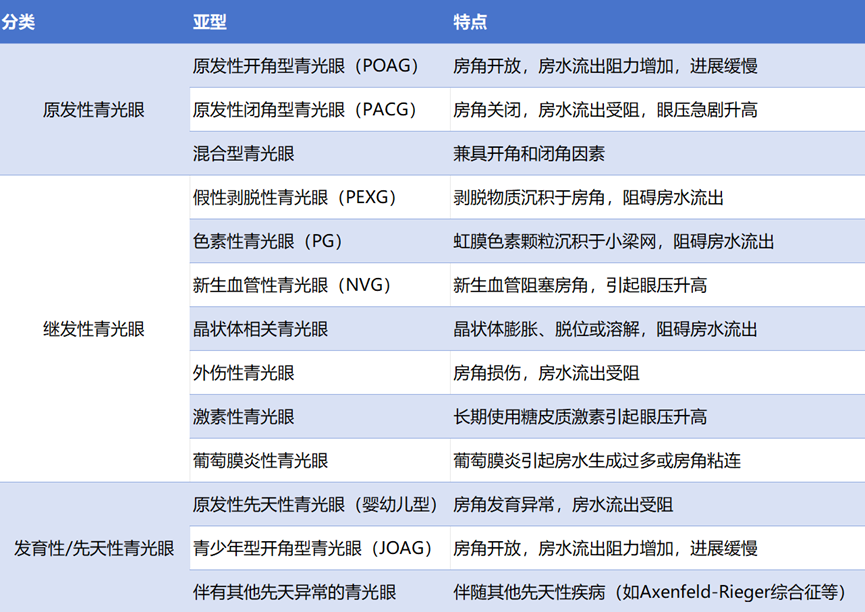
Main Types and Characteristics of Glaucoma
The treatment of glaucoma mainly focuses on reducing intraocular pressure through medications, laser, or surgeries to protect the optic nerve, prevent further vision loss, and maintain the patient’s visual function and quality of life. Currently, a variety of treatment methods are clinically applied, including medication, laser trabeculoplasty (e.g., SLT), traditional filtration surgeries (e.g., trabeculectomy), and the rapidly developing minimally invasive glaucoma surgery (MIGS) in recent years. However, there has been a long-term lack of an "effective yet non-invasive" technology for enhancing aqueous humor drainage.
PharmacotherapyMainly through topical eye drops or oral medications to reduce aqueous humor production or increase aqueous humor outflow, thereby lowering intraocular pressure. However, the eye drops can be expensive and difficult to use consistently; patients may have poor compliance (not feeling pain and thus not considering it urgent, making it easy to forget to apply the drops). Long-term use may also lead to side effects.
Laser TrabeculoplastyUsing laser energy to improve the aqueous humor drainage function of the trabecular meshwork, the operation is relatively simple, but the efficacy duration is short for some patients, with a relatively high failure rate.
Traditional Filtration SurgeryBy creating a new aqueous humor drainage channel to reduce intraocular pressure, the pressure-lowering effect is definite, but the surgical trauma is significant, and the risk of postoperative complications is relatively high;
Minimally Invasive Glaucoma SurgeryThis achieves aqueous humor drainage with minimal surgical trauma, offering advantages such as quick recovery and fewer complications. However, it mostly needs to be performed simultaneously with cataract surgery, which limits its application scope.
In 2003, femtosecond lasers were first commercialized in refractive surgery, demonstrating micron-level cutting precision without thermal damage within corneal tissue. Femtosecond lasers emit ultra-short light pulses — each pulse lasts just one hundred femtoseconds, or one quadrillionth of a second (0.000000000000001 seconds). Due to the extremely short and precise pulses, they can cut or alter tissue at the micron level without damaging surrounding areas. After 2010, the maturation of real-time imaging technologies such as OCT and gonioscopy provided an engineering basis for "image-guided precision cutting within the angle."
In 2019, Tibor Juhasz, a pioneer in femtosecond laser ophthalmology, co-founded ViaLase with glaucoma surgery expert Malik Kahook and optical engineer Ronald Kurtz. The company is headquartered in Aliso Viejo, California, USA. As a clinical-stage medical technology company dedicated to revolutionizing glaucoma treatment through femtosecond laser technology, ViaLase aims to create a one-time outpatient procedure combining "femtosecond laser + real-time gonioscopy," replacing implants with physical channels and traditional scleral flap surgery with incision-free techniques.

This innovative exploration did not happen overnight. As early as Juhasz's first attempt to apply femtosecond lasers to glaucoma treatment, the matching technical conditions were not yet mature—the imaging resolution at the time was too low, and the laser precision could not meet the requirements, so he temporarily adjusted his research direction. In this process, he developed what later became the Intralase laser technology, the first femtosecond laser for LASIK eye surgery (in LASIK surgery, the femtosecond laser reshapes vision by cutting the cornea; in ViaLase’s procedure, the laser drills tiny tunnels inside the eye to relieve pressure). This groundbreaking work earned him early industry recognition: in 2002, he was awarded the prestigious international honor—the Berthold Leibinger Innovation Prize—in recognition of his outstanding contributions to laser technology.
In 2017, Juhasz keenly realized that the relevant technical tools had made sufficient progress, finally providing the conditions to adjust the technical direction and tackle the challenges of glaucoma treatment."The imaging is better, and the laser is more precise. We can clearly see the structures that need to be observed and accurately target the treatment site."He said so. It was precisely based on such technical accumulation and judgment that ViaLase was officially founded two years later.
The founding team of ViaLase has deep expertise in the field of femtosecond laser technology, with a collective experience of over 200 years. In addition to Intralase, they have successfully developed groundbreaking technologies such as Lensx for cataract surgery, laying a solid foundation for the company's innovations in glaucoma treatment. Juhasz himself has received numerous honors for his ongoing contributions to this field, including the 2002 Berthold Leibinger Innovation Award and the Golden Goose Award in 2022, presented by the American Association for the Advancement of Science and the Association of American Universities for introducing femtosecond laser technology into ophthalmology.
It is worth noting that femtosecond laser technology has been widely used in the ophthalmology field, primarily in refractive surgeries such as LASIK and SMILE, as well as femtosecond laser-assisted cataract surgery (FLACS). However, the application of femtosecond lasers in glaucoma treatment is still in the exploratory stage. Techniques such as femtosecond laser-assisted trabeculotomy are gradually becoming a research hotspot in the field of glaucoma treatment, offering new hope for overcoming the limitations of existing treatment methods.
On April 1, 2024, glaucoma treatment developer ViaLase secured $40 million in Series C funding, led by new investors and joined by existing ones, including Venture Investors Health Fund, Arboretum Ventures, and Falcon Vision, an ophthalmology investment platform backed by private equity giant KKR. The funds will provide strong support for the clinical, regulatory, and commercial advancement of Vialase lasers.
Round | Time | Amount | Investor |
CWheel | 2024.4 | $4000Ten Thousand | Venture Investors Health Fund、Arboretum Ventures、Falcon Vision |
ViaLase's core product is the ViaLuxe™ laser system, used for treating adult patients with primary open-angle glaucoma (POAG). It received EU CE certification on July 30, 2024, becoming the first femtosecond laser system for glaucoma to achieve this certification. The system employsFemtosecond Laser Image-Guided High-Precision Trabeculotomy(Femtosecond Laser Image-guided High-precision Trabeculotomy,FLigHT),Treating open-angle glaucoma by creating channels in the trabecular meshwork is a non-invasive, incision-free method that allows doctors to achieve effects similar to surgical intervention without opening the eye, significantly reducing the risk of surgery-related vision-threatening complications.
The core of FLigHT is "two beams of light": one is a femtosecond laser with a wavelength of 780 nm and a pulse width of 600 fs, which creates a 500 µm × 200 µm elliptical cross-section aqueous humor drainage channel within the trabecular meshwork at the iridocorneal angle; the other is a 1310 nm swept-source OCT for real-time imaging, projecting the angle structure onto the surgeon's tablet with a resolution of 15 µm, enabling real-time navigation in four quadrants. The entire surgery is completed within 2–3 minutes, with the patient only requiring topical anesthesia, no conjunctival or scleral incisions, and no residual implants.
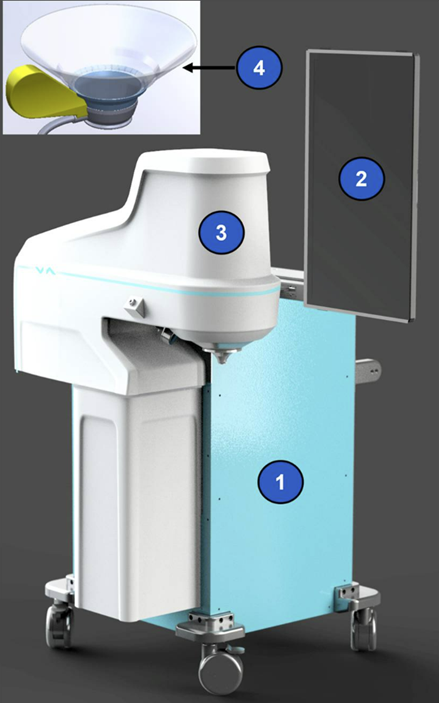
ViaLase Laser System: 1. System Chassis 2. Touch Screen 3. Optical Delivery Head 4. Dedicated Coupling Lens
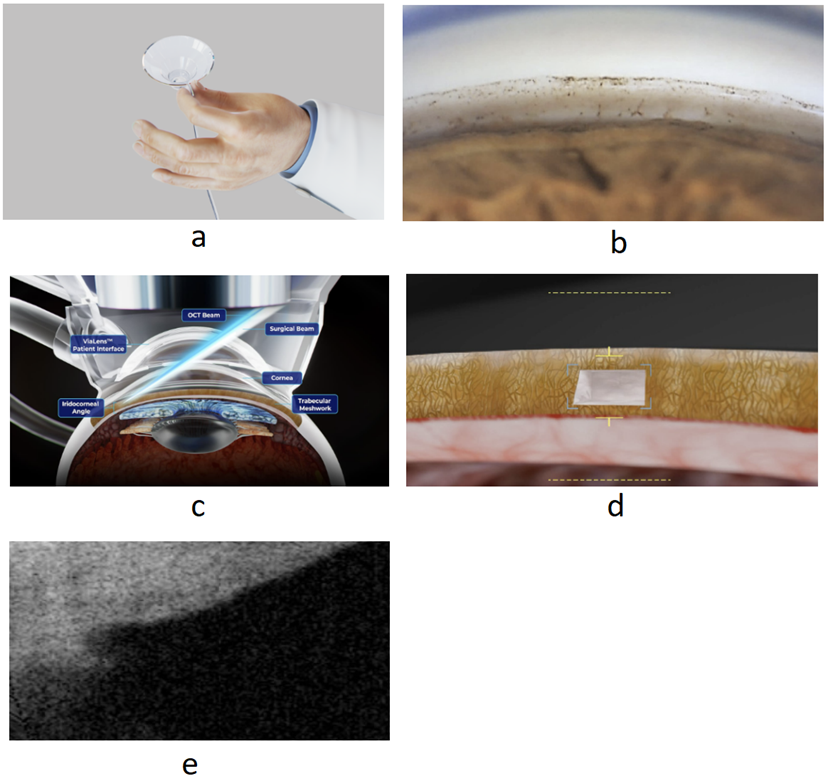
The ViaLuxe™ laser system increases aqueous humor outflow by creating precisely customized drainage channels in the trabecular meshwork at the iridocorneal angle, without opening the eyeball. The steps are as described above.As shown in the figure:
(a) Patients throughA dedicated coupling lens interfaces with the laser system and is secured by vacuum suction, allowing the surgeon to control movement of the patient’s eye, head, and body.
(b) A dedicated gonioscope can display high-resolution video of the iridocorneal angle in real time, allowing surgeons to examine the angle and select the optimal treatment location.
(c) A dedicated optical transmission system delivers highly focused femtosecond laser pulses through the cornea to the iridocorneal angle, while minimizing damage to adjacent tissues.
(d) During the treatment process, a single channel measuring 500 microns wide and 200 microns high is created through the trabecular meshwork, targeting only a 5-degree range of the angle.
(e) After the creation of the drainage channel, optical coherence tomography (OCT) imaging allows the user to observe the subcutaneous tissue structure related to the channel position and record these imaging results.
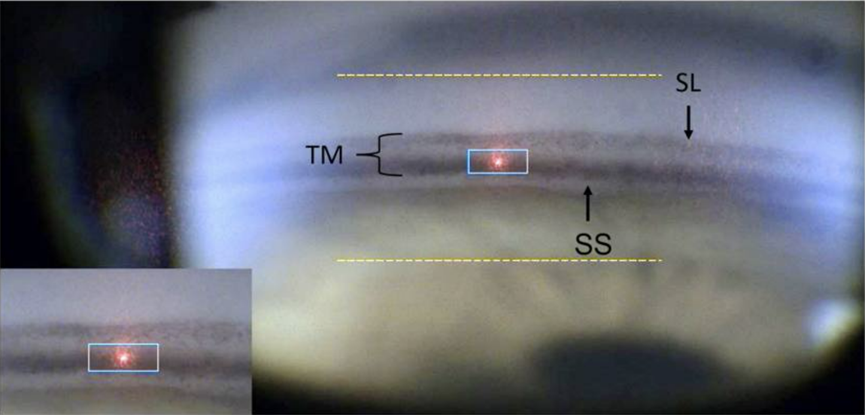
View of the iridocorneal angle through the onboard gonioscope camera. The trabecular meshwork (TM), scleral spur (SS), and Schwalbe's line (SL) are clearly visible. The blue box indicates the laser treatment area, measuring 500 μm wide and 200 μm high. Simply adjust the position of the blue box by dragging it to the desired location on the TM via the touchscreen. The red aiming beam at the center of the blue box overlaps into a point, indicating that the femtosecond laser is correctly focused on the TM.
In terms of technical principles and advantages,ViaLuxe™ Laser System Combines Femtosecond Laser Precision with Micron-Level Image Guidance for Truly Non-Invasive Glaucoma Treatment.ItsProprietary high-definition imaging capabilities overcome the limitations of traditional gonioscopy, providing uniform angle illumination and a distortion-free, wide-field visualization for ease of therapeutic procedures and verification. This technology is incision-free, avoiding the risks associated with conventional surgery, and can be performed as a standalone procedure without reliance on other surgeries, including cataract surgery, allowing flexible treatment tailored to individual patient needs. The system non-invasively creates drainage channels in the trabecular meshwork with micron-level precision, effectively reducing intraocular pressure while significantly decreasing the risk of complications from traditional invasive surgeries.
In clinical research, Vialase has conducted multiple studies to verify the safety and efficacy of the FLigHT technology. Data from a study published in April 2023 and presented at the 2023 American Glaucoma Society meeting showed that 18 patients treated with FLigHT experienced an approximately 38% reduction in intraocular pressure without serious side effects. The company’s completed enrollment for the pivotal VIA-002 trial, targeting adult patients with primary open-angle glaucoma, further confirmed the unique advantage of this technology in creating a conduit between Schlemm's canal and the anterior chamber non-invasively. Chief Medical Officer Dr. Rick Lewis stated that these studies are an essential part of evaluating the safety and efficacy of the technology, highlighting its potential as a novel non-invasive treatment.
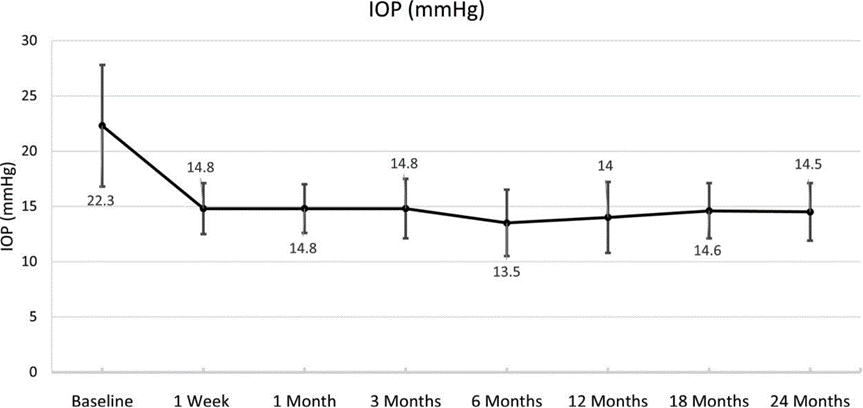
Intraocular pressure (IOP) within 24 months post-treatment. Baseline IOP was 22.3 ± 5.5 mmHg, decreasing to 14.5 ± 2.6 mmHg at 24 months (a reduction of 34.6%).
02 Competitive Landscape
The glaucoma treatment market includes numerous participants such as Novartis, Allergan, Pfizer, Aerie, Teva Pharmaceutical, Bausch + Lomb, Santen, and Qilu Pharmaceutical. These companies primarily compete through medication treatments (such as eye drops) and minimally invasive surgical devices, but most do not offer non-invasive, incision-free glaucoma treatment options, which sets them apart from ViaLase.
ViaLase stands out in the market with several competitive advantages.Its FLigHT technology is the only glaucoma treatment on the market that requires no incision, significantly reducing the risk of surgery-related complications.; Innovation combines the precision of femtosecond lasers with micron-level image guidance, achieving unprecedented treatment accuracy and visualization; can be performed as an independent procedure without relying on other surgeries, offering patients more flexible options; preliminary clinical studies confirm that FLigHT reduces intraocular pressure by approximately 38% with no severe side effects, verifying its safety and efficacy. The company’s differentiation strategy focuses on meeting patient demand for non-pharmacological, incision-free procedures, promoting innovative treatments through collaboration with the global ophthalmic community.
In terms of commercial progress, after obtaining the CE mark, ViaLase plans to selectively launch its product in key European markets in early 2025. It has established distributor partnerships with Global Surgical Service in Spain and Portugal, and Teleon Surgical in Germany and Austria. These partners, who are experienced in the ophthalmology field and have mature commercial networks, will help bring the product efficiently to doctors and patients.
 Author: Huang Changjian

Share

Like

Like