Note: This article does not constitute any investment opinions or recommendations; please refer to official/company announcements for accuracy. This article only provides an introduction to medical and health-related drugs, not a recommendation of treatment plans (if involved), and does not represent the platform's position.Any article reprinted needs to be authorized.
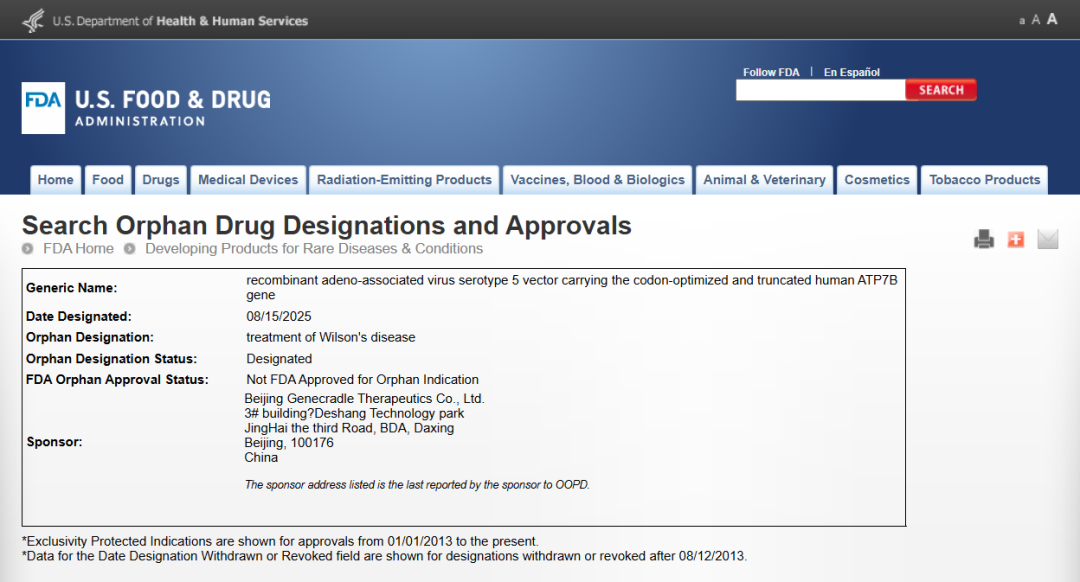
On August 15, 2025, the GC310 adeno-associated virus injection, a gene therapy drug for Wilson's disease independently developed by Beijing Genecradle Therapeutics Co., Ltd., received Orphan Drug Designation (ODD) from the U.S. Food and Drug Administration (FDA). This marks the second innovative therapy by Genecradle to achieve this honor within six months, following the ODD granted to the Pompe disease gene therapy GC301 injection on February 28, 2025.Source of the image: Screenshot from the FDA Orphan Drug Designation Database websiteFDA Orphan Drug Designation (ODD) is an important policy introduced by the U.S. Food and Drug Administration to encourage the development of drugs for rare diseases. Since the introduction of the Orphan Drug Act in 1983, this policy has successfully channeled industry resources into the rare disease field through a "combination of incentives," including tax credits, dedicated research funding, seven years of market exclusivity, and priority review pathways. It has driven the approval of over 600 innovative drugs, enabling approximately 5% of rare diseases (out of more than 7,000 worldwide) to transition from "untreatable" to "treatable possibilities."GC310 Adeno-Associated Virus Injection Granted FDA Orphan Drug Designation, Marking Another Significant Breakthrough for Genecradle in the Gene Therapy Field. Previously, GC301 Adeno-Associated Virus Injection, a Pompe disease gene therapy drug developed by Genecradle, also received FDA Orphan Drug Designation. This approval not only solidifies Genecradle's leading position in the field of rare disease gene therapy and demonstrates its innovative strength in gene therapy drug development, but also advances the company’s global strategic progress.About Hepatolenticular DegenerationHepatolenticular Degeneration, also known as Wilson Disease (WD), is an autosomal recessive genetic disorder caused by mutations in the ATP7B gene. Functional defects in the ATP7B gene lead to impaired copper metabolism, resulting in the abnormal accumulation of toxic free copper ions in the body, primarily depositing in the liver, central nervous system, kidneys, and cornea, causing a series of progressively worsening pathological changes, including cirrhosis, neuropsychiatric disorders, renal dysfunction, and the characteristic formation of corneal K-F rings. Globally, the prevalence of WD is approximately 1 in 30,000 to 100,000 people, with the carrier rate of the disease-causing gene being about 1 in 90. The age of onset for this disease varies widely but is mainly concentrated in children and adolescents, with a peak incidence between ages 5 and 35. Notably, epidemiological studies indicate that the incidence and carrier rates of WD in Asian regions such as China may be higher than in Western countries, with some data suggesting that the incidence in China may be close to 1 in 10,000.About GC310 Adeno-Associated Virus Injection GC310 Adeno-Associated Virus Injection is an AAV gene therapy drug independently developed by Genecradle for the treatment of Wilson's disease. This therapy precisely delivers a functional miniATP7B gene in a single treatment, enabling the target tissue to express the biologically functional miniATP7B copper transporter, restoring copper metabolism and increasing ceruloplasmin levels, which is expected to fundamentally improve the condition. In preclinical studies, GC310 injection demonstrated good drug safety and significant efficacy. Experimental results showed that the drug effectively reduced liver copper and urinary copper levels in Wilson’s disease model mice, increased ceruloplasmin activity, and significantly alleviated symptoms of Wilson's disease.This gene therapy has received the tacit approval for registration clinical trials from the National Medical Products Administration, and a multi-center registration clinical trial will soon be launched with Peking Union Medical College Hospital as the lead unit.Beijing Genecradle Therapeutics Co., Ltd. is a national high-tech enterprise with core business in the development of gene therapy drugs mediated by AAV vector delivery technology. It aims to advance China's rare disease gene therapies from basic research to clinical and market applications, benefiting patients and their families. The company focuses on the development of gene therapy drugs for hereditary neuromuscular diseases, inherited metabolic disorders, lysosomal diseases, and ophthalmic conditions. By promoting the research, development, and clinical application of rare disease gene drugs, the company seeks to deepen the understanding of life and health, transitioning gene therapy technologies and products from rare diseases to the treatment and rehabilitation of chronic and other major diseases.Source of the article:Genecradle