Glioblastoma (GBM)It is the most common and aggressive primary malignant brain tumor in adults. Standard treatment includes surgery, radiotherapy, and chemotherapy, but the prognosis for patients remains poor, with a median survival of only about 15 months. Therefore, there is an urgent need for new and more effective treatments to improve patient outcomes.
DOC1021It was first developed by the American biotechnology company Diakonos Oncology.Personalized Dendritic Cell Vaccine (DCV)。
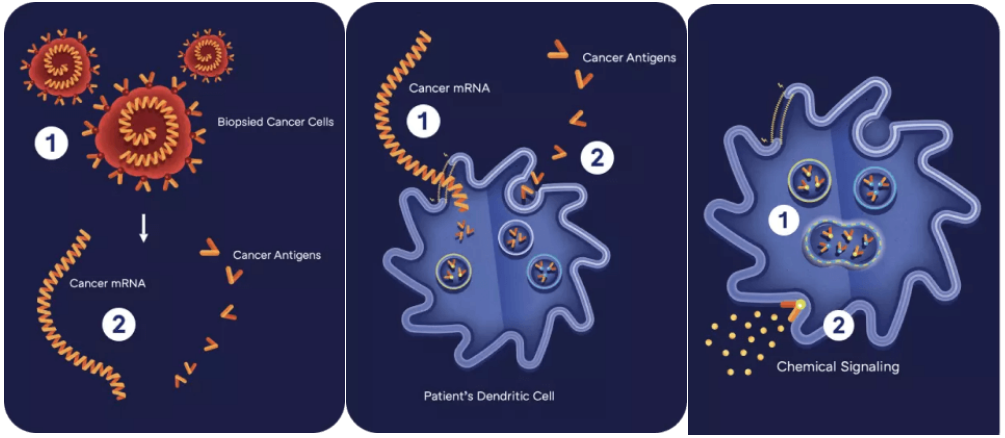
This vaccine is based on the tumor tissue surgically removed from patients and their peripheral blood mononuclear cells. Using a unique "dual-loading" technology, tumor lysates and amplified tumor-derived mRNA are co-introduced into the patient's dendritic cells. This process mimics viral infection, inducing a strong TH1-type antiviral immune response that effectively activates cytotoxic T cells and promotes the formation of immunological memory. Additionally, the vaccine is administered via ultrasound-guided deep cervical lymph node injection, allowing dendritic cells to initiate an immune response more quickly and efficiently. To further enhance efficacy, interferon is used the day after each injection, strengthening T-cell cytotoxicity and prolonging immunological memory. The vaccine does not require molecular modification of immune cells or pretreatment with chemotherapy or high-dose IL-2, offering the advantages of high safety and easy operation, making it suitable for widespread use in outpatient and community cancer centers. Currently, the vaccine has received Fast Track designation from the U.S. FDA for glioblastoma multiforme (GBM) and pancreatic cancer projects in October 2023 and May 2024, respectively, and obtained Orphan Drug Designation for the GBM project in January 2024.
June 2, 2025, Diakonos Oncology announced,Phase I Clinical Trial of Dubodencel (DOC1021) for the Treatment of GlioblastomaPositive results were achieved. The trial enrolled patients with particularly complex conditions, and the results showed that the therapy has good safety and early clinical activity signals have emerged. These results provide strong support for advancing to the randomized Phase II clinical trial.
This Phase I study enrolled16 newly diagnosed patients, with a median age of 61 years (range 47-73 years). Among them, 94% of the patients had an unmethylated MGMT status, and 25% of the patients underwent only subtotal resection. All patients received three injection treatments every two weeks in combination with weekly pegylated interferon (peg-IFN) after completing chemoradiotherapy. The study tested four dose levels, with the total cell count ranging from 3.5 million to 36 million. In addition,Two patients with recurrent glioblastoma received treatment.。
The study results showed that Dubodencel (DOC1021) inDemonstrated good safety and preliminary efficacy in patients with glioblastomaIn the trial, the most common adverse reactions were mild flu-like symptoms and injection site reactions, with no dose-limiting toxicity observed. Immunologically, patients exhibited significant immune remodeling post-vaccination, with marked expansion of CD4⁺ and CD8⁺ central memory T-cell populations in all 13 and 11 of the 13 patients, respectively. Spatial transcriptomics analysis further revealed a notable increase in both number and density of "immune triads," composed of activated CD4, CD8 cells, and migratory microglia within the tumor tissue after treatment, while regulatory T cells were excluded from these inflammatory structures. In terms of clinical outcomes,The 12-month overall survival rate of patients reached 88%, significantly better than the approximately 60% for standard treatment, with 4 patients still alive during the follow-up period of 22–33 months; the survival time for recurrent cases also reached 10–12 months.In addition, the study also provides new insights into the phenomenon of pseudoprogression: In some patients, early MRI images during treatment showed suspected progression, but there were no signs of clinical deterioration. Patients who chose observation rather than reoperation had longer survival periods; among them, three cases showed no tumors in imaging examinations and were still alive. This suggests that the immune-reactive microenvironment triggered by the treatment might manifest as pseudoprogression in the early stage.
For Phase Ⅰ study results,Jay Hartenbach, President and Chief Operating Officer of Diakonos OncologyExpressed as,"This milestone not only represents a significant advancement for Diakonos Oncology, but more importantly, it brings new hope to patients with glioblastoma and other refractory cancers who are in urgent need of better treatment options."The good safety and encouraging efficacy signals observed in the Phase Ⅰ clinical trial have laid the foundation for advancing to Phase Ⅱ studies."We look forward to entering the next phase, further validating the potential of the dendritic cell therapy platform, and bringing new hope to patients."
Dr. Joseph Georges, Neurosurgeon at Banner Health, Phoenix, Arizona, USASaid,“These results are very encouraging, especially in such a patient population with extremely challenging prognoses, including patients with unmethylated MGMT.The observed survival outcomes combined with strong immunogenicity suggest that DOC1021 is expected to induce clinically meaningful antitumor responses. In addition, the identification of pseudoprogression may also provide important insights for optimizing imaging evaluation methods and patient management in future clinical trials."
Keep up the good work! On July 22, 2025, Diakonos Oncology announced that it is currently conductingPhase Ⅱ Clinical Trial (NCT06805305)The first patient has been dosed. The first patient has received dosing at the main campus of City of Hope in Los Angeles, California. The studyTo evaluate the safety, tolerability, and efficacy of DOC1021 in combination with standard of care (SOC) compared to SOC alone in newly diagnosed adult patients with glioblastoma (IDH wild-type).The trial is expected to be conducted at approximately 20 centers across the United States, including Atlantic Health System and The University of Texas Health Science Center at Houston, both of which have recently been initiated. The primary endpoint of the trial is overall survival (OS), with secondary endpoints including 1-year, 2-year, and 3-year survival rates, as well as progression-free survival (PFS), number of adverse events, health-related quality of life, and neurocognitive function.
Jana Portnow, M.D., Medical Oncologist at City of Hope and Co-Director of the Brain Tumor ProgramSaid,"City of Hope has consistently led groundbreaking clinical research, driving the discovery of CAR-T cell immunotherapy and novel drugs that are addressing the most challenging cancers. Glioblastoma is an extremely aggressive tumor, often resistant to existing therapies, making it difficult to treat. There is an urgent need to develop more effective treatments for this fatal disease."
Dr. Laura Aguilar, Chief Medical Officer of Diakonos OncologyExpressed as,"We are extremely proud to announce the completion of the first patient dosing in this pivotal Phase II study, marking a significant step forward in our mission to develop treatments for glioblastoma. Despite notable advancements in the field of neuro-oncology, glioblastoma remains one of the most challenging cancers, with patient outcomes still falling short of expectations. This Phase II clinical trial is a crucial stage in evaluating the potential of DOC1021, which aims to enhance immune response and work synergistically with standard therapies. We have great confidence in this treatment approach and hope it will bring substantial improvements in survival rates and quality of life for patients facing this highly aggressive disease."
Darren Head, CEO of Partner Cellipont BioservicesIndicates,"As a contract development and manufacturing organization (CDMO) partner of Diakonos, we are thrilled to see the next phase of this clinical development unfold. Patient-specific cell therapies like DOC1021 require a high level of precision, flexibility, and deep scientific collaboration during the production process. We are proud to support Diakonos in advancing this novel immunotherapy and look forward to further strengthening our partnership as the trial progresses."