Weekly Medical Device News Roundup [0901-0907]: SiAiran MedTech Secures Over RMB 100 Million in New Funding

Sierra Medical
Innovative Medical Device Developer

Bloomage Biotech
Developer of bioactive substance products, producer of hyaluronic acid raw materials


01
Sierra Medical Completes New Round of Financing Exceeding 100 Million Yuan
Recently, Sierra Medical, an innovative enterprise in China's ophthalmic medical device industry, announced the completion of a new round of financing exceeding 100 million yuan. This round of financing was jointly led by Qianji Capital and Shunwei Capital, with continued investment from existing shareholders Boxin Capital and Hony Capital. The funds will mainly be used to advance the in-depth research and development of the company’s self-developed phacoemulsification and vitrectomy integrated machine product line, further enrich its portfolio of ophthalmic surgical equipment, and accelerate the import substitution of high-end Chinese-produced ophthalmic devices as well as the overseas expansion of ophthalmic products. In the field of ophthalmic surgical equipment, the domestic market has long relied on imported brands. With its independent core technology, Sierra Medical is gradually breaking this dependency. Founded in July 2022, Sierra Medical's core team has extensive industry experience and possesses complete R&D, production, and commercialization capabilities. The company focuses on providing precise, intelligent, minimally invasive surgical treatment solutions for ophthalmology, aiming to break the monopoly of foreign companies in the high-end ophthalmic surgical instruments sector and address the "bottleneck" issue of critical surgical tools.
02
Nanjing Batfulai Pharmaceutical Packaging Materials Co., Ltd CompletedSeries A Financing
Recently, Nanjing Batfulai Pharmaceutical Packaging Materials Co., Ltd. announced the completion of its Series A financing, exclusively invested by Bloomage Biotech's CVC fund, Haofu Capital. This round of financing will be used for the commercial expansion of the next-generation silicone-free pre-filled syringes, acceleration of international quality system certification, and global market expansion. Since its establishment in 2022, Batfulai has been committed to creating high-performance injectable inner packaging solutions using cyclic olefin copolymer/cyclic olefin polymer (COC/COP) as core materials, combined with a silicone-free lubrication system. Its core product – the silicone-free pre-filled syringe – has achieved technical breakthroughs such as ultra-low particle levels, tungsten-free, and silicone-free properties through a unique mold structure and fully automated production line, significantly enhancing drug safety and stability. The product has been dually registered with China’s CDE and the U.S. FDA and is already being applied in high-value products in mainland China, including nano-crystal complex injectables and injection-based medical aesthetic devices.
03
South Africa Successfully Performs Robot-Assisted Donor Nephrectomy
Recently, Stellenbosch University in South Africa issued a statement saying that the institution, in collaboration with a hospital in South Africa, successfully completed the country's first robot-assisted donor kidney removal surgery. The surgery involved a 45-year-old mother donating a kidney to her 24-year-old daughter and was performed by a joint team from Tygerberg Hospital in the Western Cape Province and Stellenbosch University. The team's urologist used a robotic platform to control four mechanical arms, performing the donor nephrectomy with extremely high precision. The statement noted that the surgery took less than 90 minutes, with the robotic platform allowing for smaller incisions, reduced postoperative pain, and faster recovery. The donor mother was discharged the next day, and the transplanted kidney had already begun producing urine, indicating normal organ function. The statement also mentioned that while South Africa has previously used robots for surgeries to remove diseased or damaged kidneys, the complexity of donor kidney removal is much higher, as it requires completely removing a healthy kidney while preserving the integrity of the renal vessels, ureter, and organ for successful transplantation.
04
MicroPort Surgical Robot Successfully Completes 10,000 Surgeries
As of August 29, 2025, the global clinical surgery volume of the Jingfeng® Multi-Port Endoscopic Surgical Robot has successfully surpassed the milestone of 10,000 cases. From continuous breakthroughs in top-tier hospitals across China to expanding coverage in grassroots county-level facilities, from international exploration to large-scale overseas deployment, from clinical registration to driving scientific research innovation, and from technology promotion to comprehensive layout of multi-regional training centers worldwide — in the process of promoting the global adoption of surgical robots, Jingfeng Medical® has established a full-cycle operational service system encompassing deployment, training, service, academic collaboration, and clinical coordination, achieving seamless conversion from product delivery to high-frequency clinical use.

05
Yuwell Medical's Revenue Exceeds in the First Half of the Year4.6 billion yuan
Recently, Yuwell Medical, a leading medical device company in China's A-share market, delivered a solid "mid-term report card," achieving a revenue of 4.659 billion yuan in the first half of 2025, representing a year-on-year increase of 8.16%, and a net profit attributable to shareholders of 1.203 billion yuan, up 7.37% year-on-year. While its core business maintained steady growth, Yuwell Medical actively embraced the new wave of AI, continuing to intensify its "AI + healthcare" strategy. At the "AI + Future of Health" new product launch event in April this year, the company unveiled more than 30 innovative products and launched the "AI Agent Health Manager," built on its self-developed large model, promoting the deep integration of digital intelligence technology with medical devices. Notably, the interim report disclosed Yuwell Medical's new strategic planning for the future, focusing on three main areas: globalization, digitalization, and wearables. In this regard, Yuwell Medical Chairman Wu Qun stated, "The company will continue to explore new forms of productivity, leveraging AI to assist in research and development, production, and management, achieving the 'hospital-to-home and home-wearable' transformation of products."
06
Mindray Leads the New Track of Digital and Intelligent Imaging
Recently, Mindray's Breast Ultrasound Auxiliary Assessment Software has passed the review of the National Medical Products Administration and officially entered the special review process for innovative medical devices. Based on artificial intelligence technology, this product is the AI-assisted diagnostic tool in China’s breast ultrasound field to enter the Class III Innovative Medical Device Special Review Process. Through a standardized intelligent workflow, the product achieves precise BI-RADS assessment and classification (Category 2, Category 3, Category 4A, Category 4B, Category 4C, Category 5) of breast lesions across multiple cross-sections, enhancing the accuracy of early breast cancer diagnosis and promoting the development of equitable healthcare quality. Using the "Expert Consensus on Quality Control for Breast Disease Ultrasound Examination (2019 Edition)" as a benchmark, Mindray utilizes images covering real clinical scenarios and expert diagnostic results as training data and the gold standard. By employing innovative deep learning algorithms, the software integrates clinical knowledge and the image interpretation experience of senior doctors into the auxiliary diagnostic model, enabling efficient and accurate clinical classification even when dealing with complex lesions.
07
Haier Bioaccelerates to"New" Breakthrough
Recently, Haier Biomedical disclosed its semi-annual report for 2025, stating that during the reporting period, it achieved operating revenue of 1.196 billion yuan, with a net profit attributable to shareholders of the listed company amounting to 143 million yuan. The life sciences and medical device industries are entering a critical period of digital and intelligent transformation. Sub-sectors such as low-temperature storage, smart medication management, and laboratory intelligence are benefiting from policy dividends in China, including the deepening of tiered medical treatment and increased investment in biopharmaceutical R&D, while also meeting the demand for upgrading medical infrastructure in emerging overseas markets. Driven by "the synergy of four major industries + AI technology empowerment," Haier Biomedical is building a differentiated competitive barrier. In the blood technology industry, leveraging its first-mover technological advantage, the company holds over 50% market share in plasma collection solutions. During the reporting period, Haier Biomedical further launched self-developed new products such as disposable leukocyte reduction plastic blood bags and fully automatic whole blood component separators, evolving its business model from "single equipment sales" to "intelligent devices + basic consumables + software platforms + value-added services," which not only enhances customer stickiness but also raises the profitability ceiling.

08
Tianjin Issues Notice on Updating and Applying National Medical Insurance Medical Consumables Classification and Coding
Recently, Tianjin City issued a notice regarding the adjustment and update of the classification and coding of national medical insurance medical consumables. To ensure that patients' medical settlement is not affected, a three-month transition period has been set for products that need to be recoded due to the adjustment of consumable classifications (the transition period starts from the earliest publication date of the updated data by the National Healthcare Security Administration each month). During this period, both old and new codes can be used for medical insurance settlement. After the transition period, only the new code will be used for settlement to ensure data quality. For medical consumable products within the coding scope, a unified classification and coding system for medical insurance medical consumables should be applied in the processes of listing, procurement, and usage. For non-chargeable medical consumables that are temporarily not included in the coding scope of the National Healthcare Security Administration's database,The "Q05000000" code serves as a transitional solution and will be uniformly replaced and updated once the national coding scheme is researched and confirmed. Existing local codes may continue to be used, but for data aggregation and uploading to the national medical insurance information platform, "Q05000000" must be uniformly used for mapping and replacement.
09
Hebei Province Issues Notice on Price Linkage for Medical Consumables Listing
Recently, the Hebei Province Drug and Medical Consumables Bidding and Procurement Management System released the "Notice on Carrying Out Price Linkage for Medical Consumables Listing." According to the Notice, relevant companies should promptly verify the listed product prices. If there is a lower provincial platform listing price (excluding centralized bulk procurement winning prices and negotiated prices), please submit a price reduction application by logging into the Hebei Drug and Medical Consumables Bidding and Procurement Management Subsystem via the "Enterprise Appeal" function before September 15, 2025. Products that fail to actively align with the lowest provincial listing price in China will be suspended from listing upon verification, and will be handled according to the relevant credit evaluation regulations. In addition to issuing the notice on linking listed consumables, Hebei also issued a document adjusting the listing prices of three medical consumable products, including the single-channel implantable deep brain stimulation pulse generator kit. This involves two companies and three products.
10
Beijing to Release Provincial Biomedical Enterprise Compliance Guidelines
Recently, the Beijing Municipal Medical Products Administration will rely on the national platform and launch a series of themed publicity campaigns through the joint efforts of municipal and district-level drug regulatory authorities to build a co-governance and shared drug safety governance model. During the event, Beijing will release provincial compliance guidelines for biopharmaceutical enterprises. This publicity week, themed “Drug Safety: Regulation for the People,” will showcase the achievements of drug regulation work and popularize knowledge about the safety of drugs, cosmetics, and medical devices ("two products and one device"). In terms of cross-regional cooperation, the city will actively participate in the exchange of cutting-edge developments in the biopharmaceutical field within the Beijing-Tianjin-Hebei region and explore innovative regulatory models; host an open day at the National Medical Products Administration’s laboratory, organizing university students in Beijing to visit the Science Popularization Exhibition Hall and laboratories of the Beijing Institute for Drug Control to uncover the mysteries of the lab and experience the power of technological support; the "Policies into Parks" initiative will precisely meet industry needs, serve enterprise development, conduct promotional sessions on innovative policies for drugs and medical devices, release provincial compliance guidelines for biopharmaceutical enterprises, and establish a platform for policy alignment and project collaboration.
11
Hebei Standardizes Radiotherapy Medical Service Price Items
Recently, the Hebei Provincial Medical Security Bureau issued the "Notice on Standardizing the Pricing of Radiotherapy Medical Services." The main contents include the addition of 15 new medical service pricing items such as "formulation of radiotherapy plans," and 27 items for additional/supplementary charges. Seventy-two medical service pricing items, including "131Iodine - Hyperthyroidism Treatment," have been discontinued. "Extra-long target area" refers to a linear accelerator electron beam field larger than 20×20cm and an X-ray beam field with one side exceeding 40cm. "Ultra-high dose rate radiotherapy" refers to a method of irradiating the tumor target area using an ultra-high dose rate (≥40 Gy/s). "Adaptive radiotherapy" refers to a technique that dynamically adjusts the radiotherapy plan based on tumor regression during the treatment process. "Motion management" refers to limiting, tracking irradiation, or controlling machine beam output at specific phases of periodic motion for tumor target areas using technologies such as implanted gold markers, optical surface monitoring, and respiratory control. This will take effect starting from October 15, 2025.
12
Shaanxi Province Standardizes and Integrates Medical Service Prices for Radiological Examinations
Recently, the "Notice of Shaanxi Province on Integrating and Standardizing Medical Service Price Items for Radiological Examinations" has been officially implemented. The cost of film consumables for radiological imaging examinations is no longer bundled into the examination fees, and the routine physical film printing service has been completely canceled. Imaging data will be provided to patients in the form of digital imaging (cloud imaging). After this integration, the original items have been significantly reduced. Meanwhile, additional charges and extended items have been set up to account for different resource consumption in various scenarios (e.g., equipment differences, technical difficulty) for the same examination — making price calculation clearer, execution more uniform, and better reflecting the technical labor value of medical staff while adapting to the development needs of new technologies such as CT and MRI. This price adjustment strictly follows the principle of "reducing material costs and increasing labor," reducing the prices of seven categories of equipment-material-based examination items, including X-ray photography, magnetic resonance (MR) plain scan, and PET/CT, to meet the target range required by the state. Overall, the prices of radiological examinations across China have stabilized with a slight decrease, which is expected to significantly reduce the examination cost burden on patients.
13
Beijing-Tianjin-Hebei"3+N" Class 1 Medical Consumables Collection to Begin
Recently, the Beijing-Tianjin-Hebei region officially announced the launch of a volume-based joint procurement of medical film consumables, and information consolidation work has now commenced. The "3+N" large-scale alliance in the Beijing-Tianjin-Hebei region is further enhancing and expanding its centralized procurement efforts by initiating volume-based joint procurement of medical film consumables. According to the Notice, the medical insurance classification and code for medical films covered in this information maintenance include, but are not limited to, products starting with C14020225900006. Additionally, the medical films involved in this information maintenance are divided into two product categories: laser films composed of polyester (PET) base coated with silver halide and protective layers; and thermal films consisting of polyester (PET) base, thermal layer, and protective layers. Inkjet printing films, toner printing films, and office laser printing films are not included.
14
Publication of the Jiangsu Free Trade Zone's Biomedical Industry Full-Chain Open Innovation Development Plan
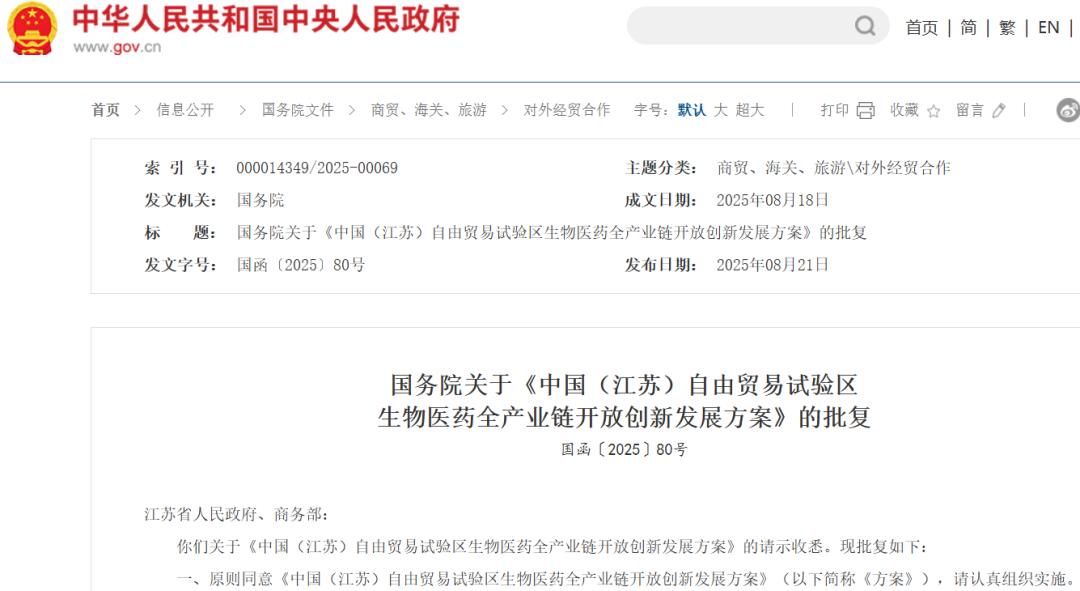
Recently, the State Council approved the "Comprehensive Innovation Development Plan for the Biomedical Industry Chain of the China (Jiangsu) Pilot Free Trade Zone." The plan was released on the Ministry of Commerce's official website on the same day. Leveraging the industrial foundation advantages of the Jiangsu Pilot Free Trade Zone, the plan focuses on enhancing biomedical R&D and innovation capabilities, improving product approval services, establishing a biomedical production and distribution system, refining procurement and usage policies for biomedical products, and increasing support and security for key elements. It outlines 18 key tasks across seven areas to promote integrated innovation throughout the entire chain. The plan aims to achieve rapid growth in the scale of the biomedical industry in the Jiangsu Pilot Free Trade Zone by 2030, with continuous optimization of the innovation ecosystem, significant improvement in the modernization level of the industrial chain, substantial enhancement in the level of openness, continuous strengthening of security capabilities, breakthroughs in key technologies, and the cultivation of distinctive and competitive industrial clusters in key areas such as large-molecule biopharmaceuticals, cell and gene therapy, and innovative medical devices.
15
Jiangsu Province Advances Deep-Level Reform in Drug and Medical Device Regulation
Recently, Jiangsu Province has comprehensively promoted in-depth reform in the regulation of pharmaceuticals and medical devices to facilitate high-quality development of the pharmaceutical industry, introducing policy measures. Optimization of medical device registration and licensing. For group enterprises that meet the criteria and have registered products domestically coming to Jiangsu for application, technical review will be completed within 5 working days. Simplification of registration application materials for low-risk category products. Concurrent review and approval for Class II medical device pre-market registration and production license applications, with renewal and change registration matters handled together. The average inspection timeframe for powered medical devices has been shortened from 85 working days to 60 working days. Priority will be given to arranging registration inspections, supplementary inspections, technical reviews, and system verifications for the first-in-China, innovative, emergency, and priority Class II medical devices. Medical device manufacturers with no critical non-conformities and no major changes in their quality management systems within two years will be issued production licenses after document review. Optimization of import declaration processes for medical device components and validation samples, simplification of rework procedures for exported medical devices, allowing companies to associate with the original customs clearance process.
16
Fujian Province Issues Implementation Plan for Pharmaceutical and Medical Device Regulatory Reforms
Recently, Fujian Province issued the "Work Plan for Implementing the Opinions on Comprehensively Deepening the Reform of Drug and Medical Device Regulation to Promote High-Quality Development of the Pharmaceutical Industry." The Work Plan emphasizes the implementation of joint development initiatives for drug and medical device clinical trials. It supports the establishment of several clinical research consortia led by national or provincial laboratories, national regional medical centers, and high-level hospitals, guided by clinical needs. These consortia will focus on fields of advantageous disciplines to conduct high-level clinical research with translational potential. It encourages qualified tertiary medical institutions to actively register as clinical trial institutions, expanding resources for drug and medical device clinical trials. Strengthening the capacity building for clinical research support, it supports high-level hospitals in recruiting clinical research talent, promotes the construction of research-oriented wards and enhances research capabilities, and improves fast-track mechanisms such as ethical review and project initiation review. Support is given to establish an innovative drug and medical device clinical trial exchange platform, organizing legal and regulatory training, innovative drug and medical device project matchmaking, and sharing experiences in clinical trials. High-level clinical trial institutions are encouraged to actively undertake innovative drug and medical device projects, as well as multi-center clinical trial projects both internationally and domestically. The support provided by public hospital clinical trial institutions for conducting clinical trials of innovative drugs and medical devices will be included in the annual performance appraisal of public hospital directors.
17
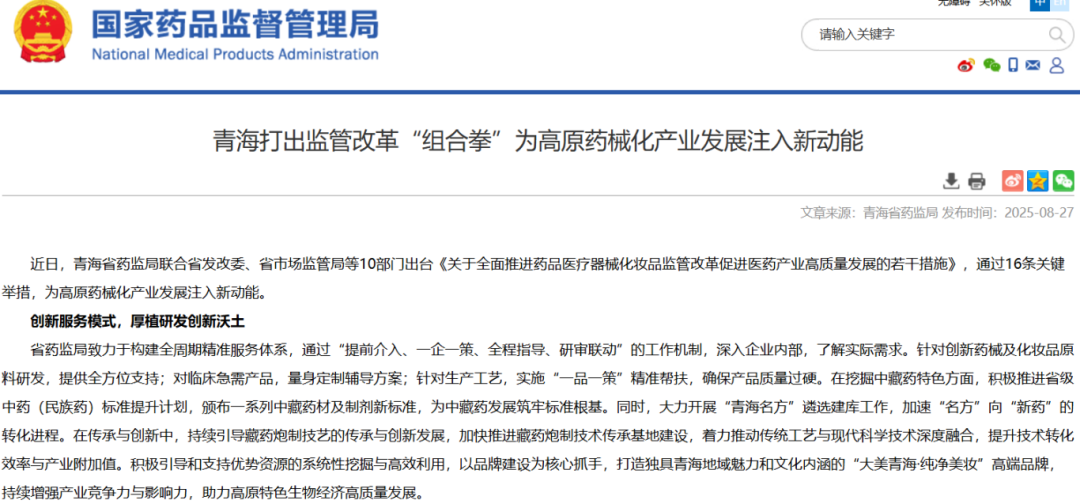
Qinghai's Sixteen Reform Measures Boost the Development of the Plateau Pharmaceutical and Medical Device Industry
Recently, the Qinghai Provincial Drug Administration, in collaboration with 10 local departments, introduced Qinghai's "Several Measures on Comprehensively Promoting the Reform of Drug, Medical Device, and Cosmetic Regulation to Facilitate High-Quality Development of the Pharmaceutical Industry." Focusing on encouraging innovation and R&D, optimizing review and approval processes, enhancing regulatory efficiency, and building a drug, device, and cosmetic safety supervision system, the measures propose 16 reform initiatives to inject new momentum into the development of the plateau drug, medical device, and cosmetics industry. In terms of encouraging innovation and R&D, the measures emphasize supporting the R&D of innovative drugs, devices, and cosmetic ingredients through a working mechanism of "early intervention, tailored strategies for each enterprise, full-process guidance, and research-review coordination." The measures also promote the enhancement of provincial Chinese medicine (including ethnic medicines) standards, initiate the selection and database construction of "Famous Qinghai Prescriptions," and accelerate the establishment of a Tibetan medicine processing technology heritage base. Additionally, enterprises and research institutions are encouraged to develop plateau-characteristic medical devices guided by clinical value. Efforts will also focus on building the "Beautiful Qinghai · Pure Beauty" brand, establishing and improving the "List of Qinghai Characteristic Cosmetic Ingredients," and enhancing the quality and competitiveness of plateau-characteristic cosmetics.
18
Shenzhen Launches Roadshow Selection for Key Innovative Medical Device Projects
Recently, the Shenzhen Market Supervision Administration organized a city-wide roadshow selection event for key innovative medical device projects. The event aims to identify high-quality projects capable of breaking through technological bottlenecks, addressing clinical pain points, and driving industrial upgrading. By focusing on three core dimensions—"originality, clinical value, and market potential"—the roadshow projects, including high-end medical devices, implantable and interventional products, and in vitro diagnostic reagents, were thoroughly analyzed and objectively evaluated. A relevant official from the Shenzhen Market Supervision Administration stated that they hope to precisely select "hard-tech" projects with originality, breakthrough potential, and significant clinical value—projects that can address major clinical needs, fill domestic gaps in China, or break foreign monopolies—and provide one-on-one pre-market services to accelerate the product launch process.
19
Malaysia and Singapore Launch Pilot Program for Expedited Medical Device Approval
Recently, the Malaysian Medical Device Authority (MDA) and the Singapore Health Sciences Authority (HSA) jointly launched a pilot program aimed at accelerating the market entry of Class B, C, and D medical devices in both countries. The pilot will officially commence on September 1, 2025, and run until February 28, 2026. This initiative represents an important step in deepening regulatory cooperation for medical devices between the two countries, with the goal of achieving faster approval processes, reducing duplicate reviews, and enabling patients to access safe, innovative, and high-quality medical devices sooner by leveraging mutually recognized evaluation and approval outcomes. Under the pilot arrangement, medical devices already registered with Singapore’s HSA can undergo a "verification pathway" via conformity assessment bodies (CABs) under Malaysia’s MDA. The evaluation time will be significantly shortened from the standard 60 working days required for full conformity assessment to just 30 working days, followed by registration completion within 30 working days. Similarly, medical devices registered with Malaysia’s MDA can enjoy simplified evaluation in Singapore’s HSA, with the review time for all Class B to D medical devices expected to be reduced by 30% overall.
20
NMPA Initiates Brain-Computer Interface Technology DevelopmentRecommended Medical Device Standards for Performance Testing of RACA Robot Motion Intention Encoding and Decoding
On September 2, the National Medical Products Administration (NMPA) announced on its official website the development plan for the recommended medical device industry standard "Performance Testing Methods for RACA Robotic Motion Intention Encoding and Decoding in Medical Devices Using Brain-Computer Interface Technology" (see figure below). During the announcement period, if there are any objections, please provide feedback to the NMPA.
Note: The information in this article is compiled based on online news.
Subsidiaries of Zhongguan Village Shuimu Medical Join Hands to Offer Benefits, Giving Away Animal Experiments!
END